China has become a major manufacturing base for diamond cutting tools, supported by strong construction, stone processing, and infrastructure demand. The China Diamond Saw Blade sector includes specialized factories, export-oriented suppliers, and highly automated production lines.
Industry data supports this market’s importance. Grand View Research’s Diamond Tools Market report identifies construction and stone processing as leading application areas, with global demand expected to grow steadily through the decade. Mordor Intelligence also reports continued expansion in diamond tools, driven by concrete renovation, ceramic processing, and natural stone fabrication. However, these reports usually combine saw blades with drilling and grinding tools. Direct blade figures remain limited.
That limitation matters. A reliable top-ten list should not depend on marketing claims alone. It should examine diamond concentration, segment welding, blade runout, cutting speed, service life, and quality-control systems. ISO certification and export records can provide useful evidence, but they do not guarantee every blade performs equally on granite, reinforced concrete, or porcelain slabs. Field testing still matters.
Small details reveal quality. A stable blade should cut cleanly without excessive vibration. Segments should remain firmly attached after repeated wet cuts. Factory consistency is often more valuable than one impressive sample.
This ranking is therefore a practical guide, not an absolute verdict. Public company data can be incomplete, and supplier capabilities may change. Buyers should verify current equipment, test reports, production capacity, and after-sales support before selecting a China Diamond Saw Blade manufacturer.
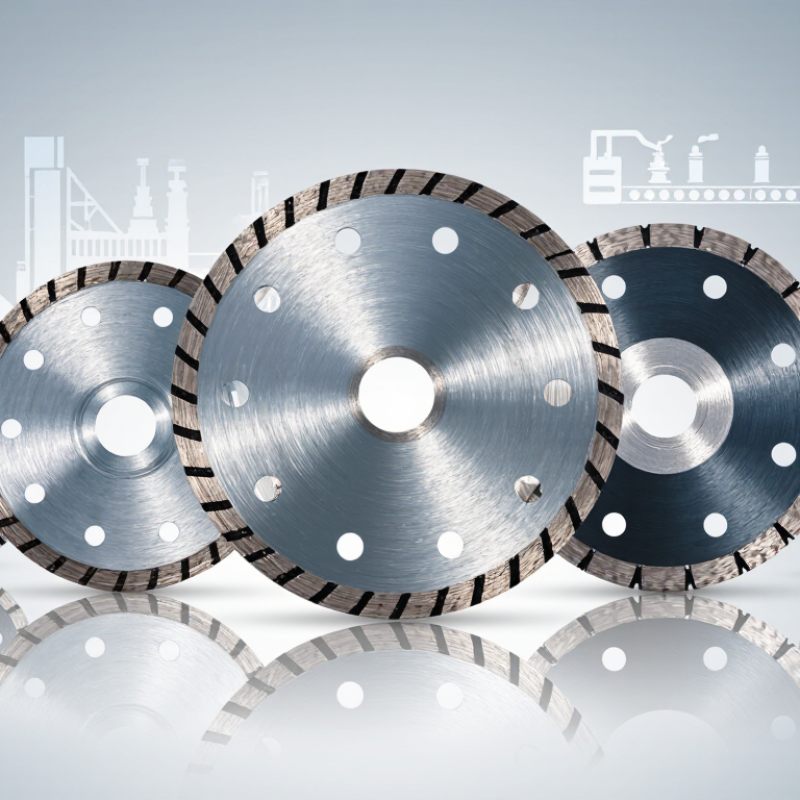
Diamond saw blades use industrial diamond particles fixed to a steel core or cutting segment. The diamonds grind hard materials instead of slicing them like ordinary teeth. This design supports accurate cutting, but performance depends on bonding, diamond quality, blade speed, and cooling.
These blades are widely used on concrete, reinforced concrete, granite, marble, brick, asphalt, and ceramic tile. Segmented blades remove dust and heat efficiently during deep cuts. Continuous-rim blades produce cleaner edges on tile and stone. Turbo-rim designs balance speed and finish. Wet cutting reduces heat and airborne dust, while dry cutting suits small jobs and controlled conditions. It still needs suitable ventilation and careful handling.
When comparing China’s top ten manufacturers, buyers should examine segment consistency, core flatness, technical testing, and production traceability. Experienced suppliers can recommend a blade for the material, machine, and cutting depth, rather than selling one general-purpose model. In practical work, even a strong blade can underperform on an unsuitable saw. The detail matters.
Cutting speed is not everything. A blade that cuts quickly may wear unevenly or chip fragile stone. I have found that operator pressure also changes results, although this factor is often overlooked. Specifications look precise, yet real materials vary from one site to another. Trial cuts remain useful. A careful purchasing decision should include test data, service guidance, and honest limits.
Diamond saw blades use diamond segments or diamond-coated rims to cut hard, abrasive materials. The chart compares common cutting applications by the representative Mohs hardness of the material being processed. Actual hardness can vary by composition, aggregate, firing temperature, and surface treatment.
Higher-hardness materials generally require a blade designed for controlled diamond exposure and effective segment cooling. Diamond saw blades are widely used in stone fabrication, construction, roadwork, tile processing, glass cutting, and masonry applications.
China’s diamond saw blade industry is organized as a layered manufacturing network, not a single production chain. Upstream suppliers produce synthetic diamond grit, steel cores, bonding powders, and protective coatings. Many factories specialize in only one of these materials.
Segment manufacturers then combine selected diamond grades with metal bonds for granite, concrete, ceramic, or asphalt cutting. Some use hot pressing, while others use laser welding or sintering. Production lines often include automatic segment pressing, core tensioning, welding, and balancing equipment. Skilled technicians still matter.
Quality control usually checks segment height, weld strength, blade runout, hardness, and cutting speed. A reliable factory should provide batch records and test samples. However, inspection standards can differ between suppliers. A polished sample proves little.
The industry also includes original equipment manufacturers, contract producers, regional distributors, and application-focused workshops. Large plants may handle export orders, while smaller factories respond faster to custom diameters or unusual materials. Their advantages are different. Neither scale nor low price guarantees performance.
From practical sourcing experience, buyers should examine the entire supply structure. Ask where the diamond grit comes from, who makes the segments, and how welding quality is verified. Field testing remains essential. A blade that cuts quickly in granite may wear poorly on reinforced concrete. This variation is easy to overlook.
| No. | Industry Segment | Typical Manufacturing Focus | Common Diamond Blade Types | Main Material Applications | Key Production Characteristics | Typical Quality Controls |
|---|---|---|---|---|---|---|
| 1 | General-purpose construction blade producers | High-volume blades for construction distributors and contractors | Segmented, turbo, and continuous-rim blades | Concrete, brick, block, asphalt, and masonry | Standardized dimensions, automated sintering, and broad size availability | Diameter and arbor checks, segment bonding, runout, and cutting tests |
| 2 | Concrete and reinforced-concrete specialists | Blades designed for hard aggregates and embedded steel | Laser-welded and high-strength segmented blades | Cured concrete, reinforced concrete, bridge decks, and precast products | Segment bond strength and heat resistance are major design priorities | Weld integrity, segment height, blade tension, and cutting performance |
| 3 | Natural-stone processing manufacturers | Blades for quarrying, block squaring, slab cutting, and fabrication | Granite, marble, sandstone, and engineered-stone blades | Granite, marble, limestone, quartzite, and other dimension stones | Diamond concentration and bond hardness are matched to stone abrasiveness | Kerf consistency, segment wear, blade straightness, and surface finish |
| 4 | Porcelain and ceramic cutting specialists | Low-chipping blades for brittle, dense tile materials | Continuous-rim and thin-rim wet-cutting blades | Porcelain tile, ceramic tile, vitrified tile, and glass tile | Thin kerfs, precise rim profiles, and controlled diamond exposure | Runout, rim uniformity, chipping rate, and wet-cutting stability |
| 5 | Road and infrastructure cutting suppliers | Large-diameter blades for floor saws and road saws | Deep-segmented concrete and asphalt blades | Road concrete, asphalt, airport pavement, and expansion joints | Designed for high power, heavy feed pressure, and extended cutting cycles | Core tension, weld strength, balance, segment retention, and field trials |
| 6 | Wall-sawing and wire-sawing equipment suppliers | Blades and diamond tools for controlled structural demolition | Wall-saw, wire-saw, and heavy-duty segmented systems | Reinforced concrete, foundations, tunnels, and nuclear-related structures | Emphasis on safety, stable cutting, cooling, and compatibility with professional equipment | Fatigue resistance, connection strength, dimensional accuracy, and safety inspection |
| 7 | Electroplated diamond tool manufacturers | High-exposure diamond tools for precision and specialty cutting | Electroplated blades, core drills, and specialty discs | Glass, composites, stone, plastics, ceramics, and difficult-to-machine materials | Nickel electroplating controls diamond exposure and tool geometry | Coating thickness, diamond distribution, adhesion, balance, and dimensional checks |
| 8 | Private-label and OEM manufacturers | Custom production for importers, wholesalers, and tool distributors | Customer-specific segmented, turbo, and continuous-rim blades | Construction materials, tile, stone, concrete, and general fabrication | Flexible packaging, labeling, specifications, minimum-order quantities, and tooling | Pre-production samples, batch traceability, packaging inspection, and outgoing tests |
| 9 | Export-oriented industrial suppliers | Products developed for overseas tool standards and distribution channels | Metric and inch-size blades for dry and wet cutting | Construction, landscaping, masonry, tile installation, and stone fabrication | Export documentation, multilingual packaging, and compatibility with international machines | Arbor accuracy, labeling compliance, carton inspection, and shipment consistency |
| 10 | Application-engineering and custom-formulation producers | Performance optimization based on machine power, material, and cutting conditions | Customized sintered, laser-welded, and electroplated blades | Specialty concrete, abrasive stone, refractory products, and composite materials | Diamond grit, concentration, bond composition, segment geometry, and cooling requirements are optimized by application | Application trials, cutting-rate measurement, wear analysis, and process documentation |
Note: China’s diamond saw blade market is organized by application, production process, and sales channel rather than by one universally accepted public ranking. The categories above describe the main manufacturer types and manufacturing structures without displaying company or brand information.
China Top 10 Diamond Saw Blade Manufacturers
Ranking China’s top diamond saw blade manufacturers requires more than checking production volume. A reliable assessment should examine diamond concentration, segment uniformity, blade runout, and cutting stability. Test results should cover materials such as granite, reinforced concrete, asphalt, and ceramic tile. Real workshop evidence matters. Inspectors can compare segment height, weld strength, kerf width, and cutting speed across several production batches.
Quality systems also deserve careful attention. Strong manufacturers maintain traceable raw materials, documented inspection procedures, and consistent packaging. Independent laboratory reports, safety documentation, export experience, and responsive technical support add credibility. Production capacity is useful, but it should never replace performance evidence. Lead times, customization ability, replacement policies, and communication quality can separate a dependable supplier from an impressive website. The ranking may still contain uncertainty. Testing conditions, operator skill, and machine power can influence results.
Tips: Request samples from different batches. Test them on your actual machine and target material. Record cutting speed, blade wear, vibration, and finish quality. Ask for batch records, inspection photos, and clear tolerances. A factory tour or third-party audit can reveal details that brochures often miss. Do not rank suppliers by price alone. Low initial cost may hide faster wear, unstable segments, or costly downtime. Even experienced buyers should review the criteria annually, because equipment, materials, and manufacturing capabilities change.
China’s leading diamond saw blade manufacturers differ by cutting purpose, factory scale, and technical focus. One profile specializes in precision blades for ceramic tiles, using narrow kerfs and controlled diamond distribution. Another serves concrete contractors, producing reinforced blades with deep segments and stable cooling performance. A granite-focused manufacturer emphasizes clean edges, reduced chipping, and consistent segment height.
Other profiles include an asphalt-cutting specialist with wear-resistant segments, a bridge-saw producer for large stone slabs, and a compact factory offering flexible OEM production. One manufacturer invests heavily in laboratory testing. Another relies on automated welding to improve segment alignment.
Export-oriented factories often maintain traceable batch records and clearer inspection procedures. A custom producer develops blades for unusual materials, though delivery times may vary. The tenth profile represents a high-volume supplier with competitive pricing, but its consistency should receive careful review.
Tips:
Check the blade diameter, arbor size, segment height, and target material before ordering. Request cutting samples when possible. A polished finish does not always indicate stronger performance. Review test records, packaging quality, and replacement support. Factory visits can reveal more than brochures.
However, even experienced buyers can misjudge a blade after one successful cut. Dust control, machine power, operator pressure, and water flow all influence results. A practical evaluation should record cutting speed, edge quality, noise, vibration, and service life. Honest comparison takes time.
Choosing among China’s top diamond saw blade manufacturers requires more than comparing online rankings. A suitable supplier should match your material, cutting method, blade diameter, and expected workload. Granite, reinforced concrete, asphalt, and ceramic require different diamond segments and bond designs. Request technical data, production samples, and test results before placing a large order. Confirm whether the factory controls segment height, core flatness, welding strength, and final balancing.
Look for practical evidence, not polished catalogs. Ask about quality systems, inspection records, export experience, and compliance documents required in your market. A reliable manufacturer should explain tolerances clearly and answer technical questions without vague promises. Test a small batch on your actual equipment. Cutting speed, blade life, vibration, and kerf quality may differ from laboratory claims. Price matters, but poor consistency can create costly downtime. A lower quote is not always a saving. I would also review packaging, lead times, replacement policies, and communication after delivery.
Tips
Prepare a written specification before contacting suppliers. Include material hardness, machine power, blade size, arbor dimensions, target speed, and daily cutting volume. Compare samples under similar conditions, and record each result. Request a video call with the production or quality team. If a supplier avoids basic questions, treat that as useful information. An imperfect trial can still reveal more than a perfect brochure.
They use industrial diamond particles fixed to a steel core or cutting segment. The diamonds grind hard materials.
They can cut concrete, reinforced concrete, granite, marble, brick, asphalt, and ceramic tile. Material choice matters greatly.
Segmented blades remove heat and dust during deep cuts. Continuous rims produce cleaner edges on tile and stone.
Wet cutting reduces heat and airborne dust. It suits longer cuts and demanding materials. Water flow must remain steady.
Dry cutting suits small jobs and controlled conditions. Use ventilation and careful handling. Dust remains a serious concern.
Check segment consistency, core flatness, technical testing, and production traceability. Request samples, records, and replacement support.
No. Fast cutting may cause uneven wear or chipped stone. Edge quality and service life deserve equal attention.
Confirm blade diameter, arbor size, segment height, machine power, and cutting depth. An unsuitable saw can weaken performance.
Real materials vary between sites. Record speed, edge quality, noise, vibration, and service life. One successful cut proves little.
Operator pressure, blade speed, cooling, dust control, and water flow all matter. I may overlook one factor sometimes.
This guide provides a practical overview of the China Diamond Saw Blade industry, explaining what diamond saw blades are, how they cut hard materials, and where they are commonly used in construction, stone processing, concrete work, road maintenance, and industrial manufacturing. It also examines how Chinese manufacturers are organized, from specialized producers and large-scale factories to suppliers focused on customized solutions and international distribution.
To identify China’s top 10 diamond saw blade manufacturers, the article introduces key evaluation criteria such as product quality, diamond concentration, cutting performance, manufacturing capacity, research and development, quality control, customization, delivery reliability, and customer service. It then presents objective profiles without focusing on brand promotion and concludes with practical advice for selecting the right supplier based on material requirements, blade specifications, production volume, budget, technical support, and long-term cooperation needs.