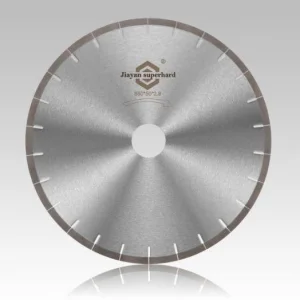
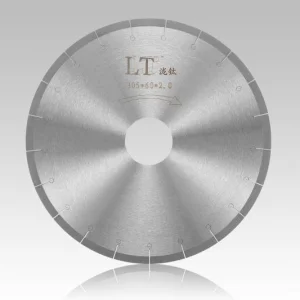
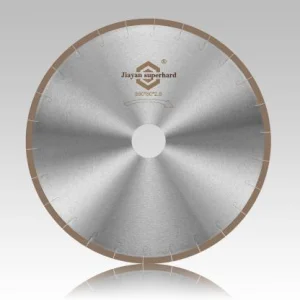
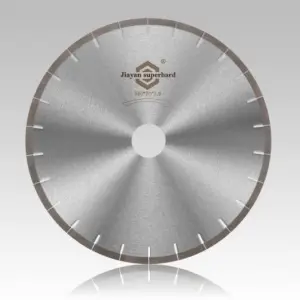
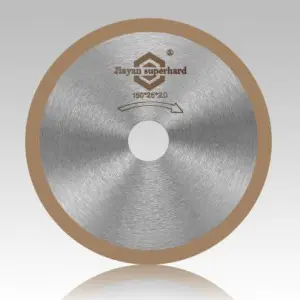
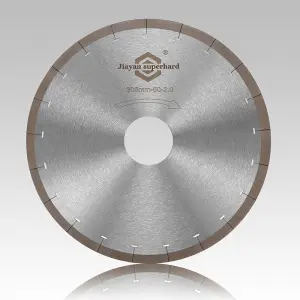
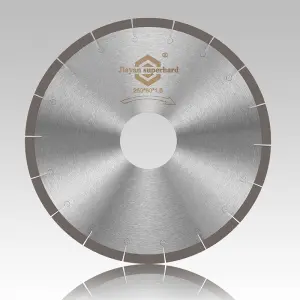
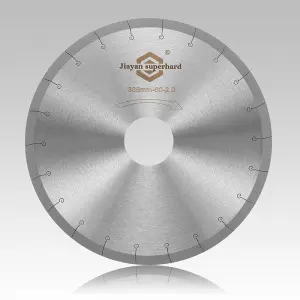
Engineered for maximum linear cut speed, minimum kerf resistance, and exceptional segment adhesion. Review our primary production lines for granite, ceramic, marble, and sintered stone.
In the ultra-competitive global cutting tool market, the term "4 Diamond Blade" represents the absolute backbone of handheld angle grinding, precision tile installation, and industrial stone fabrication. Specifically encompassing 4-inch (100mm), 4.5-inch (115mm), and 105mm standard wheel diameters, these compact superhard tools are deployed across millions of job sites worldwide every day. Selecting the right manufacturer or OEM partner requires an engineering-level understanding of synthetic diamond grain matrixing, powder metallurgy sintering, and core steel dynamic balance.
As a premier member of the China Superhard Material Association, JIAYAN Superhard Tools has engineered this industrial whitepaper to serve global procurement executives, wholesale distributors, and commercial contractors. By examining technical metallurgical formulations, comparing elite international factory capabilities, and detailing China’s Industry 4.0 automated production advantages, this report delivers high-value Information Gain to optimize your tool supply chain.
The global demand for 4-inch diamond blades is experiencing a profound technological shift driven by the rapid adoption of ultra-hard, non-porous architectural materials such as sintered porcelain slabs (Dekton, Neolith) and engineered quartz surfaces. Legacy continuous rim blades frequently fail when cutting these dense materials, resulting in edge chipping, thermal stress fractures, and premature segment glaze-over.
Modern 4" blades utilize laser-cut J-slots combined with stress-relief expansion keyholes. This geometry reduces lateral thermal expansion by up to 42%, preventing blade warpage during high-RPM dry cutting of dense vitrified tiles.
Transitioning from traditional cold-press assembly to hot-press vacuum sintering allows precise orientation of high-purity single-crystal synthetic diamonds (30/40 to 50/60 mesh sizes). This increases blade operational lifespan by 35% while keeping matrix wear perfectly proportional to diamond exposure.
Where low-tier blades rely on silver soldering (brazing) which melts under intense dry cutting heat, modern industrial-grade 4" segmented blades employ fully automated robotic fiber-laser welding, guaranteeing joint shear strength exceeding 80 MPa for maximum operator safety.
For commercial buying groups, hardware chain sourcing directors, and stone tool wholesalers, evaluating 4-inch diamond blades strictly on unit price leads to high warranty claim ratios and end-user dissatisfaction. Total Cost of Ownership (TCO) is dictated by matrix formulation harmony—matching segment bond hardness to the specific Mohs hardness of the target substrate.
| Target Substrate Material | Material Mohs Hardness | Optimal Bond Formulation | Diamond Grit Mesh Size | Recommended Rim Type |
|---|---|---|---|---|
| Porcelain & Vitrified Slabs | 7.5 – 8.5 | Soft Bronze/Copper Cobalt Matrix | 60 / 80 Fine Mesh | Continuous / Ultra-Thin Mesh Turbo |
| Granite & Engineered Quartz | 6.0 – 7.0 | Medium-Soft Iron-Cobalt Bond | 40 / 50 Standard Mesh | J-Slot / Wave Turbo Rim |
| Hard Marble & Limestone | 3.0 – 4.0 | Hard Nickel-Iron Matrix | 30 / 40 Coarse Mesh | Crown Continuous / Segmented |
| Cured Concrete & Masonry | 5.0 – 6.0 | Ultra-Hard Abrasion Resistant Bond | 35 / 45 Coarse Mesh | Laser Welded Segmented Rim |
When issuing RFQs to international suppliers, procurement teams must verify strict adherence to structural runout tolerance limits (axial dynamic runout < 0.03mm, radial dynamic runout < 0.02mm). Excessive runout induces severe high-frequency vibration during 13,300 RPM angle grinder operation, leading to immediate tile edge chipping and rapid operator fatigue.
Evaluating the global competitive landscape requires categorizing top-tier manufacturers and supply channels based on R&D capability, production throughput, custom OEM flexibility, and total cost structure. Below is an authoritative industrial breakdown of the four primary tier suppliers serving the global market:
Strengths: Highest safety certifications (OSA, EN13236 compliance), strong brand equity among premium construction firms in Western Europe and North America.
Limitations: Prohibitive unit pricing, rigid MOQ standards, elongated production leads for custom private label packaging.
Strengths: Member of China Superhard Material Association. Operates state-of-the-art automated hot-press sintering lines in Wuhu, China. Direct factory pricing, complete custom OEM/ODM packaging, precision matrix matching for specialized materials, fast 10-15 day global order turnaround.
Limitations: Dedicated exclusively to B2B bulk importers and commercial distributors rather than retail single-unit sales.
Strengths: Local warehousing presence in North America or Middle Eastern free zones, short immediate delivery timelines for standard specs.
Limitations: Subcontracted manufacturing with variable batch quality, 30%–50% distributor markups, minimal ability to adjust diamond matrix metallurgy for niche substrates.
China’s superhard material sector has evolved into a global center of manufacturing excellence. Powered by advanced powder metallurgy automation, direct control over synthetic diamond synthesis (accounting for over 85% of global industrial diamond production), and smart logistics clusters, factories like JIAYAN Superhard provide unprecedented supply chain security.
Eliminating human error in metal matrix prep, computer-controlled pneumatic balances measure metal powders (cobalt, nickel, copper, iron) down to 0.01g precision. This guarantees total segment consistency across 100,000-piece production runs.
High-density press machines simultaneously apply temperature (up to 950°C) and pressure (over 30 MPa) to compact diamond grit into dense metal bonds, maximizing segment shear strength while eliminating micro-void formation.
Every single 4-inch core plate undergoes automated camera inspection for core concentricity, followed by dynamic balance testing and 100% torque testing on segment welds prior to laser marking and packaging.
The commercial deployment of 4-inch diamond blades varies significantly across regional markets depending on local building codes, preferred substrates, and contractor tooling habits:
High demand for 4.5" (115mm) and 4" (100mm) ultra-thin turbo blades used with high-speed cordless angle grinders. Contractors prioritize clean top-edge finishing on engineered quartz and thick porcelain backsplashes without water cooling.
Strict adherence to EN13236 safety standards is mandatory. Procurement emphasizes continuous rim J-slot blades capable of precise, dust-controlled wet/dry cutting of massive 12mm-20mm sintered ceramic panels.
Focus on heavy-duty segmented 4" blades designed for continuous cutting of high-abrasion granite, thick marble slabs, and reinforced concrete in large-scale residential and commercial developments.
Technical answers to key inquiries regarding selection, blade life optimization, safety protocols, and OEM direct ordering.
Cold-pressed blades compress matrix powder and diamonds at room temperature before atmospheric sintering, resulting in lower density and shorter tool life (ideal for low-cost DIY DIY markets). Hot-pressed blades simultaneously apply intense heat and hydraulic pressure during sintering, creating an ultra-dense bond with superior diamond retention, structural safety, and up to 3x longer operational lifespan for professional contractors.
Glaze-over occurs when the metal matrix bond is too hard for the substrate, preventing worn diamonds from shedding and exposing fresh synthetic grit. To dressing/sharpen the blade, simply make several cuts into an abrasive material like soft sandstone, fire brick, or dressing stone to strip away the excess metal matrix and expose sharp new diamond crystals.
Blades marked strictly for "Wet Use Only" rely on water flow to cool the core and prevent silver-brazed segments from detaching. Running wet blades dry can lead to catastrophic segment loss and severe operator injury. However, laser-welded and specialized hot-pressed blades (such as JIAYAN's J-slot series) are fully certified for dual wet/dry operation.
JIAYAN provides complete end-to-end OEM/ODM customization: custom steel core colors, screen-printed branding, laser-etched logos, bespoke segment matrix formulas matched to your regional stone types, customized arbor hole sizes (20mm, 22.23mm, 5/8"-11 thread), and full retail blister card packaging design.
For standard stock formulations, our MOQ starts as low as 100 units per spec. Custom OEM production runs typically carry an MOQ of 500–1,000 units with an expedited manufacturing lead time of 12 to 18 working days, backed by direct sea/air shipping logistics from our Wuhu manufacturing facility.
Ultra-thin kerf blades (1.0mm–1.2mm) remove 50% less material during cutting compared to standard 2.0mm blades. This drastically decreases friction, lowers operating temperatures, protects battery life on cordless tools, and minimizes chipping on fragile porcelain slabs.
Direct sourcing options for professional stone cutters, tile installation chains, and industrial importers. Click any tool model below to submit a technical catalog request or quote inquiry.