Engineered by JIAYAN Superhard for maximum kerf stability, extreme thermal endurance, and chip-free edge finishing across melamine, laminate, ceramic, and composite stone.
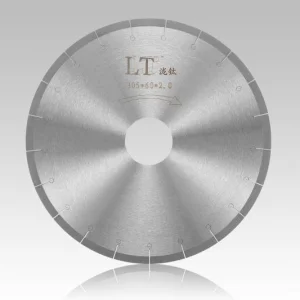
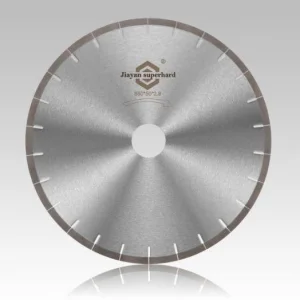
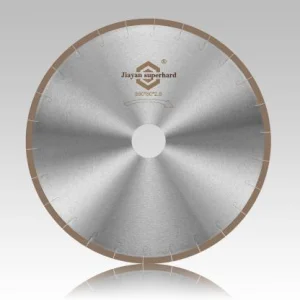
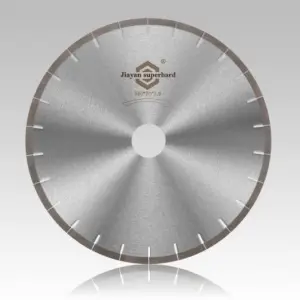
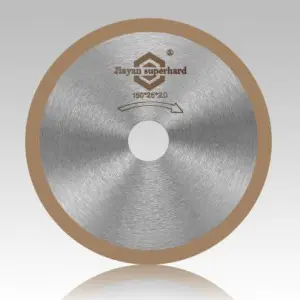
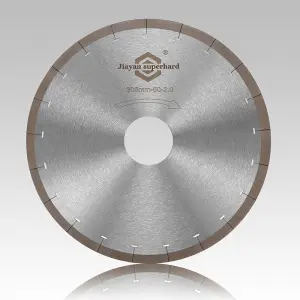
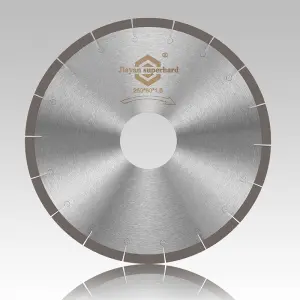
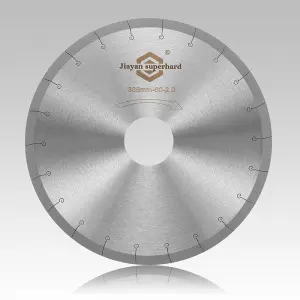
Understanding why conventional wood-cutting saw blades fail on decorative melamine laminates and how advanced metallurgy solves edge tear-out in high-volume cabinet production.
Melamine-faced chipboard (MFC) and low-pressure laminate (LPL) panels consist of a paper sheet saturated with thermosetting melamine resin, thermally bonded to a particleboard or medium-density fiberboard (MDF) core under high pressure (20–30 MPa) and high temperatures (180°C–220°C). This process yields a surface that is exceptionally hard (Barcol hardness > 65), scratch-resistant, and chemically inert, but inherently brittle.
When a standard circular saw tooth exits the top or bottom face of a melamine panel, it exerts upward or downward shear stress on the resin film. If the shear stress exceeds the ultimate tensile strength of the cured melamine-formaldehyde polymer matrix, catastrophic brittle fracturing occurs. This results in microscopic or macroscopic edge chipping—commonly known as "blowout" or "tear-out."
The interior particleboard core introduces a secondary mechanical challenge. Commercial chipboards possess a multi-layer sandwich structure: high-density fine wood particles at the outer sub-surfaces and low-density coarse flakes in the core. Variations in core density cause dynamic deflection of the saw blade body during high-speed cutting.
Furthermore, recycled wood fibers contained in standard particleboards frequently introduce micro-contaminants like silica, adhesive clumps, and trace metal particles. Blade manufacturers must engineer saw tips that combine extreme micro-hardness to withstand abrasive silica wear with sufficient fracture toughness to resist impact chipping when striking dense core pockets.
Achieving a zero-chipping edge on double-sided melamine panels using a single circular saw blade on a standard table saw without a scoring unit is physically impossible over high production runs without optimizing three parameters: (1) Tooth Geometry (Triple Chip Grind with positive/negative rake balance), (2) Blade Extension Height relative to panel thickness, and (3) Precision Zero-Clearance Throat Plates.
An operational comparison of tooth geometries, carbide grades, polycrystalline diamond tips, and laser-damped steel core designs.
| Blade Parameter | Triple Chip Grind (TCG) | Alternate Top Bevel (ATB) | Polycrystalline Diamond (PCD) |
|---|---|---|---|
| Primary Application | Industrial Laminate & Melamine Sizing | Solid Wood & Veneered Plywood Ripping | High-Volume Automatic CNC Panel Saws |
| Micro-Chipping Resistance | Exceptional (Clears core before scoring edges) | Moderate (Prone to quick tip rounding on resin) | Superior (Maintains sharp cutting edge 50x longer) |
| Tooth Rake Angle | +5° to -5° (Low impact angle) | +15° to +20° (Aggressive shearing angle) | 0° to +10° (Neutral shearing) |
| Tip Hardness (Vickers HV) | 1,500 – 1,800 HV (Sub-micron C4 Carbide) | 1,300 – 1,500 HV (Standard Micro-grain) | 8,000 – 10,000 HV (Synthetic Diamond) |
| Typical Tool Lifetime | 1,500 – 3,000 Linear Meters before regrind | 400 – 800 Linear Meters before regrind | 50,000 – 120,000 Linear Meters |
| Initial Capital Cost | Moderate ($80 - $180 USD) | Low ($40 - $100 USD) | High ($450 - $1,200 USD) |
The TCG configuration alternates between a flat "trapezoidal" tooth and a rectangular "flat" tooth. The higher trapezoidal tooth cuts a narrow groove in the center of the kerf, removing 60-70% of the material core. The trailing flat rake tooth enters the cut immediately after, clearing out the left and right corners of the kerf with zero stress on the outer melamine skin.
Cutting synthetic resin generates localized frictional heat exceeding 300°C at the tooth gullet. JIAYAN industrial circular saw blades feature laser-cut expansion slots terminated with stress-relief holes. These slots permit radial expansion without warping the blade body. Additionally, sound-damping slots filled with thermo-elastic polyurethane absorb structural harmonic vibrations.
For industrial sliding panel saws (e.g., Altendorf, SCM, Felder), zero-chipping performance on the underside panel is achieved using a pre-scoring circular saw blade. Rotating climb-cut style at 8,000–9,000 RPM, the scoring blade cuts a precise 1.0mm–1.5mm deep groove slightly wider (+0.1mm) than the main blade kerf, completely eliminating bottom surface tear-out.
How global furniture exporters, OEM cabinet builders, and architectural joinery plants specify saw blades for continuous panel sizing operations.
In European and North American cabinet manufacturing, strict environmental regulations mandate the use of Low Formaldehyde Emission (E0, CARB Phase 2, EPA TSCA Title VI) panels. These ultra-dense board cores utilize high-binder urea-formaldehyde or MDI resins, which significantly increase abrasive wear on saw teeth.
Mass customization and RTA (Ready-to-Assemble) flat-pack furniture factories in Vietnam, China, Poland, and Malaysia utilize high-speed multi-rip beam saws running continuous 24/7 cycles. Feed speeds exceed 40 to 80 meters per minute, demanding continuous-duty PCD circular saw blades.
Mathematical formulas and factory reference parameters to eliminate blade vibration and achieve micro-smooth panel cuts.
1. Surface Feet Per Minute (SFPM): $SFPM = \frac{\pi \times Diameter (inches) \times RPM}{12}$
2. Chip Load Per Tooth ($f_z$): $f_z = \frac{Feed Rate (inches per minute)}{RPM \times Tooth Count (Z)}$
Target Benchmark for Melamine: Maintain a chip load ($f_z$) between 0.03mm and 0.06mm per tooth. Lower chip loads cause friction glaze and burning; higher chip loads exceed the tensile boundary of the resin film causing chip-out.
| Blade Diameter (mm / inch) | Recommended Machine RPM | Optimal Feed Rate (m/min) | Recommended Tooth Count (Z) | Target Material Application |
|---|---|---|---|---|
| 250mm / 10" | 4,500 - 5,200 RPM | 8 - 14 m/min | 80T TCG | Cabinetry Table Saws / Miter Saws |
| 300mm / 12" | 4,000 - 4,800 RPM | 12 - 20 m/min | 96T TCG | Sliding Panel Saws (Single Sheet) |
| 350mm / 14" | 3,600 - 4,200 RPM | 18 - 30 m/min | 108T TCG | Industrial Sliding Panel Saws (Book Cuts) |
| 400mm / 16" | 3,000 - 3,600 RPM | 30 - 60 m/min | 72T - 84T PCD | Automatic Heavy Duty CNC Beam Saws |
Root cause diagnostic matrix for plant managers and saw line supervisors to solve common melamine cutting defects.
Root Causes: Blade height is set too low; saw spindle arbor runout exceeds 0.02mm; blade teeth exhibit micro-chipping under optical inspection.
Factory Action Plan: Elevate the saw blade so that 15mm to 20mm (or approximately one full tooth height plus gullet) extends above the top surface of the melamine panel. This decreases the vertical entry angle of the tooth, converting vertical pull stress into horizontal shear stress.
Root Causes: Lack of a scoring saw blade; zero-clearance insert slot is worn wider than 3mm; feed rate is too fast for tooth count.
Factory Action Plan: Replace or re-zero the throat plate insert using a phenolic or HD-PE custom insert. On sliding panel saws, check scoring blade alignment and verify that the scoring blade kerf is exactly 0.1mm wider than the main blade's kerf width.
Root Causes: Pitch buildup on blade shoulders; feed rate is too slow causing friction rubbing; blade tension lost due to thermal overload.
Factory Action Plan: Clean blade body using citrus-based resin solvent. Inspect side clearance angles. Ensure pitch and scorched resins are stripped from tooth flanks to prevent side drag friction against the panel edge.
Expert responses to critical technical queries from global buyers, woodworking plants, and circular saw exporters.
Member of the China Superhard Material Association, delivering precision-engineered diamond and carbide tools across 50+ countries.
Founded in Wuhu, China, JIAYAN Superhard is a premier manufacturer specializing in diamond circular saw blades, carbide cutting discs, and superhard tooling solutions. Utilizing state-of-the-art automated sintering presses, laser-welding robotics, and CNC dynamic balancing machines, JIAYAN tools conform strictly to ISO standards and European EN1323 safety compliance.
With over 10 years of dedicated export experience, JIAYAN supplies OEM/ODM solutions to major tool brands, commercial cabinet plants, and stone fabricators across Europe, North America, the Middle East, and Southeast Asia.
Comprehensive evaluation of testing protocols for laser-welded blade joints, including shear testing, microstructural integrity analysis, and dynamic stress evaluation.
Showcasing continuous rim diamond discs and ultra-thin circular saw blades at the Canton Fair Complex in Guangzhou.
Presenting high-speed PCD tool innovations and superhard cutting disc series to European industrial procurement managers.
Direct factory supply with custom bore sizes, pinhole patterns, expansion slot configurations, and PCD/carbide tip options.