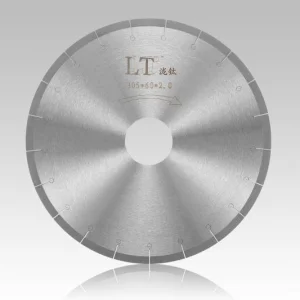
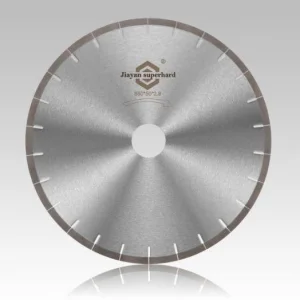
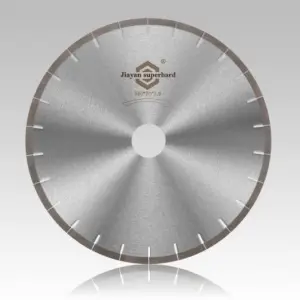
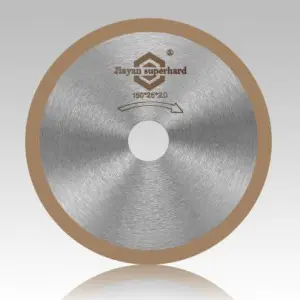
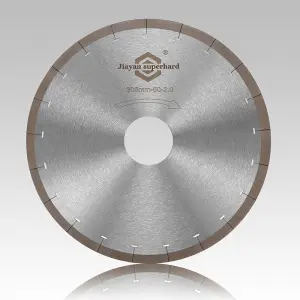
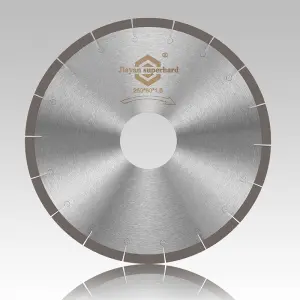
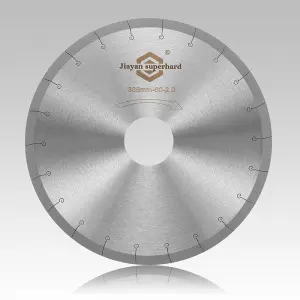
Direct Factory Sourcing Solutions Engineered for Heavy-Duty Stone, Sintered Stone, Tile, and Granite Fabrication.
Understanding the fundamental physics of waterless stone cutting, thermal dissipation dynamics, and advanced sintered matrix engineering.
In modern civil construction, masonry fabrication, and high-density stone processing, dry cut segmented diamond blades represent the pinnacle of mechanical and metallurgical tooling design. Unlike wet-cutting systems—which rely on continuous liquid streams to flush swarf and regulate thermal load—dry cutting operates under high thermal friction where interface temperatures at the segment-stone contact point can instantly exceed 800°C. Evaluating dry cut segmented diamond blade suppliers requires looking beyond basic price-per-unit metrics to assess metallurgical stability, diamond grain retention, core tensioning, and keyhole gullet aerodynamics.
Segmented slots (gullets) create centrifugal air turbulences during high RPM rotations. This airflow continuously ejects airborne particulates and conducts heat away from the steel core, preventing warping, wobbling, and stress fracturing.
Unlike traditional silver brazing which softens under intense dry friction (melting at ~650°C), laser-welded segments fuse the metal matrix directly to the high-tensile steel core, withstanding shear stresses upwards of 1,800 MPa under zero-coolant operation.
The sintered bond matrix is calibrated to erode at a rate precisely synchronized with diamond wear. As outer monocrystalline diamonds fracture and dull, the bond releases them to expose fresh, razor-sharp diamond grits.
Top-tier manufacturers like JIAYAN Superhard Tools utilize Ti-coated synthetic monocrystalline diamonds (MBD series) bonded with cobalt-nickel-tungsten alloy matrices. The titanium coating acts as a thermal barrier and chemical bridge, enhancing mechanical retention by 40% and eliminating premature diamond pop-out under intense shear stress.
Regulatory shifts, dust containment mandates, and the surging demand for modular, waterless jobsite cutting solutions.
The global dry cut segmented diamond blade market is experiencing unprecedented demand driven by strict environmental regulations, urban infrastructure modernization, and jobsite mobility trends. Industrial buyers, tool importers, and OEM brands must align with four macro trends shaping procurement decisions worldwide:
In North America and Western Europe, workplace safety agencies have imposed strict silica dust exposure limits (Permissible Exposure Limit: 50 µg/m³ over an 8-hour TWA). Dry cutting operations require specialized segment geometry compatible with vacuum extraction shrouds and HEPA collection systems. Suppliers must engineer segments that generate larger, heavier chips rather than respirable micro-dust, improving airflow efficiency inside vacuum guards.
Traditional stone blades fail when cutting modern sintered lapidary materials like Neolith, Lapitec, and porcelain slabs (Mohs hardness > 7.5). Global buyers require specialized J-Slot, Turbo-Segmented, and continuous-mesh hybrid blades that combine the thermal cooling of segmented slots with the chip-free precision of continuous rims.
The transition toward battery-powered handheld cutoff saws (e.g., 60V-120V platforms) demands ultra-thin kerf segmented blades. By reducing segment width from 3.2mm to 2.0mm or 1.2mm, energy consumption drops by 35%, extending power tool battery runtime while maintaining aggressive linear cut rates.
| Market Metric / Trend | Traditional Wet Cutting | Advanced Dry Cut Segmented | Procurement Impact |
|---|---|---|---|
| Jobsite Setup Time | High (Slurry containment, water lines) | Zero (Instant deployment, dry shroud) | Reduces labor overhead by 25% |
| Thermal Shock Risk | High if liquid flow drops intermittently | Zero (Engineered for ambient air thermal dissipation) | Prevents blade micro-cracking and core warping |
| Blade Life Expectancy | Baseline (100%) | 120% - 145% (With Ti-Coated Matrix) | Lower Total Cost of Ownership (TCO) |
| Material Compatibility | Limestone, Marble, Soft Brick | Quartzite, Granite, Sintered Stone, Concrete | Single blade SKU handles multi-substrates |
How JIAYAN Superhard Tools leverages automated sintering, laser welding robotics, and scale economies to deliver unrivaled cost-to-performance ratios.
Located in the heart of China's advanced superhard materials industrial ecosystem (Wuhu, Anhui), JIAYAN Superhard Tools Manufacturer stands as a benchmark for Industry 4.0 digital tool manufacturing. As an executive member of the China Superhard Material Association, JIAYAN has transformed diamond saw blade production into an exact science.
Traditional manual cold-pressing leads to density variations within segments, causing erratic blade wear and dangerous vibration. JIAYAN utilizes fully automated volumetric cold-pressing units paired with computer-controlled Hot Isostatic Pressing (HIP) sintering furnaces. Every batch of diamond segments undergoes precise pressure (up to 35 MPa) and temperature curves (+/- 2°C accuracy), guaranteeing uniform diamond grit distribution.
Furthermore, our dynamic laser-welding lines utilize real-time optical sensor feedback to achieve 100% penetration weld joints between the segment base and the 65Mn spring steel core. Every production batch is subjected to destructive torque and bending strength testing under the European BS EN 1323 standard, ensuring absolute operator safety during extreme high-RPM dry cutting operations.
Matching matrix bond hardness and segment geometry to specific global jobsite materials.
Challenge: Extremely abrasive, dense silicate minerals causing premature matrix glazing or excessive spark wear.
JIAYAN Solution: Soft bronze-cobalt matrix formula embedded with high-grade octahedron diamond crystals. Features standard keyhole gullets for maximum cooling and smooth surface finishing.
Challenge: Steel rebar strikes causing segment shear off, heavy vibrations, and core destruction.
JIAYAN Solution: Laser-welded slant drop-segments and undercut protection segments that shield the core from steel swarf abrasion while maintaining clean cutting paths through rebar.
Challenge: Edge chipping, micro-fracturing, and aesthetic damage on high-value decorative surfaces.
JIAYAN Solution: J-Slot and Turbo-Segmented hybrid rims featuring ultra-fine diamond mesh (100/120 grit size). Delivers chip-free dry cuts at high feed rates without liquid coolant.
Comprehensive engineering benchmarks for OEM brands, industrial tool distributors, and bulk importers.
| Blade Diameter | Bore / Arbor Sizes | Segment Geometry | Recommended Material | Optimal RPM Range | Welding Type |
|---|---|---|---|---|---|
| 105mm - 125mm (4"-5") | 20mm / 22.23mm / M14 Flange | Continuous Turbo / J-Slot | Porcelain, Ceramic, Marble | 10,000 - 13,300 RPM | Hot-Pressed Sintered |
| 180mm - 230mm (7"-9") | 22.23mm / 25.4mm / 7/8" | Keyhole Segmented / Wave Slot | Granite, Hard Brick, Concrete | 6,600 - 8,500 RPM | Laser-Welded / HIP |
| 300mm - 350mm (12"-14") | 25.4mm / 50mm / 60mm | Slant Drop-Segment / Turbo-Seg | Reinforced Concrete, Sintered Stone | 3,000 - 4,300 RPM | Automated Laser Welded |
| 400mm - 600mm (16"-24") | 50mm / 60mm / Custom Pin Holes | Deep Undercut Protection Segment | Asphalt, Green Concrete, Block | 1,800 - 2,800 RPM | Heavy-Duty Laser Welded |
Direct technical guidance from JIAYAN’s R&D engineering team to optimize your tool selection.
Select your specialized segment configuration for immediate factory-direct pricing and sample evaluation.
Expand your commercial catalog with ISO-certified, laser-welded dry cut segmented diamond blades. Request technical specifications, custom formulations, and wholesale price sheets today.
Contact Engineering Team →