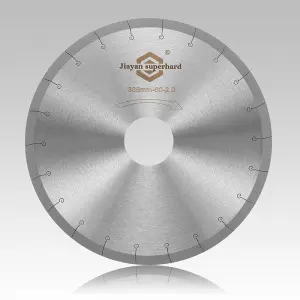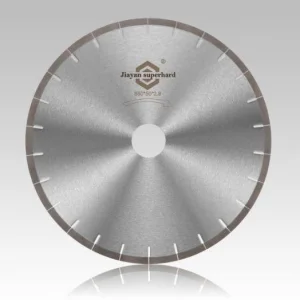
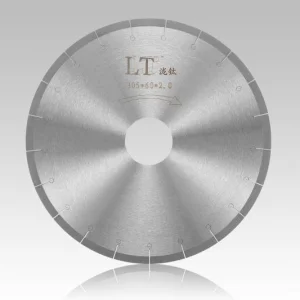
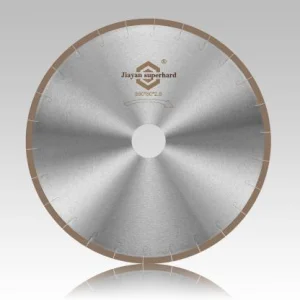
A rigorous industrial examination of certified manufacturing standards, safety parameters, and diamond matrix metallurgy for global B2B buyers.
In modern industrial civil engineering, masonry cutting, and heavy-duty stone processing, the 12-inch (300mm) diamond saw blade represents the universal standard form factor. Balancing maneuverability on handheld cut-off saws (such as gas-powered saws and electric masonry saws) with deep-section cutting capacity on floor saws, 12-inch diamond blades operate under extreme physical stresses. Linear rim speeds frequently reach 80 m/s, generating dynamic centrifugal forces, intense friction heat, and severe mechanical impacts against heavily reinforced substrates.
For international buyers, distributors, and engineering contractors, sourcing from a verified CE Certification 12 Diamond Blade Factory is not merely a legal requirement within the European Economic Area (EEA)—it is the primary baseline for workplace safety, tool integrity, and structural reliability. The European Standard EN 13236 ("Safety requirements for superabrasive products") sets non-negotiable thresholds for segment shear strength, dynamic run-out, balance accuracy, and maximum operational rotational speeds.
Deconstructing the powder metallurgy, diamond concentration, and structural core specs of 12-inch blades.
The cutting edge utilizes high-purity single-crystal synthetic diamond grit (typically Mesh 30/40 to 50/60 depending on material density). Diamond concentration is calibrated precisely—where Concentration 100 equals 4.4 carats of diamond per cubic centimeter of segment bond volume. Higher concentrations (120%-140%) are applied for high-horsepower floor sawing of abrasive green concrete, whereas moderate concentrations (80%-100%) with friable grit are engineered for hard, vitrified sintered stone slabs.
The segment matrix consists of sintered metal powders engineered to match the abradability of target substrates:
For 12-inch blades used in dry-cutting applications on handheld cut-off saws, fully automated Nd:YAG Laser Welding is mandatory under CE compliance. Laser welding fuses the segment directly to the 65Mn spring steel core at a molecular level, establishing joint shear strengths exceeding 60-80 MPa. High-frequency silver brazing remains ideal for wet-cutting bridge saws, offering repairability and dampening capacity during continuous slab cutting.
| Blade Specs / Metric | Hard Reinforced Concrete | Abrasive Asphalt / Sandstone | Vitrified Porcelain & Sintered Stone | General Purpose Masonry |
|---|---|---|---|---|
| Diamond Mesh Size | 35/45 US Mesh | 30/40 US Mesh | 50/70 US Mesh | 40/50 US Mesh |
| Matrix Bond Type | Medium-Soft (Cobalt/Iron) | Ultra-Hard (Tungsten/Co) | Soft Bronze/Cobalt Matrix | Medium Balanced Matrix |
| Segment Joinery Method | Automated Laser Welded | Laser Welded + Drop Segment | Continuous Rim / J-Slot Silver Brazed | Laser Welded / Silver Brazed |
| Steel Core Alloy | 75Cr1 / 65Mn Hardened | 65Mn Stress Relieved | Sandwich Silent Core (Cu-Steel) | 65Mn Standard Core |
| Max Peripheral Speed | 80 m/s (CE Rated) | 80 m/s (CE Rated) | 50-60 m/s (Precision Wet) | 80 m/s (CE Rated) |
Evaluating procurement behavior, regulatory hurdles, and regional operational demands across primary international markets.
Regulatory Focus: Strict enforcement of CE Marking (EN 13236) and oSa (Organization for the Safety of Abrasives) certification. Importers face legal liability for non-compliant tools.
Technical Demand: High preference for laser-welded dry blades with silent cores (copper-plated steel sandwich layers) to comply with European urban noise pollution directives.
Regulatory Focus: ANSI B7.1 standards alignment alongside OSHA silica dust management compliance (Table 1 wet-cutting equipment protocols).
Technical Demand: High-horsepower gas saws requiring 1-inch (25.4mm) and 20mm arbor knockout rings. Massive volume in dual-purpose blades capable of alternating between concrete pipe and rebar-reinforced slab.
Regulatory Focus: Focus on heat tolerance and segment structural longevity under high ambient field temperatures (>45°C).
Technical Demand: Large-diameter block cutting and 12-inch handheld trimming of dense Saudi natural granite, sandstone, and heavy pre-cast concrete structures.
Regulatory Focus: Rapid infrastructure expansion balancing strict cost-per-cut economics with basic safety compliance.
Technical Demand: High demand for versatile OEM turbo-segment 12-inch blades optimized for small-scale contractor machinery, ceramic tile retrofit, and utility road opening.
Inside the advanced production clusters that deliver high-precision CE 12 diamond blades to global distributors.
China accounts for over 85% of global synthetic industrial diamond production. Direct factory integration with raw superhard diamond synthesis allows Chinese 12-inch diamond blade manufacturers to source high-grade HPHT (High Pressure High Temperature) monocrystalline diamond grit at unparalleled cost points. This upstream integration completely eliminates intermediary supply chain markups, allowing higher carat concentrations per segment without cost inflation.
Modern Chinese factories utilize multi-stage computerized automatic hot-pressing sintering machines, robotic segment positioners, and 6-axis CNC laser welding cells. Automation ensures micro-level consistency in segment density, eliminates human error in core tensioning, and guarantees that every single batch of 300mm blades passes strict axial run-out tolerances (<0.10mm) prior to dynamic balancing inspection.
Leading Chinese superhard tool factories provide end-to-end white-label services for international brands. From custom segment geometry (Turbo, Keyhole, Wave, Slanted Protection segments) and specialized color coating to laser-etched compliance markings, custom arbor sizing, and retail packaging—factories deliver scale efficiencies that allow global distributors to maintain 30%-50% gross margins while maintaining strict CE compliance.
Selecting the optimal 12" diamond blade segment configuration based on site-specific substrate friction, moisture levels, and machinery power output.
Field Conditions: Cutting expansion joints in poured concrete within 8-24 hours of setting. High silica sand slurry causes intense abrasion at the steel core interface.
Factory Configuration: Laser-welded 12-inch blade with tungsten carbide drop-segments (undercut protection). Hard iron-matrix bond prevents slurry scouring. Keyhole slots enhance air cooling during high-speed floor sawing.
Field Conditions: Architectural fabrication shops working with 12mm-20mm thick ultra-compact sintered surfaces (e.g., Dekton, Neolith). Materials possess high internal tension and extreme brittleness.
Factory Configuration: Continuous rim or fine J-slot design silver-brazed onto a high-precision tension-free core. Soft cobalt-bronze matrix allows continuous microscopic diamond exposure, eliminating edge chipping and slab blowout.
Field Conditions: High-vibration dry cutting using gas-powered handheld cut-off saws on concrete block, clay brick, and structural rebar.
Factory Configuration: Laser-welded Turbo-Segmented 300mm blade. Turbo serrations reduce friction drag, while corrugated cooling vents rapidly eject dust, maintaining cutting speed on low-torque handheld equipment.
How verified factories test, audit, and certify 12-inch superhard cutting blades to satisfy stringent safety standards.
Under EN 13236 guidelines, hydraulic shear force is applied perpendicular to the laser-welded joint. A 12-inch segment must withstand mechanical shear stresses far exceeding 60 MPa without separating from the steel core, ensuring zero segment flying risk during high-RPM operation.
Every production batch undergoes rotational centrifugal testing at 1.5 times the maximum rated operating speed (e.g., testing at 9,450 RPM for a blade rated at 6,300 RPM). This guarantees structural integrity under sudden mechanical jam or motor over-speed conditions.
Using digital laser micrometers, every 300mm core is measured for planarity. Radial run-out is held under <0.15mm, and axial run-out under <0.10mm. Precise planarity prevents blade wobble, reduces operator arm-hand vibration (HAV), and ensures straight cut geometry.
According to EN 13236, all certified 12-inch blades must bear clear laser etching including: Factory Identifier / Manufacturer Name, EN 13236 Compliance Code, Maximum Rotational Speed (RPM & m/s), Arrow Indicating Direction of Rotation, Safety Iconography (Eye/Ear/Hand Protection), and Batch Tracking Number for complete materials origin tracing.
Next-generation advancements reshaping superhard cutting tool performance, sustainability, and manufacturing intelligence.
Transitioning from random diamond dispersion to precise 3D lattice placement (ARIX technology). By controlling the exact distance between every individual synthetic diamond crystal inside the segment matrix, cutting speed increases by 30% while extending blade lifespan by 50% through uniform wear distribution.
Applying titanium carbide (TiC) or chromium carbide nano-coatings directly onto synthetic diamond grit prior to sintering. The micro-coating forms a chemical barrier that stops thermal oxidation during dry cutting and prevents early pull-out by increasing diamond retention force inside the bond by over 40%.
In response to EU REACH regulations and human safety concerns surrounding cobalt dust exposure, forward-thinking factories are developing high-performance iron-nickel-copper (Fe-Ni-Cu) alloy matrices that match traditional cobalt matrix performance without health hazards.
Addressing critical technical queries from global buyers, factory auditors, and site managers.