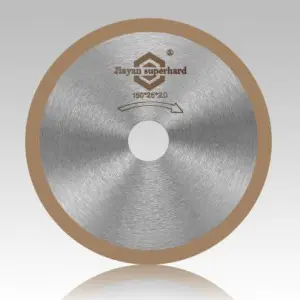
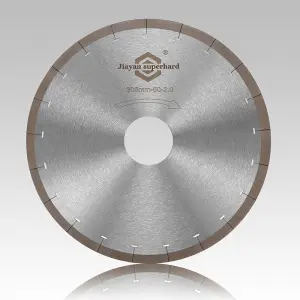
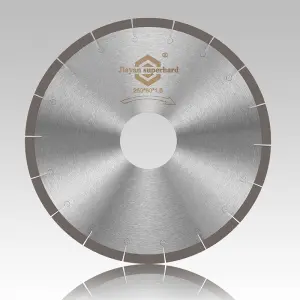
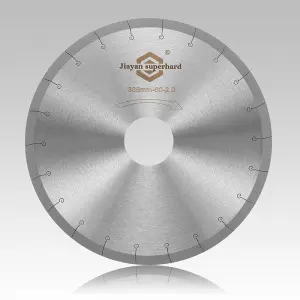
Explore our high-efficiency diamond cutting tools engineered with European EN 13236 compliance, optimized for sintered stone, hard porcelain, granite, and ceramic tiles.
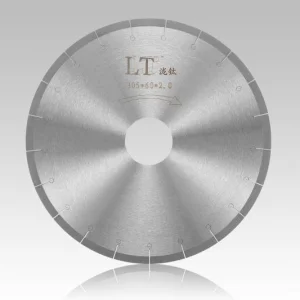
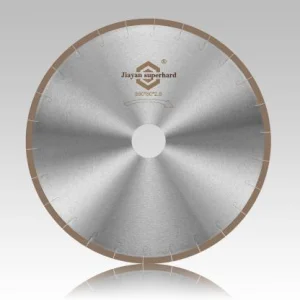
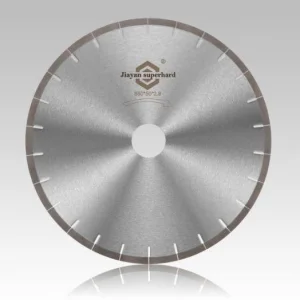
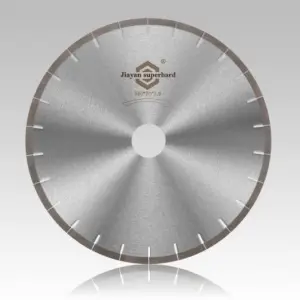
An in-depth analysis of emerging architectural surface trends, sintered stone adoption, and global sourcing imperatives for diamond cutting tools.
The global construction and architectural surface sector is undergoing a massive paradigm shift. The rapid transition from natural marble and granite to engineered ultra-compact surfaces, large-format porcelain slabs (such as Neolith, Dekton, Lapitec, and Laminam), and dense vitreous ceramic tiles has fundamentally altered industrial cutting requirements. These modern sintered materials possess extreme hardness (Mohs scale 7 to 8), ultra-high density, and internal structural tension. Traditional abrasive discs and non-specialized circular saw blades consistently fail when applied to these surfaces, causing catastrophic edge chipping, micro-fractures, blade warping, and accelerated diamond matrix burnout.
To overcome these engineering bottlenecks, tier-one manufacturers and industrial distributors require specialized CE Certified Ceramic Diamond Saw Blades. The demand for precise, chip-free, and high-speed cutting solutions has created a global market valued in billions. Sourcing directors across Europe, North America, the Middle East, and Latin America are increasingly shifting toward top-tier Chinese superhard material factories capable of delivering CE-compliant (EN 13236) tools that combine metallurgical excellence, automated sintering accuracy, and robust price-to-performance ratios.
Commercial buyers do not simply purchase a diamond blade; they invest in total cut yield per linear meter, cut edge quality (minimizing post-cut polishing labor), and operational operator safety. Factories holding legitimate CE certification ensure that every blade undergoes rigorous centrifugal burst tests, dynamic balancing, and weld shear strength evaluations, mitigating high-velocity workplace risks on industrial bridge saws and handheld angle grinders.
Understanding the rigorous safety engineering, structural integrity, and quality control protocols required for European market entry.
In the European Union and international jurisdictions enforcing stringent occupational safety standards, diamond cutting tools operating at linear speeds between 30 m/s and 80 m/s must comply with the EN 13236 safety requirement standard to qualify for CE marking. This certification is not a mere administrative formality; it represents a comprehensive engineering audit of tool geometry, structural core resilience, segment bond strength, and thermal safety limits.
Under EN 13236, blades are subjected to overspeed testing up to 50% above maximum operating RPM to prove structural core stability without radial fracturing or segment separation.
For laser-welded and hot-pressed ceramic segments, the shear stress resistance must exceed minimum thresholds (typically >600 MPa) to eliminate the risk of segment detachment under heavy side load.
High-precision laser tensioning ensures runout tolerances within ±0.02mm, preventing arbor vibration that causes edge chipping in delicate ceramic glazing.
| Blade Diameter (mm) | Recommended Application | Optimal Operating RPM | Max Peripheral Speed | EN 13236 Safety Standard |
|---|---|---|---|---|
| 105mm – 125mm | Angle Grinder Tile Slicing | 10,000 – 13,200 RPM | 80 m/s | CE / EN 13236 Certified |
| 200mm – 250mm | Electric Tile Cutter / Wet Table Saw | 3,000 – 4,500 RPM | 60 m/s | CE / EN 13236 Certified |
| 300mm – 350mm | Bridge Saw / Sintered Slab Line | 1,800 – 2,400 RPM | 50 m/s | CE / EN 13236 Certified |
| 400mm – 500mm | Heavy Industrial Stone Sawing | 1,200 – 1,600 RPM | 45 m/s | CE / EN 13236 Certified |
How advanced diamond crystal selection, bond alloy formulation, and segment geometries eliminate chipping on hard substrates.
The performance of a diamond blade designed for ceramic and sintered stone depends on the micro-structure of its cutting segment. A diamond segment is a sintered composite consisting of synthetic diamond crystals encapsulated within a metallic alloy bond matrix. Achieving clean, fast cuts without edge micro-cracking requires exact tuning of three metallurgical variables:
For ceramic tiles and porcelain slabs, ultra-fine synthetic diamond grit (ranging from Mesh 80/100 to 120/140) is utilized. Fine grit distributes cutting force evenly across thousands of tiny contact points, preventing heavy localized impact that shatters vitreous glazes.
The metallic bond (composed of Cobalt, Bronze, Copper, Nickel, and Tungsten Carbide) must wear down at a rate perfectly synchronized with diamond grit breakdown. In continuous-rim ceramic blades, a softer bronze-rich bond continually exposes fresh, sharp diamond edges.
Configurations such as Continuous Rim, J-Slots, and Mesh Turbo Segments facilitate rapid slurry evacuation and thermal reduction. J-Slot stress-relief grooves prevent thermal deformation during continuous wet cutting.
Leveraging supply chain integration, automated sintering technology, and global OEM/ODM capabilities.
China produces over 80% of the world's synthetic industrial diamonds and dominates the global superhard material equipment sector. Factories located in established industrial hubs, such as Wuhu and the surrounding East China manufacturing corridors, benefit from an integrated raw material and machinery ecosystem. This concentrated infrastructure provides distinct commercial and technical advantages to international procurement partners:
State-of-the-art multi-cavity vacuum hot-pressing machines maintain uniform temperature and pressure distribution across all segments, ensuring consistent density and bond strength across mass production runs.
Fully automated 3D laser welding systems yield high joint precision between the diamond segment and steel core. Laser welding creates a metallurgical fusion zone capable of withstanding extreme thermal loads during dry cutting.
In-house steel core tensioning, automated segment grinding, and direct access to high-grade synthetic diamond powders reduce manufacturing costs, offering global buyers competitive factory-direct wholesale pricing.
Field-proven cutting performance across specialized ceramic, granite, and sintered architectural stone environments.
High-end kitchen counter processing demands tension-free cut lines without radial cracking. Recommended tool: 14" (350mm) specialized J-slot bridge saw blades operated at 2,000 RPM with continuous water coolant.
High-speed automatic table saws require ultra-thin blades (1.0mm to 1.2mm) featuring fine continuous rim diamond matrices to ensure glass-smooth edges ready for immediate installation.
Corner jointing for sintered tables requires high steel core stiffness to prevent blade deflection under diagonal pressure. Reinforced center hub cores maintain perpendicular cutting accuracy.
Segmented diamond saw blades engineered with high cobalt binder matrices deliver long life and steady feed rates (1.5 – 3.0 meters/minute) on dense igneous natural stones.

Founded in Wuhu, China, JIAYAN Superhard is an established manufacturer of high-performance diamond saw blades, circular cutting discs, and superhard tools for stone, ceramic, and construction industries. As an official member of the China Superhard Material Association, JIAYAN combines advanced sintering technology with strict ISO9001 quality assurance processes to serve international B2B buyers.
With over a decade of export experience across Europe, the Middle East, Southeast Asia, and the Americas, JIAYAN offers full OEM/ODM custom branding, tailored bond development, flexible MOQs, and complete CE compliance certification.


Standard Operating Procedure (SOP) for procurement directors sourcing CE-certified diamond blades from China.
Verify that factory CE test reports originate from recognized third-party testing houses, confirming bursting speed safety margins and laser weld bending stress thresholds.
Supply the factory with specific material density metrics (e.g., Mohs hardness 7+ porcelain vs Mohs 5 marble). Request customized bond matrix samples optimized for regional stone types.
Evaluate tool performance based on cost per meter cut ($/m) rather than unit purchase price. High-density diamond concentration delivers lower overall operational expense.
Confirm factory capabilities regarding laser logo engraving, custom color coating, specialized arbor reduction rings (e.g., 60mm to 50mm / 25.4mm), and protective export packaging.
Continuous innovation in laser weld testing and international technical trade participation.
Technical analysis of destructive shear testing, metallurgical grain boundary examination under digital microscopy, and non-destructive ultrasonic flaw detection for laser-welded joint safety.
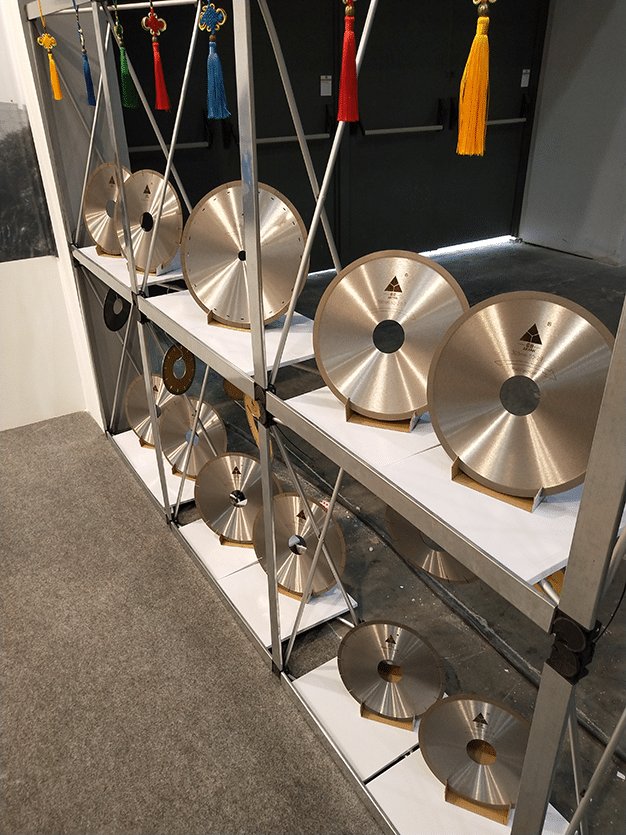
Showcasing next-generation ultra-thin diamond cutting discs at the Guangzhou Canton Fair Complex, demonstrating zero-chipping performance on high-density ceramic slabs.
Engaging with European stone machinery manufacturers and presenting CE certified cutting tools tailored for Italian and Spanish porcelain slab processing lines.
Direct technical guidance covering CE standards, blade selection, feed rates, and chip-free cutting methodologies.
Direct procurement catalog for commercial importers, distributor networks, and stone processing machinery operators.
Connect with JIAYAN sales engineers to request custom quotes, engineering data sheets, or factory OEM catalog documentation.
Whether you require standard 350mm bridge saw blades or specialized 1.0mm ultra-thin ceramic cutting discs, our engineering team provides direct technical support and global freight logistics coordination.