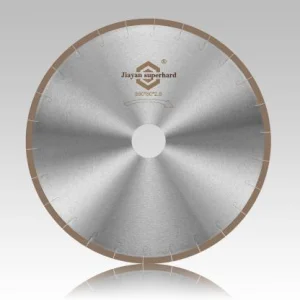
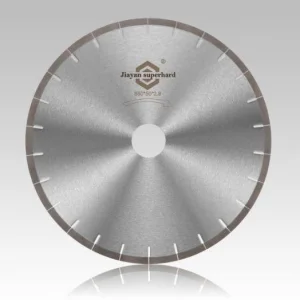
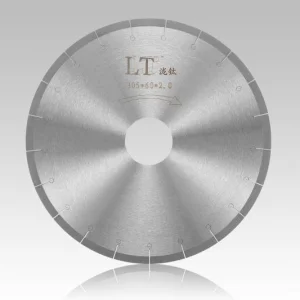
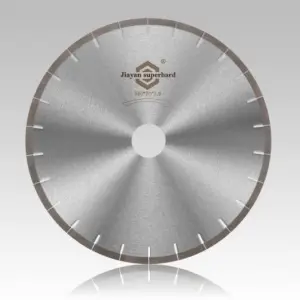
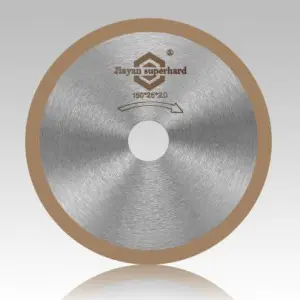
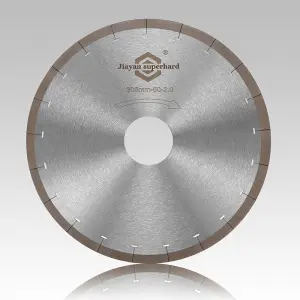
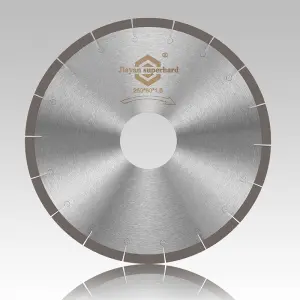
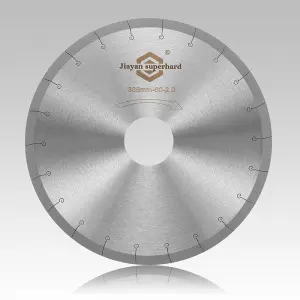
Explore high-performance diamond saw blades engineered for rigorous industrial stone, ceramic, and granite processing.
When enterprise procurement teams select CE certified diamond cutting tool suppliers and companies, the CE mark represents far more than a basic regulatory hurdle. In the domain of superhard abrasive tools, European Conformity (CE) requires strict adherence to EN 13236 (Safety Requirements for Superhard Abrasive Products). Standardizing cutting safety under high rotational velocities (reaching up to 80 m/s peripheral speed) requires sophisticated mechanical engineering, structural integrity validation, and material traceability.
Uncertified diamond saw blades pose catastrophic risks in automated bridge sawing and manual masonry operations. Segment shear detachment, core fatigue fracture, and dynamic wobble can cause significant downtime, equipment destruction, and severe worker safety violations under European OSHA and global labor standards. Premium manufacturers like JIAYAN Superhard Tools implement complete quality loops ensuring every batch exceeds structural thresholds before leaving the production line.
| Compliance Parameter | EN 13236 Standard Requirement | JIAYAN Enterprise Quality Benchmark | Operational Impact |
|---|---|---|---|
| Laser Weld Shear Test | ≥ 35 MPa Minimum Shear Stress | 45 – 52 MPa Tested Range | Zero segment throw-off risk under thermal load |
| Runout Tolerances | Radial/Axial Deviation < 0.05 mm | Radial/Axial Deviation < 0.02 mm | Ultra-smooth cuts, chip-free edge finishing |
| Centrifugal Burst Test | 1.5× Max Operating Speed (RPM) | 1.8× Max RPM Destruction Limit | Complete containment of structural core stability |
| Acoustic Damping | EN ISO 3744 Compliant (<85 dB) | Silent Core Sandwich Dampening (<78 dB) | Drastic noise mitigation for indoor work sites |
The performance of a diamond cutting tool depends on the precise balance between synthetic diamond crystal quality and the powder metallurgy bond matrix. Premium diamond blade manufacturers do not rely on generic bonding recipes; they engineer tailor-made matrix formulations optimized for specific material hardness levels (MOHS hardness 3 to 9).
Utilizing high-purity single-crystal synthetic diamonds (Ti-coated MBD8/MBD12 series). Titanium coating acts as a thermal barrier, preventing diamond graphitization during high-temperature sintering up to 1050°C.
The metallic bond matrix (comprising Cobalt, Copper, Nickel, and Tungsten Carbide) wears away at a rate synchronized with diamond erosion. This controlled micro-fracturing mechanism continuously exposes sharp new diamond cutting points.
J-Slot, Keyhole, and Narrow Water Slot configurations are engineered using computational fluid dynamics (CFD) to maximize coolant delivery, accelerate slurry evacuation, and eliminate heat-induced warping.
For international distributors, industrial tool brands, and large-scale stone fabrication hubs, China remains the epicenter of superhard material production. Over 85% of global synthetic diamond grit and over 70% of finished diamond cutting discs originate from advanced manufacturing clusters in China, such as the Wuhu & Anhui Superhard Industrial Zones.
By partnering directly with member companies of the China Superhard Material Association, global enterprises unlock significant Total Cost of Ownership (TCO) savings without sacrificing CE compliance or cutting performance:
Top-tier CE certified diamond cutting tool suppliers do not merely ship products; they provide complete end-to-end technical localized support to meet regional operational standards.
Mandatory CE mark laser engraving, EN 13236 compliance declaration, REACH chemical safety matrix certification, and acoustic damping for urban indoor construction compliance.
ANSI B7.1 safety compliance, dual wet/dry rating standards, OSHA-aligned silica dust suppression cooling slots, and standard inch/arbor arbor sizes (5/8", 1", 50mm, 60mm).
High-thermal dissipation segments customized for extreme ambient quarry temperatures, continuous high-RPM primary sawing, and ultra-abrasive sandstone and block processing.
The global cutting tool market is experiencing a structural technological shift driven by the rapid adoption of engineered sintered stone (e.g., Dekton, Neolith, Lapitec) and ultra-thin ceramic slabs. Traditional segment geometries often cause edge chipping on these dense, zero-porosity materials.
Micro-thin steel cores coupled with continuous rim diamond segments minimize material loss (kerf waste) by up to 40%, essential for high-cost large format ceramic tiles and sintered stone slabs.
Replacing traditional high-frequency silver soldering, direct 3D laser fusion creates a molecular bond between the diamond segment and steel core, enabling safe dry-cutting under severe friction.
Compliance with global environmental directives requires eliminating lead, cadmium, and reducing cobalt dependence in the sinter matrix, replacing them with eco-friendly iron-copper nano-alloys.
Selecting the ideal CE certified blade requires aligning tool specifications with the machine type, operating RPM, cooling method, and substrate density.
| Application Scenario | Recommended Diameter | Segment Type / Configuration | Optimal Operating Conditions |
|---|---|---|---|
| Automated Bridge Saw Granite Processing | 350mm – 600mm | Laser Welded Keyhole / Sandwich Segment | Wet Cutting, 1400–2100 RPM, 3.5–6.0 m/min Feed Speed |
| High-Speed Ceramic & Porcelain Fabrication | 105mm – 250mm | Continuous Rim / J-Slot Ultra-Thin | Wet/Dry Dual Rating, Angle Grinders up to 12,000 RPM |
| Sintered Stone Slab Mitering & Chamfering | 300mm – 400mm | Close-Pitch Micro Segment (Dekton Grade) | High Coolant Flow, 1800–2400 RPM, Controlled Low Feed |
| Heavy Civil Concrete & Road Sawing | 350mm – 800mm | Deep Protection Laser Segments | Walk-Behind Floor Saw, Wet Cutting, Max 65 m/s Peripheral Speed |
Expert insights answering common technical, regulatory, and sourcing questions from global industrial buyers.
Authentic CE compliance for superhard diamond tools requires explicit certification against the EN 13236 standard. Reputable suppliers provide official test reports from accredited third-party labs (such as TÜV, SGS, or ISO/IEC 17025 accredited testing bodies) detailing dynamic run-out, centrifugal speed safety testing, and laser weld shear strength values.
Laser welding uses a high-energy laser beam to fuse the diamond segment directly into the steel core plate, creating a solid molecular bond that resists extreme heat (>500°C) without melting. Silver brazing uses a silver solder alloy filler; while ideal for wet cutting, excessive heat during dry cutting can cause solder breakdown and segment loss. Laser welding is mandatory for dry-cutting safety under EN 13236.
Yes. Leading manufacturers like JIAYAN Superhard offer full OEM/ODM services. This includes custom arbor bore dimensions (e.g., 20mm, 22.23mm, 25.4mm, 50mm, 60mm with drive pin holes), specialized segment matrix formulas for regional stone types, customized laser marking, and customized private-label packaging.
To achieve chip-free results on sintered stone: 1) Select a specialized continuous rim or ultra-fine pitch J-slot blade; 2) Ensure rigid machine bearings with axial runout below 0.02mm; 3) Maintain adequate water coolant pressure directed precisely at the cutting point; 4) Reduce entry and exit feed speeds by 30%.
Explore our standard and OEM certified diamond cutting tools available for global batch supply.