Empowering Global Stone Processing Plants with Precision Sintered Diamond Matrix Technology, Zero Edge-Chipping Standards, and Certified Industrial Safety.
High-precision circular saw blades engineered for marble slabs, granite block splitting, porcelain, and sintered stone.
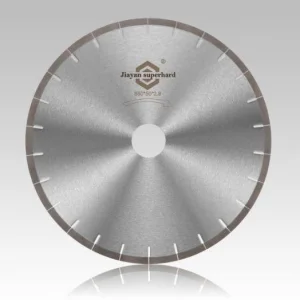
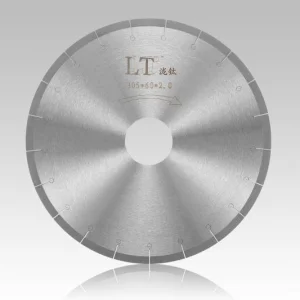
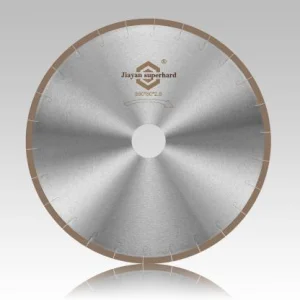
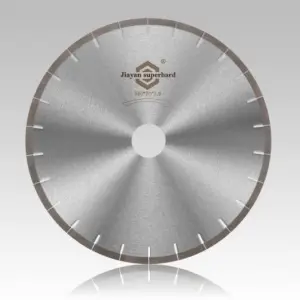
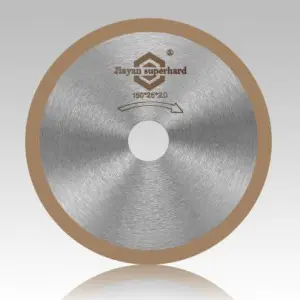
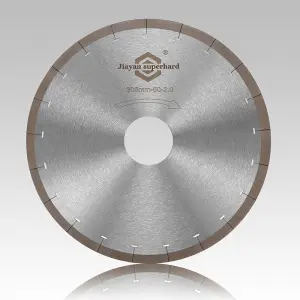
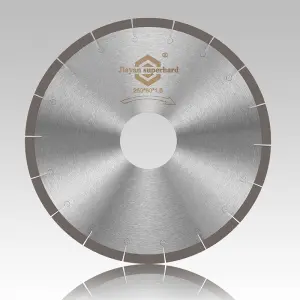
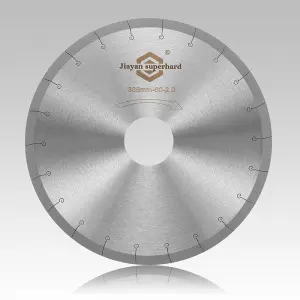
Establishing Structural Safety, Dynamic Balancing, and Metallurgical Reliability for High-Speed Marble Sawing Equipment
In industrial stone fabrication, tool integrity directly governs both operational safety and production yield. For global stone processing factories, marble slab distributors, and architectural stone contractors, procuring a CE Certification Diamond Saw Blade for Marble from a qualified manufacturer is a critical safeguard against catastrophic segment loss, core fatigue failure, and worker hazards.
The European Standard EN 13236 specifies safety requirements for superhard abrasive products (diamond and cubic boron nitride). A legitimate CE-certified diamond saw blade undergoes rigorous destructive and non-destructive testing before entering commercial circulation:
Information Gain Insight: Non-certified diamond saw blades often suffer from uneven sintered density, leading to thermal expansion variances across the steel core. This results in "blade walking" (directional warping during deep cuts), causing severe slab edge blowout and ruining high-value marble blocks.
Optimizing Cobalt-Bronze-Iron Powder Formulas and Micro-Diamond Grit Distributions for Soft and Fragile Calcite Stones
Marble is predominantly composed of calcite ($CaCO_3$) or dolomite ($CaMg(CO_3)_2$), exhibiting a Mohs hardness between 3 and 4. Unlike granite (which contains highly abrasive quartz), marble is relatively soft but exceptionally prone to micro-fracturing along natural vein lines. Cutting marble requires a specialized matrix that maintains extreme sharpness while preventing segment loading (clogging).
| Parameter Specifications | Marble Sawing Optimized Standard | Granite Sawing Benchmark (Comparison) |
|---|---|---|
| Diamond Grit Size (Mesh) | 40/50, 50/60 Mesh (Fine to Medium Grit) | 30/40, 40/50 Mesh (Coarse Grit) |
| Diamond Type & Grade | High-Clarity Micro-Fracturing Synthetic Monocrystal | High-Toughness Heavy-Duty Monocrystal (MBD-8 Grade) |
| Sintered Bond Matrix | Soft Bronze-Cobalt (Cu-Co-Fe) Matrix with High Ductility | Hard Cobalt-Tungsten Carbide (Co-WC) Matrix |
| Diamond Concentration | 25% - 30% Volumetric Density | 35% - 45% Volumetric Density |
| Cooling Requirement | Abundant Water Cooling (25 - 40 L/min) | High-Pressure Water Cooling (35 - 60 L/min) |
During the sawing process, synthetic diamond grains act as microscopic cutting teeth. In marble cutting, the bond matrix must wear away at an exact rate matching the degradation of the diamond crystal. If the bond is too hard, the diamonds become dull ("glazed"), generating high friction and causing heat-induced cracking in marble slabs. If the bond is too soft, diamonds fall out prematurely, shortening tool life.
Our CE-certified manufacturing process utilizes hot-press vacuum sintering under 35 MPa pressure at 850°C. This forms a dense metallic bond where copper and tin act as low-friction lubricants, while trace cobalt secures the diamond crystals against lateral shock loads during high-rpm pass cuts.
How Vertical Integration, High-Purity Synthetic Diamond Supply, and Sintering Automation Drive Global Procurement Value
China produces over 80% of the world's synthetic diamond raw materials and superhard cutting tools. Factory clusters located in Henan, Fujian (Shuitou stone hub), and Anhui form the epicenter of international stone tool manufacturing.
Direct sourcing of industrial diamond grit from domestic HPHT (High Pressure High Temperature) producers eliminates intermediary supply markups, reducing raw material costs by 25-30% compared to European suppliers.
Fully automated robotic laser welding systems ensure 100% joint repeatability, eliminating human error in segment placement and guaranteeing consistent shear resistance across multi-blade gang saws.
Every production batch undergoes ultrasonic flaw detection, core hardness testing (Rockwell HRC 35-42), and dynamic balance calibration before packaging and CE compliance certification.
Adapting Sawing Technologies to Sintered Stone, Silent Core Construction, and Automated CNC Operations
Modern interior architecture has rapidly embraced sintered stone slabs (such as Dekton, Neolith, and Lapitec). These ultra-compact surfaces exhibit extreme internal stress. Standard marble blades can cause catastrophic slab shattering due to excessive cutting friction. Innovation in 1.0mm - 1.2mm continuous rim and J-slot ultra-thin diamond blades has drastically reduced mechanical resistance, enabling clean, chip-free cuts on 6mm-12mm porcelain and sintered materials.
Urban environmental regulations in Europe and North America impose strict decibel limits on stone fabrication workshops. Traditional solid steel cores generate acoustic vibration exceeding 95 dB. Modern diamond saw blade manufacturers now implement "Silent Sandwich Cores"—two outer layers of steel bonded with an internal copper or rubber dampening sheet. This design absorbs resonance, reducing operating noise below 80 dB while dramatically improving edge cut smoothness.
In response to international REACH regulations regarding heavy metal hazards, advanced diamond tool research focuses on eco-friendly iron-copper-nickel (Fe-Cu-Ni) alloy matrices. These green bonds eliminate toxic cobalt while matching the mechanical performance and tool life of traditional cobalt-rich blades.
Tailoring Blade Specs and Operating Parameters to Global Stone Types and Processing Machinery
| Stone Type & Region | Recommended Blade Spec | Peripheral Speed ($v_s$) | Linear Feed Rate | Coolant Flow Rate |
|---|---|---|---|---|
| Italian Carrara / Volakas Marble | 350mm J-Slot Continuous Rim (15mm Segment) | 40 - 50 m/s | 2.5 - 4.0 m/min | 30 L/min (Clean Water) |
| Crema Marfil / Burdur Beige | 400mm Key-Slot Segmented Blade | 35 - 45 m/s | 3.0 - 5.5 m/min | 35 L/min |
| Black Nero Marquina / Calacatta | 350mm Silent Core High-Frequency Brazed | 38 - 48 m/s | 2.0 - 3.5 m/min | 35 L/min |
| Heavy Block Splitting (Quarry Slabs) | 800mm - 1600mm Multi-Blade Array | 30 - 40 m/s | 1.5 - 2.5 m/min | 60 - 100 L/min |
To maximize tool life and prevent edge blowouts when sawing marble, machinery operators should adhere to strict operational practices:
Calculating Total Cost of Ownership per Square Meter Cut and Negotiating Manufacturer OEM Contracts
For large-scale stone processors and importers, initial blade purchase price represents only a fraction of overall processing expenses. Procurement managers must evaluate tools using the Total Cost of Ownership (TCO) formula:
$$TCO = \frac{\text{Initial Blade Cost (\$) } + \text{Downtime Labor Cost (\$) } + \text{Slab Scrap Value Loss (\$)}}{\text{Total Surface Area Cut (m}^2\text{)}}$$
A lower-quality blade that costs 20% less but causes slab chipping or requires frequent tool changes dramatically increases TCO due to wasted marble inventory and machine downtime. High-grade CE-certified marble diamond saw blades maintain constant speed and straight cutting pathways, reducing overall slab yield loss by up to 4.5%.
Explore specialized cutting solutions for stone fabrication facilities worldwide.




Expert Guidance on Blade Diagnostics, Operating Life, Maintenance, and CE Regulatory Standards