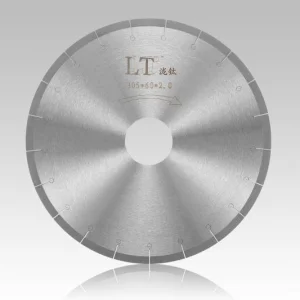
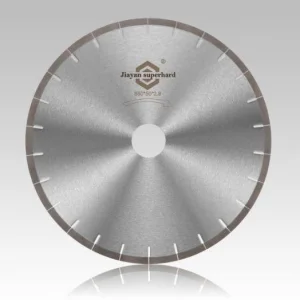
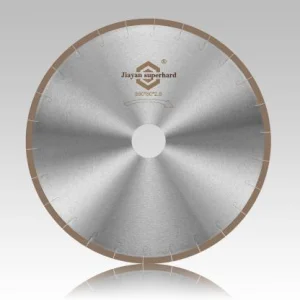
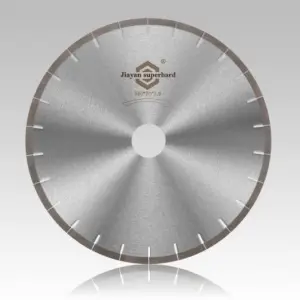
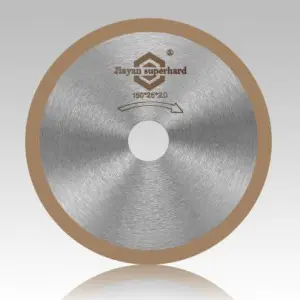
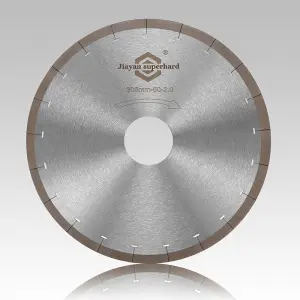
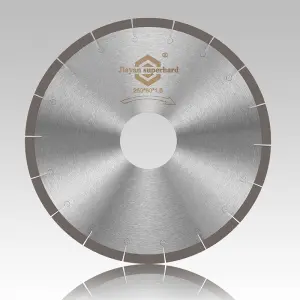
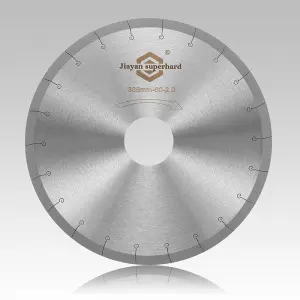
Industrial-grade superhard cutting tools certified under EN 13236 standards. Engineered for maximum speed, zero chipping, and extended thermal stability during dry cutting.
Understanding the rigorous thermal, structural, and centrifugal stress thresholds required for professional diamond blades under European regulatory frameworks.
In the global industrial tool sector, securing CE Certification for Dry Cutting Saw Blades is far more than a simple regulatory badge—it is a critical mechanical safety assurance validated by European standard EN 13236 ("Safety requirements for superabrasive products"). Dry cutting environments impose extreme physical pressures on circular diamond blades. Unlike wet cutting operations, where liquid coolant continuously flushes swarf and absorbs thermal energy, dry cutting relies entirely on the tool’s inherent metallurgical stability, airflow aerodynamics, and segment joint integrity to prevent catastrophic failure.
Technical Information Gain: Under EN 13236 safety compliance, dry-cutting laser-welded diamond blades must withstand a minimum segment shear strength testing threshold exceeding 8.5 MPa (N/mm²), ensuring that under extreme dry friction (exceeding temperatures of 600°C), the diamond segment will never detach from the steel core at operating speeds up to 100 m/s.
As a premier member of the China Superhard Material Association, JIAYAN Superhard Tools engineers every dry cutting diamond blade with precision-matched cobalt-bronze matrix powders and high-purity synthetic diamond grit (SDA-100+ industrial grade). When operating portable angle grinders, masonry table saws, or walk-behind concrete saws, operators are exposed to severe dynamic forces. CE certification ensures that the core steel blank (made of 65Mn or 75Cr1 high-alloy spring steel) has undergone rigorous dynamic balancing, tensile stress normalization, and 100% automated laser weld beam penetration testing.
Empowering European, Middle Eastern, and American B2B buyers with verified manufacturing capacity and compliance guaranteed tools.
The global demand for high-performance dry cutting diamond blades has spiked dramatically over the past decade, driven by urban renovation projects, stringent workplace environmental laws, and the mass adoption of ultra-dense architectural surfaces such as Sintered Stone (Dekton, Neolith, Lapitec), hard porcelain pavers, and reinforced granite slabs. Construction contractors in Western Europe and North America increasingly demand tool suppliers capable of delivering full CE compliance alongside reliable bulk manufacturing repeatability.
As an audited supplier base in Wuhu, China, JIAYAN Superhard Tools bridges the gap between high-end metallurgical innovation and cost-effective volume manufacturing. By controlling every stage of production—from raw synthetic diamond grading, metal matrix formulation, thermal vacuum sintering, to dynamic balancing—we ensure our global OEM distributors receive tools that outperform standard market alternatives by 35% in cutting linear meters per blade.
A comprehensive deep-dive into diamond crystal retention, matrix self-sharpening dynamics, and core tension mechanics.
The cutting efficiency of a dry diamond saw blade relies fundamentally on the microscopic interaction between single-crystal synthetic diamonds and the workpiece material. JIAYAN utilizes High-Pressure High-Temperature (HPHT) synthetic diamonds featuring high cubic-octahedral crystal perfection. In dry cutting applications, temperature at the cutting tip can quickly exceed 700°C. Standard low-grade diamonds undergo thermal oxidation, turning into soft graphite and failing prematurely. Our CE-certified dry blades feature thermally stable diamond crystals (grade SDA-100+) coated with titanium/nickel jackets that delay thermal degradation and enhance mechanical retention within the sintered metal matrix.
A common failure mode in dry cutting is "blade glazing," where the metal matrix fails to erode fast enough to expose new sharp diamond edges, leading to friction overheating and core warping. Conversely, a matrix that is too soft wears out prematurely. JIAYAN’s metallurgical engineers customize the cobalt, tungsten carbide, copper, and iron powder compositions based on the target substrate:
| Target Substrate Material | Substrate Hardness (Mohs / Shore) | Matrix Bond Composition Type | Recommended Segment Geometry | Cooling & Expansion Design |
|---|---|---|---|---|
| Sintered Stone / Porcelain Slabs | Mohs 7 – 8 (Ultra-Dense) | Soft, High-Bronze / Cobalt Bond | Continuous Rim J-Slot / Mesh Turbo | Laser Slot + Water-Drop Expansion Hole |
| Hard Granite (Class 4 & 5) | Mohs 6 – 7 (Abrasive / Hard) | Medium-Soft Cobalt-Tungsten Matrix | Key-Segment / Alternating Turbo | Deep Gullet Radial Air Passages |
| Reinforced Concrete & Masonry | Mohs 5 – 6 (Highly Abrasive) | Hard Iron-Tungsten-Nickel Matrix | Laser-Welded Deep Tooth Segment | Slanted Protection Segments |
| Natural Marble & Limestone | Mohs 3 – 4 (Soft / Soft-Brittle) | Hard Electroplated / Vacuum Brazed | Continuous Smooth Rim / Fine Pitch | Standard Narrow Key Slots |
Without continuous water flow to remove micro-chips and stone slurry, dry cutting saw blades must generate their own micro-airflow to evacuate debris. JIAYAN incorporates computerized CAD-designed J-Slots and laser-cut teardrop expansion slots around the blade perimeter. These geometric cutouts serve three critical functions:
Optimizing operational parameters for dry cutting across diverse jobsite environments worldwide.
Challenge: Micro-chipping along the decorative glaze layer of 12mm–20mm sintered porcelain slabs during dry installation cuts.
Solution: JIAYAN 14-inch J-Slot Continuous Rim Blade (1.0mm-1.2mm ultra-thin kerf). Operating speed at 2,800–3,500 RPM with step-cutting depth of 3-5mm per pass ensures glass-smooth edges without edge chipping.
Challenge: Heavy thermal friction and rapid diamond blunting when dry trimming 350mm quartz-rich granite blocks on remote jobsites.
Solution: Laser-Welded 350mm Circular Segmented Blade with self-sharpening cobalt matrix. Dynamic core tension allows dry cutting up to 1.5 m/min linear speed without cooling water supply.
Challenge: Segment shearing caused by sudden impacts with steel rebar embedded in aged cured concrete structures.
Solution: CE EN 13236 certified laser-welded blades featuring undercut protection segments. Fiber laser deep welds resist extreme shear loads exceeding 12 MPa, preventing segment drop.
Unlocking reliable lead times, material purity control, and OEM scalability from our automated facility in Wuhu, China.
Global industrial tool distributors often face significant supply chain friction—ranging from fluctuating raw material quality to extended manufacturing lead times. Located in Wuhu, China, JIAYAN Superhard Tools operates an integrated superhard material manufacturing ecosystem that mitigates these risks for global B2B procurement partners.
By leveraging China’s mature industrial cluster for synthetic diamond synthesis (representing over 80% of global synthetic diamond capacity), JIAYAN delivers superior cost-to-performance metrics without compromising strict European CE safety mandates. Whether supplying high-volume retail brands with custom color-coded packaging or producing private-label blades for specialized stone processing machinery, our production throughput guarantees predictable fulfillment timelines under ISO 9001:2015 quality assurance protocols.
Addressing key engineering questions regarding CE certification, blade lifespan optimization, and dry cutting safety.
Explore our flagship stone cutting series. Select any product below to access detailed engineering blueprints and bulk procurement pricing.