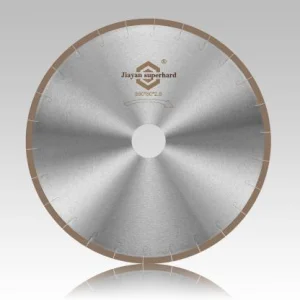
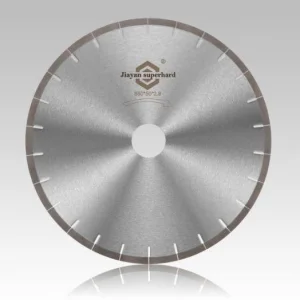
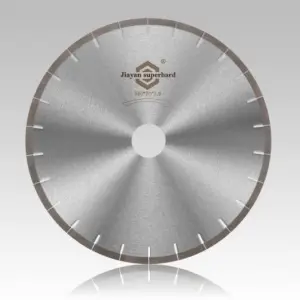
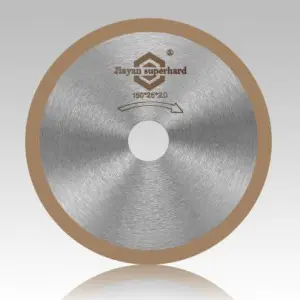
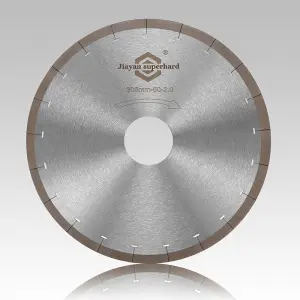
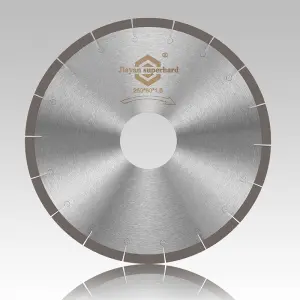
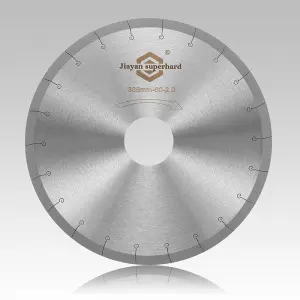
Direct from JIAYAN Superhard Tools — China's premier manufacturer of high-durability circular saw blades, diamond cutting discs, and custom wood processing solutions.
Deep-dive into micro-grain tungsten carbide formulations, high-tensile alloy steel plate dynamics, and precision thermal dissipation engineering.
Modern chop saw blades for high-volume wood processing utilize sub-micron Tungsten Carbide (WC-Co) formulations, specifically grades C4 / K10–K20. By optimizing cobalt binder ratios between 6% and 9%, these tips achieve an exceptional equilibrium between hardness (HRA 92.5–94) and transverse rupture strength (TRS > 2,800 N/mm²), mitigating edge micro-chipping under high impact.
The structural integrity of a wood chop saw blade relies on its steel core plate. Utilizing premium Japanese SKS51 or German 75Cr1 high-tensile alloy steel, plates undergo computerized vacuum heat treatment to achieve a uniform Rockwell hardness of 44–46 HRC. This resilience prevents blade warping, dish deformation, and high-frequency flex under extreme operational torque.
Frictional heat generated during rapid crosscutting causes thermal radial expansion. Engineered chop saw blades integrate laser-cut expansion slots terminating in anti-stress circular holes. Higher-end industrial lines incorporate sound-dampening poly-silicone resin inserts within these slots to absorb resonant frequencies, dropping operational noise levels by up to 10 dB(A).
Unlike standard budget blades using single-alloy solder, professional wood chop saw blades manufactured by top Chinese exporters employ dynamic 3-layer Tri-Metal Brazing (Ag-Cu-Ag). This sandwiched braze layer provides high shock absorption against knot impacts in dense hardwoods while maintaining a shear strength exceeding 320 MPa.
Understanding tooth configuration, hook angle mechanics, and kerf width dynamics for pristine finish crosscutting.
For crosscutting solid timber, hardwoods, and veneered moldings on chop and miter saws, ATB geometry alternates tooth bevel angles between 15° and 25°. The razor-sharp shear points cut wood fibers cleanly before removing the core matrix, eliminating bottom-side tear-out. High-ATB (30° bevel angle) is specified for delicate melamine and ultra-thin veneers where zero scoring is required.
When crosscutting dense composite materials, MDF, plywood, or abrasive tropical hardwoods, TCG geometry alternates a trapezoidal flat tooth with a slightly lower rectangular raker tooth. The trapezoid cuts a narrow groove, and the flat raker cleans the shoulders. This balanced chip distribution prevents tooth corner chipping and drastically increases blade longevity.
Unlike table saws requiring aggressive positive hook angles (+15° to +20°) to pull wood through during ripping, chop saws and miter saws require negative hook angles (-5° to 0°). A positive angle forces the saw blade to climb over the timber, causing aggressive self-feeding, severe work-piece climbing, motor strain, and potential kickback hazards. A negative hook angle ensures smooth, controlled plunge cutting with zero material lift.
| Blade Parameter | Thin Kerf (2.2mm - 2.6mm) | Standard Kerf (3.0mm - 3.2mm) | Heavy-Duty Industrial (3.5mm+) |
|---|---|---|---|
| Target Equipment | Portable Miter Saws & Jobsite Chop Saws | Stationary Miter Saws & Radial Arm Saws | Automated Industrial Crosscut Systems |
| Power Requirement | Low - Medium (1.5 HP to 2.5 HP) | Medium - High (3.0 HP to 5.0 HP) | High Industrial (7.5 HP+) |
| Material Yield | Maximum Yield (Minimal Sawdust Loss) | Standard Yield | Moderate Yield (Focus on Rigidity) |
| Deflection Resistance | Moderate (Requires Stiffening Collars) | High Deflection Resistance | Maximum Dynamic Stability |
| Primary Application | Fine Finish Trim, Crown Molding, Flooring | General Hardwood & Softwood Fabrication | Continuous Heavy Structural Timber Cutting |
Why Tier-1 Chinese exporters dominate the global tooling landscape: Ecosystem synergy, automated 5-axis CNC grinding, and flexible OEM scale.
Leading Chinese saw blade factories utilize full-automated 5-axis CNC grinding centers (such as German Vollmer and Loroch units). Oil-coolant micro-grinding ensures surface roughness tolerances under Ra 0.2 µm on face, top, and side clearance angles, guaranteeing consistent razor-sharp geometry across every production batch.
China hosts the world's most concentrated superhard materials cluster (e.g., Zhuzhou Cemented Carbide Hub). Direct factory access to virgin-grade tungsten powders, synthetic diamond matrices, and specialized steel plate rolling mills reduces raw material procurement lead times while ensuring uncompromised metallurgical standards.
From custom arbor dimensions (5/8", 1", 20mm, 30mm, pin-hole setups) to specialized anti-friction coatings (PTFE, Chrome Nitride, Titanium), Chinese manufacturers offer seamless white-label production, laser-etched branding, and customized packaging tailored for global distributors.
Ensuring full alignment with European Union EN 847-1 regulations, North American ANSI B7.1 guidelines, and ISO quality management systems.
For European and premium global markets, saw blades must adhere strictly to EN 847-1 standards. Chop saw blades manufactured for export feature limiter teeth (anti-kickback guards) integrated into the core body in front of each carbide tip. This design restricts chip thickness during crosscutting, eliminating dangerous kickback forces if a timber knot is encountered.
Operational safety demands precise dynamic balancing. High-speed chop saw blades operating between 3,000 and 6,000 RPM are subjected to computerized balancing machines to ensure residual unbalance does not exceed G2.5 standards according to ISO 1940. This eliminates high-frequency vibration, bearing wear on machinery, and structural blade fracture.
Exported chop saw blades from certified suppliers include compliant laser markings directly on the steel core. Markings specify Max RPM, Rotation Arrow, Bore Diameter, EN 847-1 stamp, and Material Safety Icons, fulfilling strict OSHA, CE, and ANSI jobsite inspection compliance across Europe, North America, and Australia.
Field-proven cutting performance across architectural millwork, automated timber truss production, and furniture manufacturing lines.
Configuration: 10" / 12" 80T - 100T Hi-ATB, -5° Hook.
Outcome: Deliver splinter-free miter joints on pre-painted oak, maple, and polyurethane crown moldings without delicate edge blowout.
Configuration: 14" / 16" 36T - 48T ATB, 0° Hook Heavy Kerf.
Outcome: High-speed crosscutting of 2x4, 2x8 dimensional softwood framing lumber. Built to withstand continuous 18-hour plant production cycles.
Configuration: 10" 60T TCG, Negative Hook, PTFE Coated.
Outcome: Prevents resin pitch buildup and resists abrasive aluminum oxide wear coatings found on modern laminate and SPC composite flooring.
Configuration: 12" 60T ATB with Anti-Kickback Limiter.
Outcome: Multi-purpose crosscutting of wet pressure-treated timber, plywood formwork, and exterior siding under demanding jobsite conditions.
Exploring PVD nanocoatings, polycrystalline diamond (PCD) integration, and smart saw blade telemetry.
Advanced Physical Vapor Deposition (PVD) coatings such as Titanium Aluminum Nitride (TiAlN) and non-stick PTFE thermal barriers reduce friction coefficients by up to 60%. This prevents wood pitch loading, minimizes thermal drag, and extends edge sharp life by up to 300% over bare carbide blades.
For high-volume industrial processing of highly abrasive medium-density fiberboard (MDF), cement fiberboard, and composite panels, PCD-tipped chop saw blades offer up to 50 times the working lifespan of premium carbide, drastically reducing machinery downtime and sharpening frequency.
Future manufacturing leverages automated laser-stress mapping to create custom tension rings tailored to specific saw motor RPMs. Combined with internal vibration-dampening geometries, modern chop saw blades deliver near-silent idling and ultra-smooth cutting stability.
Strategic purchasing guide for international hardware brands, timber machinery distributors, and industrial importers.
When evaluating chop saw blade suppliers from China, global procurement teams must calculate cost per cut rather than initial unit price:
TCO = [ Unit FOB Cost + Logistics + ( Downtime Cost × Sharpening Cycles ) ] / Total Linear Cut Meters
| Grade Tier | Carbide Specification | Plate Tension Tolerance | Target Lifespan (Linear Meters) | Best Suited For |
|---|---|---|---|---|
| Professional Contractor | Micro-grain C3 (K10) Carbide | < 0.03mm Run-out | ~ 15,000 Meters | Jobsite Miter Saws & Tradesmen Retail |
| Industrial High-Production | Sub-micron C4 (K05-K10) Carbide | < 0.015mm Run-out | ~ 45,000 Meters | Cabinet Factories, Furniture Plants |
| Ultra-Premium PCD | Polycrystalline Diamond Tipped | < 0.010mm Run-out | ~ 250,000+ Meters | Continuous Composite Panel & Flooring Mills |
Expert answers to essential questions regarding chop saw blade selection, manufacturing standards, and export logistics.
Explore our full range of certified industrial saw blades, sintered stone cutting discs, and custom superhard diamond tools.