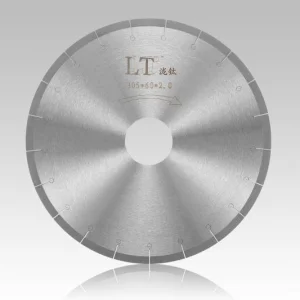
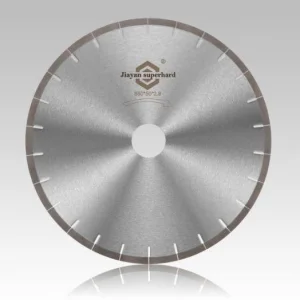
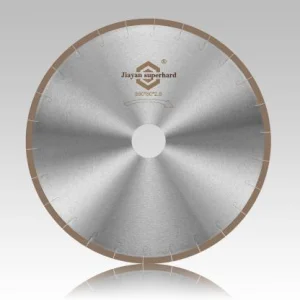
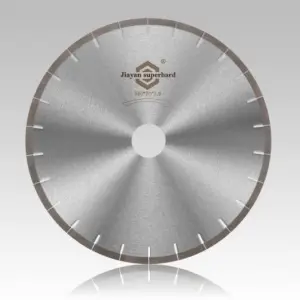
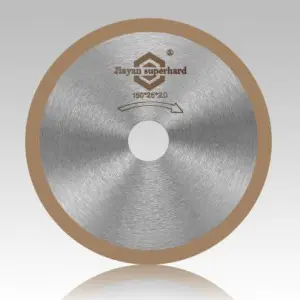
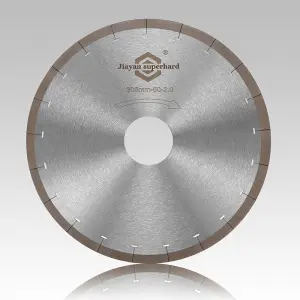
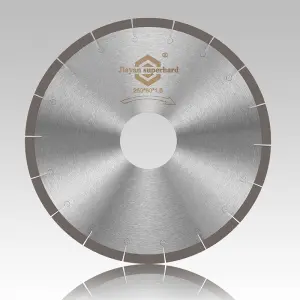
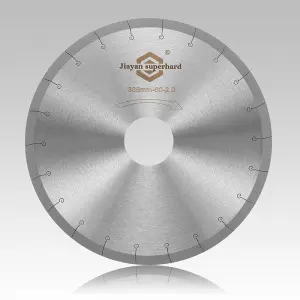
Engineered for vibration-free execution, zero micro-chipping, and maximum peripheral speed on ultra-dense sintered materials.
Why cutting sintered stone and ultra-dense porcelain requires custom diamond bond formulation and microscopic erosion control.
Porcelain slabs exhibit extreme Mohs hardness (7–8) paired with high fracture toughness. Standard granite segment bonds glaze rapidly. Sintered stone tooling requires precise Cobalt-Bronze-Nickel matrix sintering to continuously expose fresh synthetic diamond grit without thermal degradation.
We deploy premium synthetic monocrystalline diamonds calibrated between 100/120 to 140/170 mesh density. High-grade friability enables controlled micro-fracturing of individual diamond crystals, producing sharp cutting edges continuously to prevent slab tension cracking.
High-speed cutting generates localized thermal expansion up to 300°C. Our saw cores utilize cold-rolled 75Cr1 spring steel subjected to precision laser tensioning, maintaining runout tolerances under 0.02mm to eliminate wobble and rim deflection during 45° miter cuts.
| Blade Diameter | Segment Thickness | Recommended RPM Range | Linear Cutting Speed | Target Substrate Material | Cooling Mode |
|---|---|---|---|---|---|
| 115mm - 125mm (4.5" - 5") | 1.0mm - 1.2mm | 10,000 - 12,200 RPM | 35 - 45 m/s | Porcelain Tile, Thin Ceramic, Vitrified Tiles | Dry / Wet Air-Cooled |
| 250mm - 300mm (10" - 12") | 1.8mm - 2.2mm | 2,200 - 3,000 RPM | 28 - 38 m/s | Sintered Stone Slabs (6mm - 12mm) | Continuous Wet Flow |
| 350mm - 400mm (14" - 16") | 2.2mm - 2.8mm | 1,800 - 2,400 RPM | 30 - 40 m/s | Heavy Porcelain Architectural Slabs (20mm) | High-Pressure Wet Flow |
Industrial breakdown of physical forces: How specialized J-Slot, Mesh Turbo, and Continuous Rim geometries equalize cutting torque.
When cutting dense porcelain at 2.5 meters per minute, friction generates immediate kinetic heat. Standard segmented blades expand non-uniformly, causing the core to dish and pinch the slab, which leads to catastrophic corner cracking. Partnering with a specialized China Cutting Disc Porcelain Supplier gives fabricators access to engineered J-slot laser keyways that absorb radial expansion, maintaining a straight cutting plane under continuous load.
Furthermore, the laser slots promote fluid slurry ejection, washing away abrasive vitreous dust before it can re-grind against the core body.
Traditional wide-gap segments create rhythmic micro-impacts that shatter delicate porcelain edges. Continuous mesh-rim technology places diamond matrix teeth in close proximity (interlocking matrix patterns), spreading shear forces uniformly across the substrate.
This results in zero edge-flaking, making subsequent edge polishing fast and low-cost for fabricators producing high-end kitchen countertops and wall cladding.
Integrating synthetic diamond synthesis with precision metallurgy in Wuhu to deliver unparalleled factory-direct economies of scale.
China produces over 70% of the world's synthetic diamond mesh. Direct integration with superhard material refineries in Anhui and Henan allows JIAYAN to secure high-purity single-crystal diamond grit at optimized cost, completely insulated from raw material price spikes.
Our manufacturing facility utilizes multi-stage fully automated hot-press sintering furnaces. Computerized thermal and pressure monitoring guarantees uniform matrix density across every batch, eliminating segment separation risks under heavy loads.
Every continuous rim disc and large bridge saw blade undergoes 100% optical inspection and dynamic balance testing up to 1.5x maximum operational RPM, ensuring absolute safety and smooth spindle rotation on CNC equipment.
Moving beyond purchase price per unit: Evaluating cut length per blade, labor efficiency, and factory customization.
Cheap, poorly-bonded diamond discs glaze quickly, reducing cutting speed by up to 50% and doubling labor costs per slab. Premium hot-pressed diamond matrix discs maintain high linear speed throughout their service life, driving down the overall cutting cost per linear meter significantly.
We provide end-to-end OEM manufacturing for global distributors: custom segment heights (7mm, 10mm, 12mm), specialized arbor sizes (22.23mm, 25.4mm, 50mm, 60mm with custom pinhole patterns), dynamic core painting, laser marking, and customized retail packaging.
Disruption in matrix hardness across production lots damages brand trust. JIAYAN enforces standardized powder metallurgy blending and automated ultrasonic weld inspections to ensure that order 100 delivers identical performance to order 1.
Full compliance with European safety standards, zero heavy metal contamination, and streamlined global logistics.
All continuous rim, segmented, and turbo cutting discs strictly conform to EN 13236 safety specifications for superhard abrasive tools. Every disc is burst-tested to guarantee operator safety on high-speed hand angle grinders and industrial bridge saws.
Our metal powder binders undergo strict chemical purity verification. We manufacture low-cobalt and lead-free matrix formulations that align fully with European REACH and RoHS environmental standards for workplace health and safety.
To serve tier-1 importers, we partner with major global logistics hubs offering DDP (Delivered Duty Paid) shipping, streamlined customs clearing, bonded warehouse storage options, and local technical field support across Europe, America, and the Middle East.
Optimizing cutting parameters for diverse field environments, from high-capacity CNC fabrication plants to jobsite hand installation.
Material: 12mm-20mm Sintered Stone Slabs (e.g. Dekton, Neolith)
Tool: 350mm/400mm Silent Core Diamond Saw Blade
Operating Specs: RPM: 1,800–2,100 | Feed Speed: 1.5–2.2 m/min | Water Flow: >30 L/min
Key Benefit: Straight cuts, minimal noise pollution, clean 45-degree miter joints without edge chip marks.
Material: Ultra-dense Vitrified & Porcelain Floor Tiles
Tool: 115mm/125mm 1.0mm Super-Thin Turbo Blade
Operating Specs: RPM: 11,000 | Dry / Light Water Mist
Key Benefit: Ultra-fast plunging, razor-thin cut line, minimal dust generation, zero back-splintering of glaze.
Material: Industrial Mass-Production Ceramic Slabs
Tool: Multi-Blade Gang-Saw Continuous Rim Discs
Operating Specs: Automated In-line Cutting | Continuous Recirculating Coolant
Key Benefit: High wear resistance, 24/7 continuous operation without blade glazing or matrix breakdown.
Anticipating technological shifts in slab fabrication, eco-conscious tooling, and smart diamond matrix manufacturing.
Next-generation diamond blades are adopting Titanium/Silicon nano-coatings on diamond crystals. This thermal barrier prevents diamond graphitization at high temperatures (above 800°C), extending total blade life by up to 35% during high-speed dry cutting applications.
As porcelain slabs become larger yet thinner (3mm–6mm formats), cutting tools must evolve to sub-millimeter thickness (0.8mm–1.0mm) with reinforced center flanges to minimize material displacement and eliminate cracking risks during high-speed cuts.
Industry 4.0 integration enables precise micro-layering of diamond concentration across the segment cross-section. Diamond particles are positioned in geometric array patterns rather than random distribution, ensuring uniform wear rates and constant cutting speed.
Selecting the exact diamond matrix specification for your target substrate and machinery setup.
Detailed technical and procurement answers for industrial buyers, factory engineers, and distributors.
Porcelain and sintered stone slabs are manufactured under high compression pressure (>15,000 tons) and fired at temperatures above 1200°C, creating extreme density, near-zero porosity, and high internal stress. Standard granite saw blades feature harder matrix bonds designed for quartz-rich, brittle stone; on porcelain, these bonds fail to wear away fast enough, causing the diamond grit to dull and "glaze." The dull blade builds immense friction, leading to edge chipping, blade dishing, and slab cracking. Dedicated porcelain cutting discs utilize a softer, self-sharpening cobalt-bronze matrix that continuously exposes sharp diamond grains.
To ensure optimal performance, provide: (1) Substrate specifics—brand and thickness of porcelain or sintered stone; (2) Machinery specifications—spindle motor power (kW/HP), fixed operational RPM, and arbor size (e.g. 50mm, 60mm with pinhole specs); (3) Cutting environment—wet vs dry, feed speed requirements (m/min); and (4) Desired edge quality—straight cut vs 45-degree miter cut requirement.
Cold-pressed sintering is an economical process suitable for general DIY blades with lower density. Hot-pressed sintering subjects the metal matrix and diamond powder to simultaneous high temperature and pressure, yielding maximum matrix density and superior diamond retention—essential for continuous rim ultra-thin porcelain discs. Laser welding uses high-energy beams to fuse segments directly to the steel core, providing maximum mechanical bond strength for heavy-duty dry cutting and large bridge saw blades.
J-Slots are specialized micro-expansion channels laser-cut into the outer perimeter of the blade core. As thermal energy builds up during high-speed cutting, the steel core expands radially. J-Slots absorb this thermal expansion, preventing lateral tension buildup that would otherwise deform the blade core and result in wavy or skewed cuts.
The ideal linear peripheral speed for cutting dense porcelain slabs ranges between 28 m/s and 35 m/s. Running a blade too fast causes matrix glazing and thermal shock; running too slow leads to accelerated segment wear and uneven edge chipping. For a 350mm blade, this corresponds to approximately 1,500 to 1,900 RPM.
Under EN 13236, every batch of diamond cutting discs undergoes: (1) Dynamic runout and balance testing (≤0.02mm); (2) Spin burst safety testing up to 1.5 times the maximum rated operating speed; (3) Segment shear strength testing to ensure weld integrity; and (4) Metallurgical density verification via ultrasonic testing.
Small-diameter continuous turbo discs (105mm–125mm) with specialized airflow slots are engineered for both dry and wet cutting on hand-held angle grinders. However, for large-diameter blades (250mm–400mm) used on bridge saws for thick sintered slabs, continuous high-pressure water cooling is mandatory to prevent thermal stress fractures and ensure optimal blade longevity.
Sourcing direct from an integrated manufacturer eliminates distributor markups while granting direct access to customized matrix formulations. China's raw synthetic diamond ecosystem keeps material costs predictable, while automated hot-pressing ensures high batch consistency—reducing jobsite blade changes, labor downtime, and slab scrap rates.
When a blade glazes due to cutting extremely hard non-abrasive porcelain, it can be re-dressed (sharpened) by making several cuts into a soft, highly abrasive substrate such as an abrasive dressing stone, soft sandstone, or a concrete block. This strips away the worn metal matrix, re-exposing sharp diamond grit.
Standard inventory items ship within 3–7 business days. Custom OEM orders (with specialized arbor sizing, customized core painting, and private label screen printing) feature a standard manufacturing turnaround of 15–25 days depending on batch size. Flexible MOQs are available for trial engineering samples.
JIAYAN Superhard Materials Co., Ltd. — Professional Manufacturer & Member of China Superhard Material Association.