Engineered for extreme wear resistance, high removal rates, and micron-level precision across marble, granite, sintered stone, and industrial ceramics.
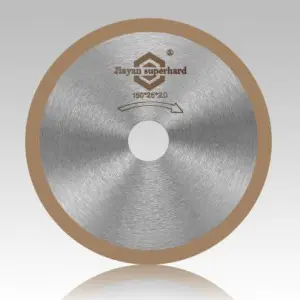
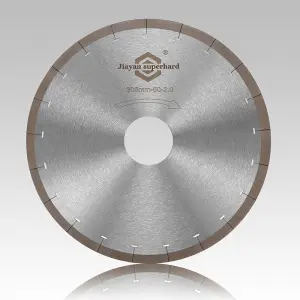
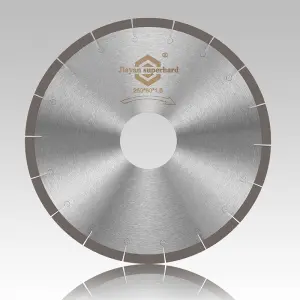
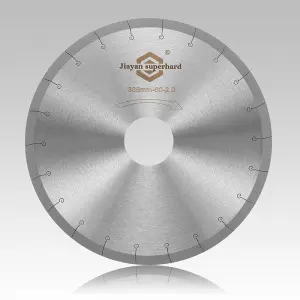
The global industrial manufacturing paradigm is undergoing a profound structural shift toward ultra-precision machining, hard-material processing, and high-efficiency material removal. At the epicenter of this transformation lies the synthetic diamond and superhard tool industry. Modern industrial applications—ranging from architectural stone processing and sintered porcelain slab profiling to semiconductor wafer slicing, automotive brake disc chamfering, and aerospace alloy finishing—demand tooling solutions capable of enduring extreme thermal stress while maintaining sub-micron dimensional stability.
Industrial statistics indicate that the global market for superhard abrasive tools, specifically diamond grinding wheels, diamond saw blades, and CBN (Cubic Boron Nitride) tooling, is projected to surpass $7.5 Billion USD by 2030, expanding at a CAGR of 6.2%. The key catalyst for this growth is the rapid replacement of conventional aluminum oxide and silicon carbide abrasives with synthetic diamond matrix solutions. Synthetic diamond offers an unmatched Mohs hardness of 10 and a thermal conductivity exceeding 2000 W/m·K, enabling material removal rates (MRR) up to five times faster than traditional abrasive media, while reducing thermal damage to workpiece substrates.
In this global landscape, procurement directors and industrial engineers face a critical imperative: securing steady, quality-certified, and cost-optimized supply chains capable of delivering custom bond formulations tailored to specific hard substrates. As non-standard stone materials like sintered porcelain slabs (Dekton, Neolith) gaining widespread architectural adoption, traditional cutting tools suffer from micro-chipping and rapid segment degradation. This creates a technical mandate for advanced metal-bond, resin-bond, and vacuum-brazed diamond grinding tools manufactured under rigorous quality control standards.
China has evolved from a high-volume manufacturer into the world’s definitive hub for advanced superhard material engineering. Today, China produces over 90% of the world's synthetic diamond grit via High-Pressure High-Temperature (HPHT) and Chemical Vapor Deposition (CVD) methods. This complete upstream industrial clustering grants Chinese superhard tool factories like JIAYAN Superhard Materials Co., Ltd. an unprecedented competitive advantage in raw material selection, grain Friability tuning, and matrix synthesis.
By controlling the synthesis of diamond crystals, matrix metal powders (Cobalt, Nickel, Copper, Bronze, Tungsten Carbide), and laser-welding core blanks under one ecosystem, Chinese manufacturers eliminate intermediary markups and guarantee batch-to-batch chemical purity.
Leading factories utilize fully automated cold-pressing, hot-pressing atmosphere sintering furnaces, and robotic Dr. Fritsch laser welding systems. This ensures zero joint defects, higher shear strength (>35 MPa), and perfect dynamic balancing.
Whether a enterprise client requires continuous rim J-slot designs for ultra-brittle ceramics or heavy-segment cup wheels for concrete grinding, Chinese suppliers provide fast-turnaround tooling customization within 7-14 business days.
As an active key member of the China Superhard Material Association, JIAYAN Superhard Materials Co., Ltd. (based in Wuhu, China) operates under ISO9001 quality system management. Utilizing proprietary vacuum sintering and precise grain orientation techniques, JIAYAN delivers industrial cutting discs and diamond grinding wheels with extended life cycles (+35% vs regional averages) to global buyers across 50+ countries.
Selecting the correct diamond grinding wheel or saw blade requires an in-depth understanding of the chemical interaction between synthetic diamond grit and the supporting matrix bond. The matrix must wear away at a rate synchronized with diamond micro-fracturing—exposing fresh sharp diamond points while retaining spent crystals until maximum work is performed.
| Bond Matrix Type | Primary Composition | Key Characteristics | Optimal Target Substrates |
|---|---|---|---|
| Metal-Bond (Sintered) | Cobalt (Co), Bronze (Cu-Sn), Iron (Fe), Nickel (Ni) | Extreme wear resistance, superior heat dissipation, high structural strength under heavy load. | Granite, Reinforced Concrete, Quartzite, Refractory Bricks. |
| Resin-Bond | Phenolic Resin, Polyimide, Copper/Aluminum Powder fillers | Excellent surface finish (Ra < 0.2µm), elastic dampening, low chatter, chip-free cut. | Sintered Stone, Glass Edging, Silicon Wafers, Tungsten Carbide. |
| Vitrified-Bond | Glass-ceramic frit, Borosilicate matrix | High rigidity, controllable porosity for coolant flow, easily dressed on CNC centers. | PCD/CVD Tool Regrinding, Precision Automotive Gears, Engine Components. |
| Vacuum-Brazed / Electroplated | Direct Nickel Plating or Active Brazing Alloy (Ni-Cr) | 100% exposed diamond concentration, maximum cutting speed, aggressive material stock removal. | Marble, Fiberglass, Cast Iron, Ultra-Hard Composites, Emergency Rescue Blades. |
In professional industrial grinding, diamond concentration is standardly defined where 100 Concentration equals 4.4 carats of diamond grit per cubic centimeter of bond layer (1 cm³).
Superhard diamond tools are not one-size-fits-all. Performance optimization depends entirely on aligning tool design with the specific mechanical properties of the target workpiece.
Challenge: Sintered stones (e.g., 3-12mm porcelain slabs) possess intense internal tension, high Mohs hardness (7+), and extreme brittleness. Standard blades cause edge blowout and micro-cracking.
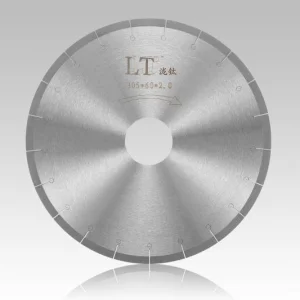
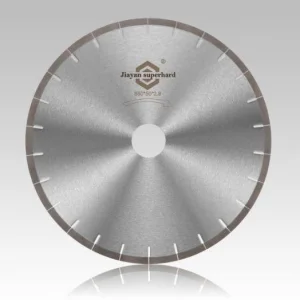
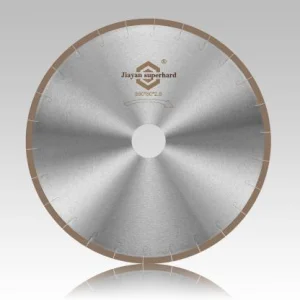
Solution: JIAYAN 14-Inch Sintered Stone Diamond Saw Blades with specialized J-Slot expansion channels and continuous rim soft metal bond matrices. Provides clean 45-degree miter cuts at feeds up to 3.5 m/min without chipping.
Challenge: Natural granite contains high quartz content, causing violent abrasive wear on segment bonds and risk of segment detachment during high-speed bridge saw operation.
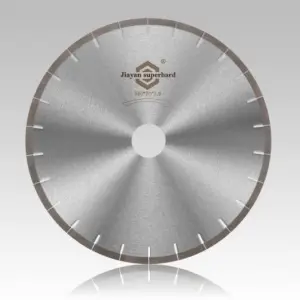
Solution: 350mm–800mm Laser-Welded Segmented Diamond Saw Blades featuring sandwich diamond distribution and Cobalt-Tungsten reinforced matrix. Ensures 100% safety against segment shear off at rotational speeds of 1450–2800 RPM.
Challenge: Rapid stock removal on grey cast iron, thermal spray coatings, and hardened steel alloys requires high wheel stiffness and thermal resistance.
Solution: Electroplated & Vitrified Diamond/CBN Grinding Wheels engineered for CNC grinding centers. Maintains precise wheel geometry across thousands of grinding cycles with zero thermal micro-fracturing on the metal surface.
For global procurement managers, industrial distributors, and OEM buyers, verifying the technical competence of a China diamond grinding wheel supplier requires strict evaluation criteria beyond unit price comparison.
High-speed circular saw blades and grinding wheels operating above 3000 RPM must maintain dynamic balance within G2.5 precision limits. Unbalanced steel cores cause machine spindle vibration, wavy cuts, and accelerated bearing failure. Reliable factories perform 100% electronic dynamic balancing before segment sintering.
For laser-welded diamond blades, joint integrity is paramount to operator safety. Quality audit protocols demand high-frequency ultrasonic non-destructive testing (NDT) alongside destructive shear testing to confirm shear strength exceeding 35 MPa (N/mm²).
Precision edging and profiling demand extreme flatness. Premium Chinese manufacturers enforce axial runout tolerances under 0.03mm and radial runout tolerances under 0.02mm across all 230mm to 350mm diamond cutting discs.
When evaluating a Chinese manufacturer: (A) Verify membership in national bodies such as the China Superhard Material Association; (B) Confirm availability of automated Dr. Fritsch laser welding equipment; (C) Request spectral analysis reports for cobalt/nickel bond powders; (D) Ensure flexible OEM packaging and custom arbor size (e.g., 20mm, 22.23mm, 25.4mm, 50mm, 60mm) adaptation.
The superhard material manufacturing industry is transitioning into a new era characterized by intelligent sintering, green environmental compliance, and microstructural matrix manipulation.
Vacuum brazing technology utilizes active titanium/chromium alloys to form true chemical carbide bonds with diamond crystals at 900°C+. This prevents premature diamond pop-out, allowing up to 80% crystal exposure for aggressive cutting speeds on difficult composite materials.
Advanced Chinese factories are deploying AI-driven thermal feedback systems during hot pressing. Real-time temperature, pressure, and vacuum regulation eliminate micro-voids, increasing mechanical bond density by 15% and standardizing tool life across mass production runs.
With environmental regulations tightening globally, leading manufacturers are adopting closed-loop water filtration, solvent-free binder chemistry, and solar-powered electric sintering furnaces to drastically reduce carbon footprints across the supply chain.
Select from our field-tested diamond saw blades, ultra-thin cutting discs, and heavy-duty grinding tools available for immediate OEM worldwide shipping.
Looking for custom diamond grinding wheel formulations, wholesale factory pricing, or reliable OEM production? Our technical engineering team is ready to analyze your material cutting requirements.