Precision-tensioned cutting discs manufactured with optimized cobalt-bronze metallurgical matrices, high-purity synthetic diamond grits, and advanced sandwich silencing technology.
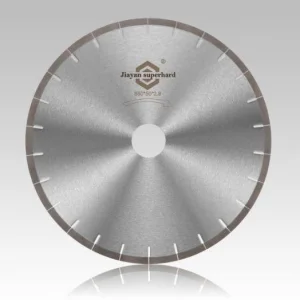
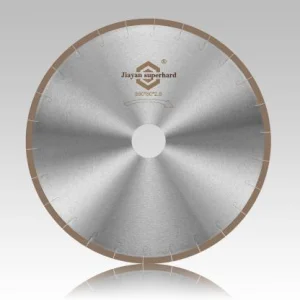
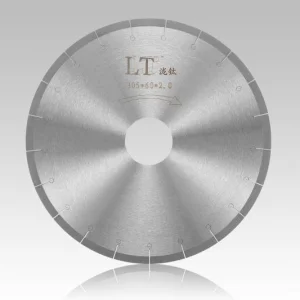
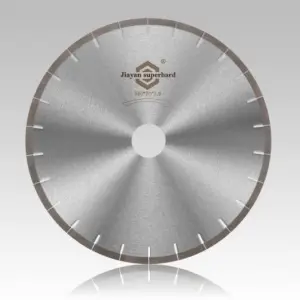
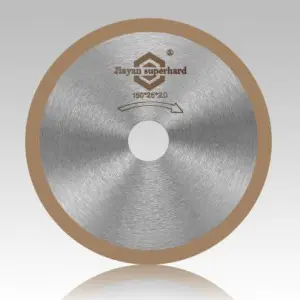
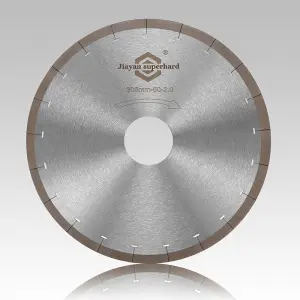
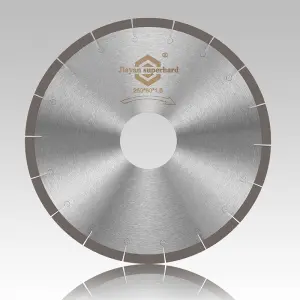
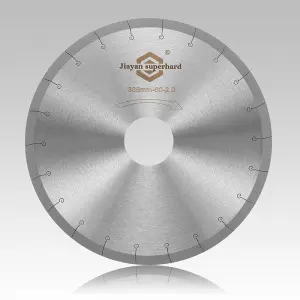
Natural granite remains one of the most abrasive and heterogeneous architectural substrates processed on modern industrial bridge saws, multi-blade block cutters, and 5-axis CNC workcenters. Composed predominantly of crystalline quartz (Mohs hardness 7), alkali feldspars, and plagioclase, granite exerts extreme abrasive wear and mechanical shock on circular saw segments.
As global stone infrastructure transitions toward high-speed automated fabrication line speeds (exceeding 4 to 8 meters per minute on slab trimmers), conventional electroplated and generic sintered blades fail due to rapid segment loss, excessive thermal glazing, core dishing, and erratic blade deflection. China produces over 90% of the world's industrial monocrystalline synthetic diamonds through High-Pressure High-Temperature (HPHT) and Chemical Vapor Deposition (CVD) technologies. JIAYAN Superhard leverages this localized supply chain integration in Wuhu, China, delivering metallurgically engineered diamond saw blades optimized for specific abrasive classifications—ranging from fine-grained dense granites (e.g., Absolute Black, Baltic Brown) to highly quartzitic granites (e.g., Brazilian Exotic Quartzites, G603, and G654).
Balancing diamond crystal retention, controlled bond matrix erosion, and thermal oxidation resistance across varying Mohs hardness levels.
Segment durability relies on tailored metallic bond formulations. JIAYAN balances high-purity Cobalt (Co), Bronze (Cu-Sn alloys), Tungsten Carbide (WC), and Carbonyl Nickel (Ni) to govern matrix wear velocity.
We utilize single-crystal HPHT diamonds characterized by sharp octahedron morphology, superior impact toughness (TI & TTI indexes >85), and elevated thermal breakdown resistance up to 1100°C.
Gullet and segment profiles dictate slurry extraction efficiency and hydrodynamic coolant circulation, directly preventing segment overheating and diamond graphitization.
Precision laser welding combined with computerized steel core roll-tensioning guarantees blade stability under high peripheral speeds (30–45 m/s).

In standard wet-cutting bridge saw applications, high-frequency silver-copper brazing provides cost-efficient segment bonding. However, heavy-duty quarrying, high-load push feeds, and dry cutting demand deep-penetration fiber laser welding.
JIAYAN's CNC fiber laser welding workstations fuse the cobalt transition layer of the segment directly with the 75Cr1 or 65Mn alloy steel core. The resulting metallurgical bond achieves shear failure resistance exceeding 40 MPa—far surpassing the European EN13236 safety threshold. Every welded segment undergoes hydraulic bending and torque load testing to ensure zero segment detaching risks in continuous production.
Acoustic pollution in urban fabrication workshops is stringently regulated. JIAYAN silent diamond blades utilize a laminated steel structure featuring a micro-thin copper or polymeric viscoelastic damping foil sandwiched between two hardened 75Cr1 steel plates. This absorbs harmonic resonance generated by high-frequency diamond-granite impact, decreasing operational sound levels by 8 to 15 dB(A) and suppressing micro-chatter that leads to edge chipping.
Centrifugal force and frictional thermal gradients cause saw blades to expand during operation. Without precise pre-stress tensioning, circular blades wobble, wander off straight cut lines, or suffer irreversible dish warping. Our automated roll tensioners apply radial internal stress zones tailored to the customer's specified RPM range (e.g., 1450 RPM for 350mm or 850 RPM for 600mm), ensuring the blade remains dead flat at high cutting temperatures.
Standardized parameters for CNC 5-axis workcenters, manual bridge saws, and primary multi-blade block slabbers to maximize linear meter throughput.
| Blade Outer Diameter (mm / Inch) | Typical Segment Specs (L x W x H mm) | Recommended Spindle Speed (RPM) | Linear Peripheral Speed (m/s) | Feed Speed Rate (m/min) | Target Granite Class |
|---|---|---|---|---|---|
| 300mm / 12" | 40 x 2.8 x 12/15 | 1,900 – 2,400 | 30 – 38 m/s | 3.0 – 6.0 m/min | Class I (Soft) & Engineered Quartz |
| 350mm / 14" (Standard Bridge) | 40 x 3.2 x 15/20 | 1,450 – 2,100 | 28 – 38 m/s | 2.5 – 5.5 m/min | Class II–IV (G603, Baltic Brown, Kashmire) |
| 400mm / 16" | 40 x 3.6 x 15/20 | 1,200 – 1,800 | 28 – 36 m/s | 2.0 – 4.5 m/min | Class IV–V (Absolute Black, Red Granite) |
| 500mm / 20" | 40 x 4.2 x 15/20 | 950 – 1,450 | 25 – 35 m/s | 1.8 – 3.8 m/min | Heavy Architectural Kerbs & Slabs |
| 600mm / 24" | 40 x 4.8 x 15/20 | 800 – 1,200 | 25 – 35 m/s | 1.5 – 3.2 m/min | Monumental & Thick Slabs (50–100mm) |
| 1000mm – 3500mm (Block Cutter) | 24 x 7.4/8.4 x 13/15 | 250 – 550 | 22 – 32 m/s | 10 – 25 m/min (Step Cut) | Quarry Block Multi-Blade Gang Slicing |
Ensure uninterrupted water delivery directed straight into the cut kerf. Inadequate cooling (under 15–25 L/min on 350mm blades) causes immediate thermal glazing of diamond crystals and core warping.
Flange diameter must equal at least 1/3 of the total blade diameter for precision bridge saws (e.g., minimum 115mm flange for a 350mm blade) to prevent lateral core deflection during mitering.
If cutting speed drops or amp draw spikes on the spindle motor, dress the glazed blade by running 2 to 4 passes through an abrasive refractory brick or soft limestone slab to re-expose fresh diamond points.
Decades of export experience with stringent testing regimes ensure seamless OEM/ODM collaboration for international diamond tool distributors.
Certified safety testing covering bursting speed resistance, bending stress thresholds, and impact endurance on all manufactured rotary diamond tools.
100% segment torque verification combined with ultrasonic microscopic seam inspection prevents catastrophic segment detachment in wet or dry use.
Comprehensive private labeling including customized core silk-screening, laser segment etching, barcode packaging, and bespoke segment formulas.
Wuhu-based automated sintering kilns generate over 80,000 blades monthly, ensuring reliable 15-day batch lead times for distributors globally.
Strategic research initiatives transforming the performance boundaries of industrial stone cutting blades.
Random diamond distribution causes premature pull-out of clustered grits and inefficient work distribution. Our Next-Gen ARIX technology places individual synthetic diamonds in precise 3D cubic lattices within each segment, guaranteeing consistent exposure, increasing cut speeds by 40%, and extending total lifespan by up to 60%.
Anticipating European chemical and occupational safety regulations regarding fine cobalt dust emissions, JIAYAN has engineered ultra-dense Pre-Alloyed Iron-Copper-Nickel-Titanium composite powders that replace up to 80% of cobalt without sacrificing mechanical retention or impact toughness.
Reducing cutting kerf from 3.2mm down to 2.2mm on 350mm blades reduces stone slurry volume and motor energy draw by 32%. Combining stiffened carbon-fiber composite core dampeners with ultra-narrow segments enables precision miter joins with minimal raw stone wastage.
In-depth technical answers addressing blade selection, segment metallurgy, maintenance, and global B2B supply agreements.
Glazing happens when the metallic bond matrix is too hard for the specific stone hardness. Instead of eroding at a rate proportional to diamond wear, the metal covers the diamond crystals, causing the blade to polish rather than grind through the quartz matrix. The solution is to switch to a softer cobalt-bronze matrix formulation (e.g., JIAYAN S-Grade bond) or increase down-feed pressure.
Silent cores contain a laminated copper or viscoelastic layer between two outer steel sheets. This internal barrier disrupts acoustic vibrations, dampening operational noise by 8 to 15 dB(A). More importantly for fabrication accuracy, it dissipates micro-vibrations, yielding razor-sharp miter cuts and extending segment life by avoiding micro-impact diamond fracture.
All laser welded blades undergo rigorous quality control per EN 13236 standards. Every batch is subjected to destructive torque shear testing (demanding minimum shear stresses above 40 MPa) and non-destructive hydraulic bending loads on 100% of perimeter segments. The steel-to-cobalt fusion zone is verified via metallurgical cross-section microscopy.
For standard 350mm (14-inch) circular granite cutting, we recommend a continuous clean water flow rate of 15 to 25 liters per minute at 2.0–3.0 bar pressure. Water must be split evenly on both faces of the blade into the kerf to ensure slurry extraction and prevent thermal warping of the 75Cr1 steel core.
No. Natural granite requires a bond that can withstand quartz impact, whereas sintered stone (e.g., Dekton, Neolith) has zero porosity, high tension, and fine crystalline structures. Sintered stone requires an ultra-fine mesh diamond matrix (70/80 or 100/120 mesh) with a softer, highly responsive bond to prevent catastrophic slab cracking.
Our standard OEM batch MOQ is 50 pieces per custom specification (size/bond/bore diameter). Standard lead time from sintered powder batching to laser etching and dynamic balancing is 15 to 25 business days, supported by express container dispatch from Shanghai/Ningbo ports.
Direct manufacturer pricing, bespoke OEM private labeling, and tested diamond matrices ready for global deployment.