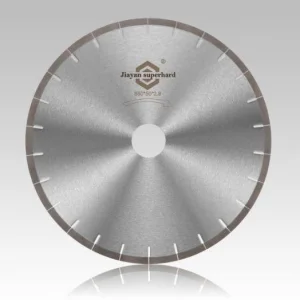
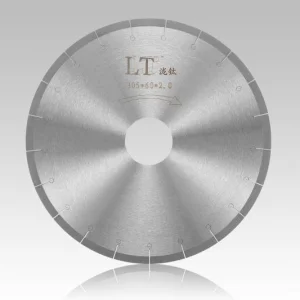
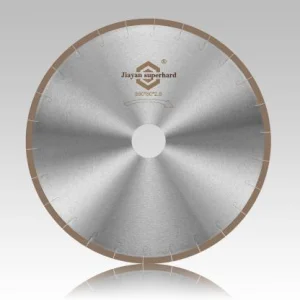
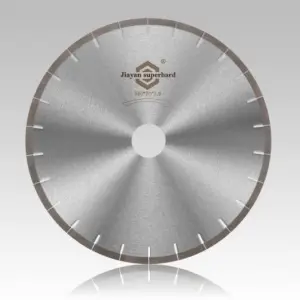
Engineered for extreme wear resistance, zero edge chipping, and mirror-grade surface finishing across industrial continuous lines and CNC processing hubs.
The global surface material landscape has experienced a seismic architectural shift toward large-format porcelain slabs and ultra-compact sintered stone. Valued for their non-porous structure, thermal resistance, and Mohs hardness scale rating of 7 to 8, these advanced ceramics match or exceed natural granite in structural rigidity. However, these physical attributes introduce significant tribological challenges during post-extrusion calibrating, squaring, chamfering, and polishing operations.
Standard granite and marble abrasives often fail when applied to modern vitreous porcelain. Porcelain’s extreme flexural strength (>50 N/mm²) causes traditional soft-matrix metal wheels to glaze over, generating localized thermal stress spikes that induce micro-cracking along edge profiles. Achieving a Gloss Unit (GU) rating exceeding 90 GU requires engineered diamond grit matrices that balance controlled micro-fracturing of synthetic diamond crystals with rapid matrix attrition.
Porcelain tiles undergo high-pressure compaction (>40,000 tons) and high-temperature sintering (>1,200°C). This creates a vitrified glass-crystalline structure with minimal porosity. Polishing tools must maintain precise coolant hydro-planing while delivering uniform mechanical abrasion across high-speed industrial processing lines.
How China’s integrated superhard materials ecosystem delivers superior cost performance, technical consistency, and custom OEM manufacturing speed.
China accounts for over 85% of global synthetic industrial diamond production. Direct access to high-purity single-crystal synthetic diamond grit via HPHT (High-Pressure High-Temperature) synthesis allows Chinese tool manufacturers like JIAYAN to select optimal crystal friability, shape regularity, and thermal toughness for porcelain applications.
State-of-the-art automated hot-press sintering furnaces and vacuum brazing tech ensure uniform alloy matrix densities. By controlling sintering parameters (temperature curves accurate to ±1°C and pressure levels up to 35 MPa), Chinese suppliers produce tools with zero micro-voids, preventing premature segment loss.
Industrial clusters in Henan, Anhui (Wuhu), and Guangdong allow immediate sourcing of pre-balanced steel cores, high-purity metal powders (Cobalt, Bronze, Nickel, Tungsten), and specialized resin formulas. Sourcing cycles for customized OEM tooling are reduced from 60 days in Europe to 14 days in China.
A technical breakdown of matrix bonds, diamond grit distribution, and physical application dynamics.
To achieve high-efficiency material removal without edge micro-fracturing, porcelain polishing tool design relies on precise pairing between the chemical composition of the bond matrix and the mesh size of the synthetic diamond abrasive particles. Polishing systems operate across a progressive multi-stage reduction sequence:
| Tool Phase | Bond Matrix Type | Diamond Grit Range | Primary Processing Function | Coolant Protocol |
|---|---|---|---|---|
| Calibrating & Heavy Stock | Cobalt-Bronze Metal Bond | #30 / #50 / #80 Mesh | Thickness levelling, high-volume material removal | High-Pressure Wet Cooling (>35 L/min) |
| Squaring & Chamfering | Iron-Nickel Sintered / Brazed | #100 / #140 / #200 Mesh | Precise 90° edge squaring and top-edge beveling | Continuous Flood Coolant |
| Pre-Polishing & Smoothing | Hybrid Metal-Resin Bond | #400 / #800 Mesh | Elimination of grinding scratches & subsurface micro-fissures | Wet Cooling (Controlled flow) |
| High-Gloss Final Finishing | Thermosetting Polyurethane Resin | #1500 / #3000 / Buff | Final specular reflection polishing, reaching >90 Gloss Units | Low-Volume Mist or Specialized Liquid |
Metal bond tools utilize cobalt-rich powder formulations sintered under high temperature and mechanical pressure. These tools excel in heavy-duty stock removal on continuous porcelain production lines. The metal matrix retains high-strength diamond crystals against shear stress, providing a lifetime index up to 3x higher than standard abrasive stones.
Resin bond tools utilize thermosetting phenolic or polyurethane matrices filled with fine diamond powder (#400 to #3000 grit). Resin bonds exhibit natural elastic compliance under downward pressure, allowing the diamond abrasives to smooth out microscopic surface variations and create a haze-free mirror gloss on dark or patterned glazed porcelain.
Optimized parameters for automated tile plants, architectural stone fabricators, and countertop processing centers.
Operating speeds on high-efficiency continuous squaring lines reach up to 40 meters per minute. Porcelain squaring wheels are mounted in multi-spindle banks with progressive grit steps. Dynamic wheel balance (<0.01g/mm tolerance) is vital to avoid high-frequency chatter marks across tile edges.
Fabrication of 45-degree mitered edges for kitchen countertops and waterfall island slabs demands ultra-sharp vacuum-brazed diamond routers and fine-grit edge profiling wheels. Zero edge chipping is critical for seamless resin-bonded miter seams.
In field installation settings where wet cooling is impractical, specialized heat-resistant resin dry-polishing pads are utilized. Formulated with ceramic fillers, these pads withstand operational temperatures up to 250°C without burning the resin or staining light porcelain surfaces.
Emerging technologies transforming industrial stone and ceramic tool performance.
In response to international REACh regulations and cobalt supply volatility, leading Chinese manufacturers are pioneering Iron-Copper-Nickel pre-alloyed powders. These eco-matrices equal or exceed traditional cobalt-rich tools in tensile strength and matrix toughness.
Integration of real-time piezoelectric load sensors within polishing spindle heads allows automated pressure adjustments. As porcelain slab curvature varies, the grinding head maintains a constant force, preventing uneven edge burnish or center gouging.
By blending sub-micron ceramic whiskers with nanometer diamond crystals in final resin steps, new-generation pads seal microscopic pores on polished porcelain surfaces. This eliminates the need for post-polishing chemical nano-wax coatings.
Key metrics B2B buyers must evaluate when procuring diamond tools from China exporters.
In high-volume tile production, evaluating a diamond tool solely on unit purchase price is misleading. Procurement teams should analyze the Cost Per Square Meter ($/m²) processed. A high-grade sintered squaring wheel costing 30% more upfront may yield 2.5x longer service life while reducing machine downtime for tool changes.
For international buyers and distributors, JIAYAN Superhard Tools provides customizable manufacturing specifications:
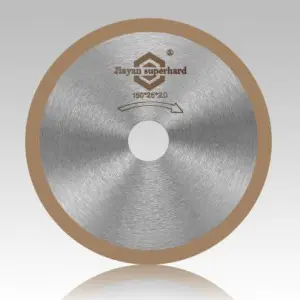
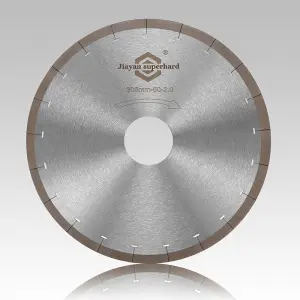
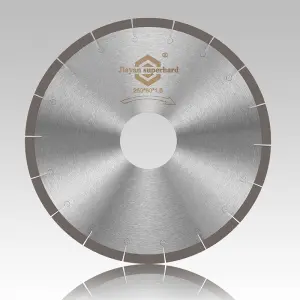
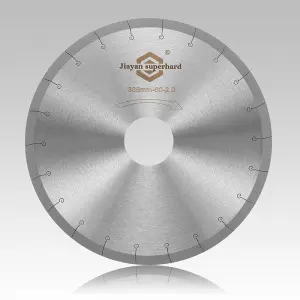
• Segment Geometry: Continuous Rim, J-Slot, Turbo, Keyhole, Wave Segment
• Steel Core Steel Specs: 75Cr1, 65Mn, 50Mn with tension balancing
• Bore Sizes & Pin Holes: Custom CNC arbor configurations (22.23mm, 25.4mm, 50mm, 60mm)
• Quality Control Standard: 100% dynamic balance testing, micro-hardness verification, and ultrasonic flaw detection
Select high-performance tooling built for professional stone fabricators, distributors, and processing factories.
Expert engineering answers regarding porcelain tool selection, line setup, and troubleshooting.
Member of the China Superhard Material Association. Specializing in high-precision diamond saw blades, continuous rim cutters, squaring wheels, and resin polishing systems for global ceramic & stone industrial buyers.