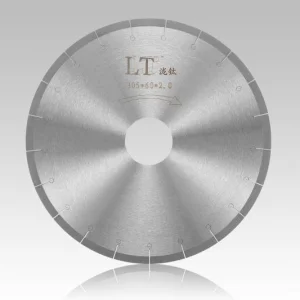
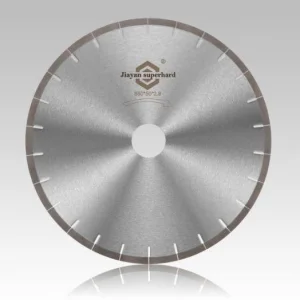
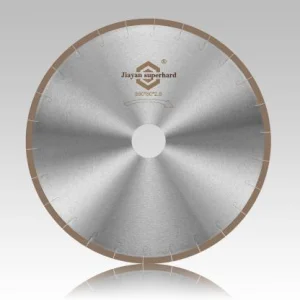
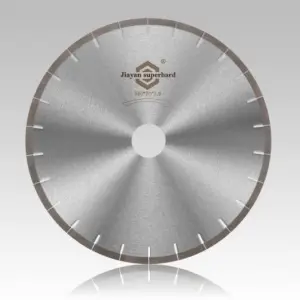
High-performance matrix segments, continuous rim blades, and multi-blade circular cutters engineered for extreme quartz-content stone cutting.
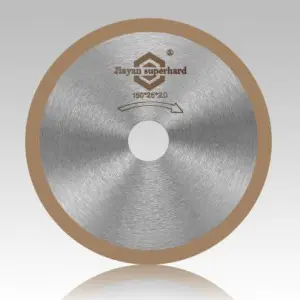
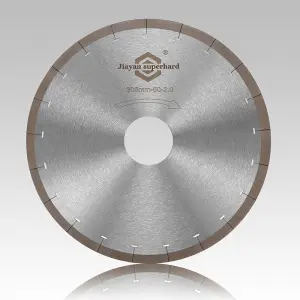
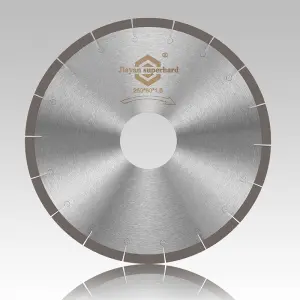
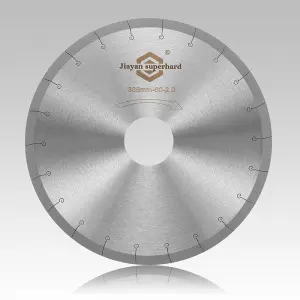
Analysis of abrasive rock cutting tribology, mineral hardness variations, and structural demands on modern superhard cutting segments.
The global natural stone processing industry relies heavily on diamond segments as the critical consumable interface between circular saw machinery and hard rock formations. Natural granite, petrologically classified into quartz-diorite, granodiorite, and true alkali-feldspar granites, exhibits extreme variability in mineralogical composition. Hardness ranges from 6 to over 7.5 on the Mohs scale, driven by high free-quartz ($SiO_2$) contents, plagloclase feldspars, and amphiboles. Cutting these heterogenous structures efficiently requires advanced diamond segment technology capable of enduring severe impact shocks, high thermal gradients, and intense abrasive friction.
In major stone production centers across Brazil (Espírito Santo), India (Rajasthan, Karnataka), Italy (Carrara/Verona processing hubs), Spain, and North America, stone fabricators are under continuous margin pressure. Operational success depends on minimizing cost-per-square-meter cut ($/m²), maximizing square meters per hour production speed, and ensuring kerf consistency to reduce slabbing waste. The market has consequently transitioned from standard randomly-dispersed diamond segments toward specialized, alloy-engineered powder metallurgy matrices tailored to specific stone classifications.
How advanced powder metallurgy, cobalt-nickel binder matrices, and controlled hot-press sintering deliver superior segment wear resistance.
Rather than random diamond grit distribution, Chinese manufacturers utilize automated micro-robotic 3D arrangement (ARIX technology). Every synthetic diamond crystal is positioned at exact spatial intervals (X, Y, Z axes), guaranteeing constant exposure, balanced load distribution, and eliminating premature diamond pop-out.
Formulated with high-purity Cobalt (Co), Nickel (Ni), Copper (Cu), Iron (Fe), and Tungsten Carbide (WC). The matrix bond erosion rate is calibrated precisely to match the crushing kinetics of the selected diamond grade, ensuring the diamond remains anchored until maximum thermal and mechanical work is achieved.
Utilizing fully automated, multi-stage hot-press sintering furnaces operating between 750°C and 980°C under computer-controlled hydraulic compaction (30-45 MPa). This process yields near-zero porosity, maximum mechanical interlocking strength, and preserves diamond single-crystal integrity.
Technical Insight on Diamond Grit Selection: High-grade Chinese granite segments incorporate premium synthetic diamonds (MBD/SDB series) treated with Ti/Ti-N chemical coatings. The titanium coating creates a carbide bond interface during hot sintering, increasing diamond retention strength by up to 45% and preventing thermal oxidation up to 900°C during heavy dry or water-restricted sawing operations.
Why leading global stone processing enterprises source custom diamond blade segments directly from specialized Chinese manufacturing clusters.
China accounts for over 90% of the world's industrial synthetic diamond powder production, centralized primarily in Henan and surrounding provinces. This absolute proximity to synthetic diamond crystal synthesis gives Chinese segment exporters direct control over grit consistency, particle size distribution (US Mesh 30/40, 40/50, 50/60), and thermal toughness parameters. Furthermore, domestic availability of ultra-fine sub-micron metal powders (Co, Fe-Ni, WC) eliminates international supply disruptions and dramatically lowers raw material procurement overhead.
Modern Chinese segment manufacturing facilities employ automated gravimetric powder blending, automatic cold-pressing segment compactors, and computerized laser welding systems. Standard quality checks include ultrasonic segment joint integrity analysis, micro-hardness Rockwell (HRC) testing, and automated laser dimensioning to enforce strict dimensional tolerances (±0.05mm).
Global stone fabricators require versatile segment geometries to match specific sawing machinery (Bridge Saws, Multi-blade Cutters, Block Cutters, Edge Trimming Machines). Chinese suppliers lead the industry in engineering customizable segment geometries:
Recommended cutting speeds, peripheral velocities, step-down depths, and water flow parameters across blade diameters.
| Blade Dia. (mm) | Segment Size (LxWxH mm) | Optimal RPM (RPM) | Peripheral Speed (m/s) | Step Down Depth (mm) | Coolant Water Flow (L/min) | Target Granite Class |
|---|---|---|---|---|---|---|
| 350 mm (14") | 40 x 3.2 x 12/15 | 1800 - 2300 | 33 - 38 m/s | 15 - 30 mm | 15 - 25 L/min | Class I & II (Soft-Medium Granite) |
| 400 mm (16") | 40 x 3.6 x 15/20 | 1600 - 2000 | 33 - 38 m/s | 20 - 40 mm | 20 - 30 L/min | Class II & III (Abrasive Hard Granite) |
| 600 mm (24") | 40 x 5.0 x 15/20 | 1100 - 1400 | 32 - 36 m/s | 30 - 60 mm | 35 - 50 L/min | Class III & IV (High Quartz Granite) |
| 1200 mm (48") | 24 x 8.4 x 15/20 | 550 - 700 | 30 - 35 m/s | 10 - 20 mm/pass | 60 - 90 L/min | Block Squaring / Primary Quarrying |
| 1600-2000 mm | 24 x 10.5 x 20 | 350 - 450 | 28 - 32 m/s | 8 - 15 mm/pass | 100 - 150 L/min | Multi-Blade Gang Sawing Systems |
Optimizing segment longevity requires calibrating the bond matrix to the specific geological properties of the stone being processed. Below is the operational tuning protocol used by technical field engineers:
Examples: Red Multicolor, Kashmir White, Baltic Brown.
Recommended Bond: Soft Bronze-Copper rich matrix with high friability diamonds to promote rapid self-sharpening and prevent blade glaze.
Examples: Black Galaxy, Indian Green, Grey Granites.
Recommended Bond: Medium-Hard Tungsten Carbide enriched matrix. Retains matrix shape against intense abrasive slurry wear.
Examples: Shanxi Black, Absolute Black, Basalt.
Recommended Bond: Hard Cobalt-Iron tough matrix with low diamond concentration to maintain point pressure penetration.
Verification steps for international stone processing enterprises evaluating Chinese segment manufacturers.
For heavy-duty granite cutting, segment attachment safety is critical. Factory verification requires torque testing (shear strength > 350 MPa for high-frequency silver brazing and > 600 MPa for direct laser welding). Laser welded segments undergo 100% automated optical inspection (AOI) to eliminate weld seam micro-cracks.
Inspecting hardness variance across segment length using Rockwell Hardness Testers (HRC 25-45 depending on rock classification). Segments undergo differential thermal analysis (DTA) to ensure matrix bonds maintain elastic modulus up to 800°C operational friction temperatures.
When supplying finished circular blades with segments pre-welded, strict radial runout (<0.03mm) and axial runout (<0.05mm) tolerances must be certified to prevent vibration chatter marks on slab surfaces and extend machine spindle motor lifespan.
Professional Chinese suppliers encode laser markings on each segment batch, specifying metal powder batch numbers, diamond grit grade, concentration, and production date to guarantee exact replication during bulk reorders.
Expert answers to critical operational, technical, and procurement questions regarding diamond saw blade segments.
Glazing occurs when the metal bond matrix is too hard relative to the stone's abrasiveness. The matrix fails to wear away, preventing new sharp synthetic diamond edges from exposing. To fix this: (1) Reduce cooling water volume temporarily to increase friction, (2) Dress the segment by cutting into abrasive refractory brick or soft sandstone, or (3) Re-order segments with a softer, higher-bronze binder matrix formulation.
Single bridge saw blades (350-800mm) emphasize fast cutting speed, smooth edge finish, and low vibration for detailed slab cutting. Multi-blade setups (up to 32 blades operating on a single arbor) demand segments with extremely tight dimensional tolerances (±0.02mm width) and consistent wear rates across all segments so that all blades maintain equal diameter during block slabbing.
ARIX technology places individual diamond grains in precise 3D grid patterns within the matrix segment. This ensures uniform diamond work distribution, prevents diamond clumping, allows 20-30% faster cutting speeds, increases total segment life by 30-50%, and provides consistent power draw on machine motors.
Diamond concentration measures the weight carats of diamond per cubic centimeter of segment matrix (100 Concentration = 4.4 carats/cm³). For soft-medium granites, concentrations between 18% and 22% yield high cutting speed. For hard, dense granites (e.g., Black Galaxy, Impala Black), slightly lower concentrations (14%-18%) increase point load pressure, helping the diamonds bite into the mineral phase.
Yes, professional Chinese manufacturers offer complete OEM/ODM customization. You can specify segment length, thickness, height, matrix hardness, segment radius curvature, and side layer distribution to match existing steel core blanks (350mm to 3500mm diameter) and silver welding equipment.
Uneven wear usually stems from bad flange alignment, spindle shaft play, incorrect coolant pressure distribution across blade sides, or non-sandwich segment designs. Using Sandwich Structural Segments (with harder matrix/higher diamond content on outer lateral sides) ensures uniform kerf profile across the segment's full lifespan.
Explore our full line of superhard material saw blades engineered for professional stone fabricators and machinery distributors worldwide.
Request custom segment matrix formulation, request sample testing batches, or schedule a technical engineering consultation for your stone processing factory.
Contact Engineering & Export Team