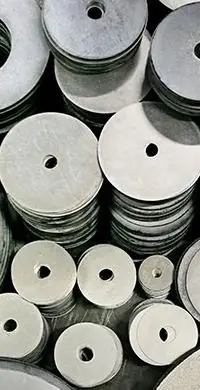
Engineered for high-speed cutting, maximum linear meter life, and zero edge chipping across ceramic, granite, marble, and sintered stone substrates.
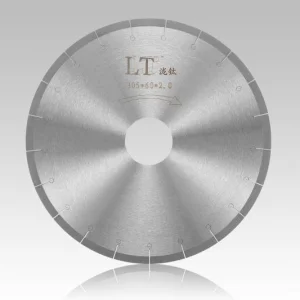
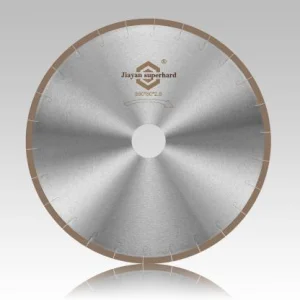
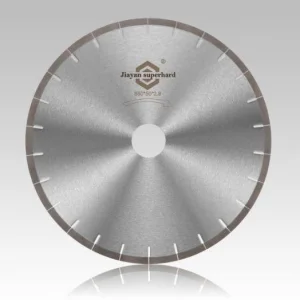
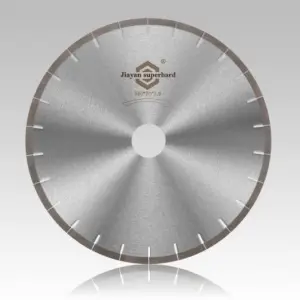
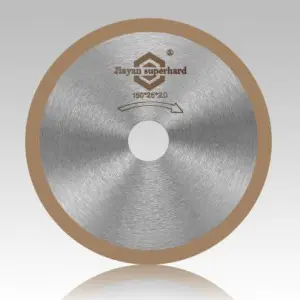
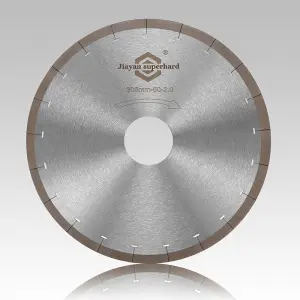
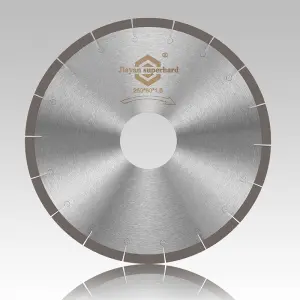
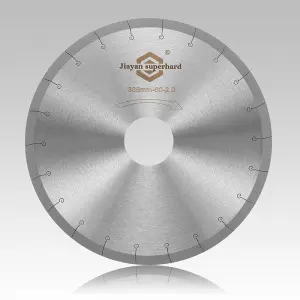
Comprehensive engineering analysis of diamond grit concentration, bond matrix wear dynamics, and structural tensioning for heavy industrial stone and ceramic processing.
In modern architectural construction, structural engineering, and dimensional stone manufacturing, the demand for precision cutting tools has evolved exponentially. As a global custom diamond cutting blades exporter and primary manufacturing enterprise, JIAYAN Superhard Tools operates at the convergence of advanced powder metallurgy, single-crystal synthetic diamond chemistry, and dynamic laser-welding mechanics. The performance of a diamond saw blade is not merely determined by the hardness of diamond particles, but by the precise tribological balance between diamond friability, matrix erosion rate, thermal dissipation efficiency, and steel core tensioning.
Unlike conventional metal-cutting saws that shave material via solid tooth shear, dynamic diamond saw blades operate via high-speed micro-fracturing and abrasion. Synthetic diamond crystals (manufactured via high-pressure high-temperature HPHT or chemical vapor deposition CVD processes) are embedded within a sintered metal matrix alloy composed of cobalt, copper, iron, bronze, nickel, and tungsten carbide powders.
During the cutting process, the exposed diamond points gouge microscopic grooves into the target material (e.g., granite, quartz, porcelain, or reinforced concrete). As these diamond crystals wear, dull, and experience impact fatigue, they must fracture under controlled force to expose fresh, sharp crystallographic edges—a mechanical property known as friability. Simultaneously, the surrounding metal bond matrix must erode at a rate strictly synchronized with diamond breakdown. If the metal matrix is too hard, the blade "glazes" over as worn diamonds remain trapped without cutting; if the matrix is too soft, diamond crystals fall out prematurely, resulting in rapid blade destruction and excessive cost-per-cut.
Cutting abrasive materials (like sandstone or green concrete) requires a hard metal matrix (high tungsten carbide/iron ratio) to resist severe slurry wear. Cutting non-abrasive, extremely hard materials (like high-density sintered stone slabs or Class 5 porcelain) demands a soft metal matrix (high bronze/cobalt ratio) that wears quickly enough to expose fresh micro-grit continuously.
The structural backbone of any industrial diamond blade is its high-alloy steel core, typically constructed from 65Mn spring steel or heat-treated 50Mn2V alloy steel. Operating at peripheral rim speeds ranging from 30 m/s to 80 m/s (4,000 to 12,000 RPM depending on blade diameter), circular saw blades are subjected to centrifugal force, lateral deflection pressures, thermal expansion, and mechanical vibration resonance.
To ensure perfect flatness, straight linear feed, and low operational noise, JIAYAN utilizes precision hydraulic hammer tensioning and laser-cut expansion slots (including J-slot, keyhole, and radial noise-reduction slots). Tensioning induces controlled internal compressive stress in the core's mid-zone, compensating for centrifugal expansion during high-speed rotation. This prevents blade "wobble," edge deviation, and surface burning on premium architectural materials.
Selection of uniform octahedral synthetic diamonds featuring high thermal stability (up to 1100°C) and tight mesh particle distribution.
Full-penetration laser beam welding fuses metal segments directly to the steel core, providing supreme resistance to lateral shear failure.
Automated vacuum hot-press sintering ensures 99.8% matrix density, eliminating microscopic voiding and segment cracking.
JIAYAN Superhard Tools (Member of China Superhard Material Association) provides global OEM/ODM manufacturing, technical compliance, and multi-national procurement infrastructure.

Founded in Wuhu, Anhui, China, JIAYAN Superhard Materials Co., Ltd. has grown into a tier-1 supplier of industrial circular saw blades, ultra-thin diamond cutting discs, and custom segment tools. Serving clients across Europe, North America, the Middle East, and Southeast Asia, we maintain strict adherence to international safety standards, certified under ISO 9001:2015 quality systems.
Our OEM/ODM procurement pipelines support custom segment geometry, private labeling, specialized arbor bore sizes (e.g., 20mm, 22.23mm, 50mm, 60mm with pinholes), and substrate-specific matrix formulations optimized for local stone hardness metrics.
Standardized metallurgical parameters for industrial cutting operations. Select the exact bond hardess and diamond mesh size according to material density and feed velocity.
| Target Material Substrate | Hardness / Density | Recommended Bond Matrix | Grit Size (Mesh) | Optimal Rim Speed (m/s) | Blade Segment Type |
|---|---|---|---|---|---|
| Sintered Stone (Dekton, Neolith) | Mohs 7-8 / Zero Porosity | Soft Bronze-Cobalt Blend | 120 / 140 Mesh | 25 - 35 m/s | Continuous Rim / J-Slot |
| High-Quartz Granite (Class 4-5) | Mohs 7 / Highly Abrasive | Medium-Hard Iron-Cobalt | 40 / 50 Mesh | 30 - 40 m/s | Keyhole / Laser Segment |
| Calacatta Marble & Dolomite | Mohs 3-4 / Soft-Medium | Hard Bronze Matrix | 60 / 80 Mesh | 35 - 45 m/s | Turbo Rim / Narrow Slot |
| Glazed Ceramic & Porcelain Tile | Mohs 6-7 / Vitrified | Cobalt-Nickel Soft Bond | 100 / 120 Mesh | 28 - 38 m/s | 1.0mm Ultra-Thin Rim |
| Heavy Reinforced Concrete | High Compressive Strength | Tungsten Carbide-Iron Bond | 30 / 40 Mesh | 40 - 60 m/s | Laser-Welded Keyhole |
Direct field engineering analysis detailing localized work environments and four-stage quality assurance in high-volume production.
Industrial applications vary significantly based on geographic stone density and regional construction equipment setup:
Discover how JIAYAN is leading the next generation of diamond blade manufacturing through cobalt-free green matrix formulations, vacuum brazing, and AI-driven thermal analysis.
By refining matrix powder particle size down to sub-micron scales, sintering temperatures can be lowered while improving diamond holding strength by 35%, preventing premature diamond popup.
Responding to European chemical compliance and sustainability mandates, JIAYAN has engineered iron-copper-tin (Fe-Cu-Sn) alloy matrices that match traditional cobalt performance without supply toxicity.
Utilizing algorithmic multi-axis diamond distribution (ARED technology), diamond crystals are placed in precise 3D grid geometric patterns within the segment, ensuring 100% consistent wear profile.
Stay updated with JIAYAN's engineering research articles, laser testing whitepapers, and international ceramic industry trade show footprints.
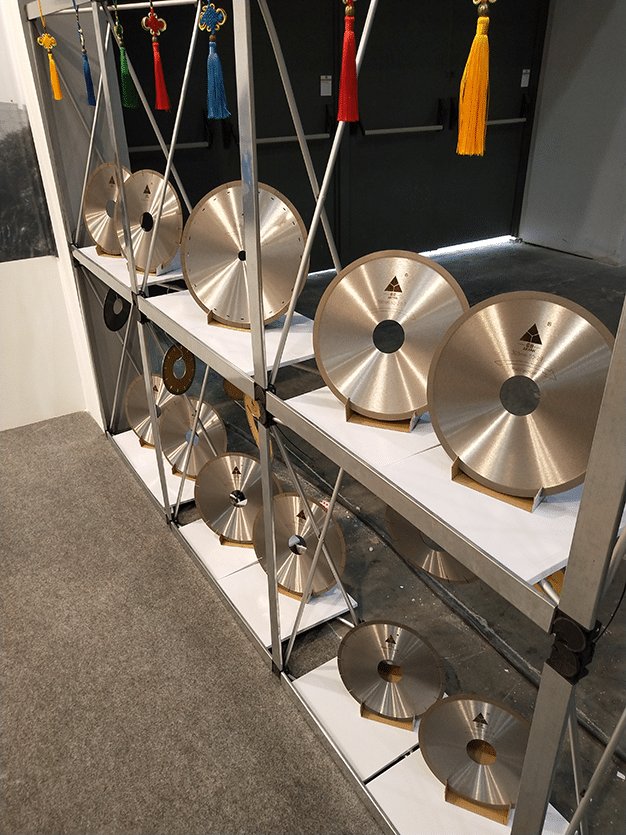
Engineering responses to common procurement questions, troubleshooting operational blade defects, and optimizing operational cost-per-meter.
Edge chipping occurs when the metal bond matrix is too hard for the dense, non-porous structure of sintered stone, causing diamond points to glaze. Excessive blade runout or improper RPMs also generate heavy vibration micro-fractures. Solution: Use a soft bronze-cobalt J-slot blade, ensure water volume is at least 15 L/min, and verify flange stability.
Laser welding directly melts the metal matrix segment toe into the steel core substrate, creating a seamless metallurgical joint capable of withstanding extreme temperatures (over 500°C) without segment detachment. Silver brazing relies on a filler solder layer, making it suitable for wet cutting only, whereas laser welding handles dry cutting safely.
Custom orders require specifying blade outer diameter (e.g., 350mm), arbor bore diameter with pinhole placement, target substrate material (e.g., quartz, granite, porcelain), machine motor power (kW/HP), wet or dry operational mode, and target feed speed requirement (m/min).
When a blade glazes (stops cutting and sparks excessively), make 5 to 10 shallow cuts into an abrasive material such as a soft sandstone block, green concrete brick, or aluminum oxide dressing stone. This erodes the matrix face, re-exposing sharp diamond grit tips.
RPM only measures shaft rotational speed, whereas linear rim speed (m/s = π × Diameter × RPM / 60,000) calculates the actual physical velocity of the diamond grit striking the stone. Operating outside the recommended m/s window causes accelerated wear or severe diamond impact fracture.
European markets require strict safety compliance under EN 13236 (Safety requirements for superabrasive products), which mandates rigorous bend test, shear test, and unbalance test limits. Manufacturing processes should also conform to ISO 9001:2015 quality control systems.
Explore our complete catalog of professional cutting tools. Click any product below to view detailed dimensional and custom manufacturing specifications.
China Superhard Material Association Member | Global Export Manufacturing Division