Featured Industrial Diamond Cutting Solutions Manufactured for Heavy Infrastructure, Ceramics, and Natural Stone
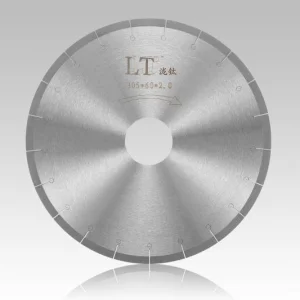
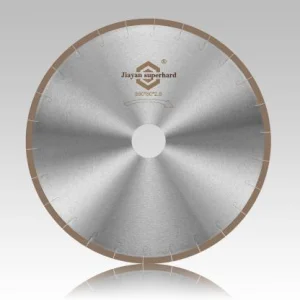
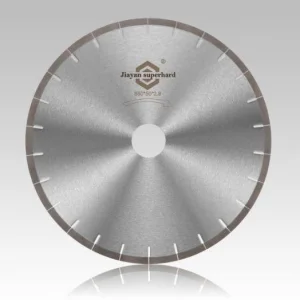
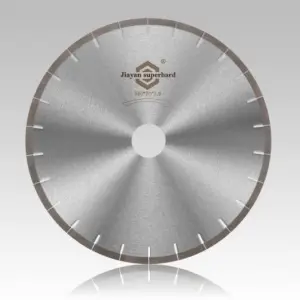
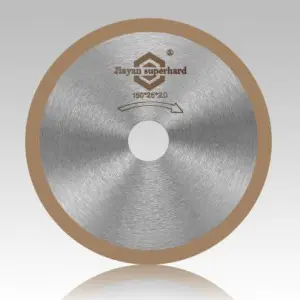
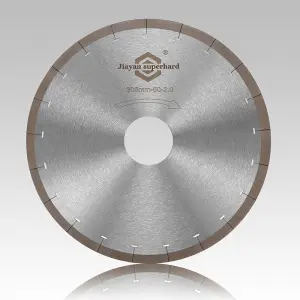
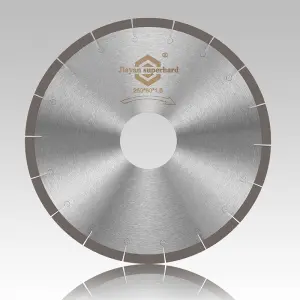
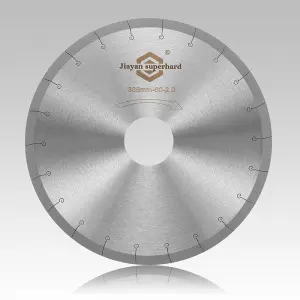
Analyzing atomic bond integrity, heat-affected zone (HAZ) control, and synthetic diamond crystal retention in superhard industrial cutting tools.
In modern industrial stone processing and heavy civil engineering, traditional silver-brazed circular saw blades present operational limits under severe conditions. Thermal stresses exceeding 450°C cause silver solder to soften, resulting in segment detachment—a catastrophic safety and production hazard. Laser welding technology completely redefines joint shear strength by achieving direct metallurgical fusion between the diamond segment transit layer and the high-tensile steel core.
During the automated laser welding process, a high-density CO₂ or fiber laser beam ($>10^6 \text{ W/cm}^2$) melts both the steel core matrix (such as 75Cr1 or 65Mn) and the cobalt-iron-copper bronze alloy transition layer of the diamond segment. This rapid thermal process generates a narrow, deep weld seam characterized by an exceptionally small Heat-Affected Zone (HAZ).
The structural advantage lies in the creation of an intermetallic alloy zone where joint shear strength regularly exceeds 600 MPa, compared to ~250–300 MPa in conventional brazed blades. This permits safe, high-speed dry cutting through heavily reinforced concrete, quartzite, dekton, and refractory materials without water cooling reliance.
Diamond grit (synthetic monocrystalline diamond MBD/SDA grades) cannot be welded directly due to thermal graphitization above 700°C. OEM laser blade factories utilize Titanium or Silicon chemical vapor deposition (CVD) coatings on synthetic diamond crystals. This creates a protective TiC layer that chemically bonds to the powdered metal matrix during hot pressing, preventing premature diamond micro-pullout.
Next-Generation Advances Shaping Custom Diamond Blade Manufacturing and Superhard Tool Engineering
Leading custom factories are implementing real-time infrared laser pyrometry coupled with AI vision models. By analyzing heat signatures dynamically during seam welding, machine algorithms auto-adjust laser power to eliminate micro-porosity and joint distortion in real time.
Advancements in powder metallurgy allow the creation of bimodal metallic binders combining sub-micron Cobalt, Iron, and Tungsten Carbide powders. This optimizes the self-sharpening matrix erosion rate to match ultra-hard engineered slabs such as sintered stone (Dekton).
Next-gen laser blades for delicate architectural porcelain utilize multi-layered core sandwich geometry with sound-damping copper foils or laser-etched resin slots. This cuts noise output by up to 15 dB while suppressing high-frequency chatter marks on fragile slab edges.
Tailored Technical Blade Formulations Designed for Demanding Application Environments Globally
Demolition contractors require blades capable of slicing through 35mm high-tensile steel rebar embedded in high-density aggregate concrete. Custom laser blades for floor saws and wall saws utilize drop-segment undercut protection and robust Co-Fe matrix formulations, ensuring segment durability under high impact and high torque conditions.
Modern sintered slabs exhibit extreme internal stress and high hardness (Mohs scale 7-8). Standard diamond tools lead to edge chipping or slab cracking. Custom J-Slot and continuous-rim laser-welded blades incorporate high diamond concentration (Grade SDA-100+) with soft-bond metallic binders to deliver clean, chip-free mitering cuts.
Large-scale granite processing centers require high operational stability. Custom OEM blade manufacturers provide gang-saw and multi-blade configurations with precision-tensioned cores (diameter 1000mm–3500mm). This reduces kerf loss, minimizes power consumption per square meter cut, and delivers high linear square meter yields.
Cutting abrasive green concrete and asphalt requires specialized protective design. Laser-welded asphalt blades integrate specialized keyhole slots and slanted carbide protection segments that shield the core from slurry erosion (undercutting), extending core reusability across multiple retipping cycles.
Adhering to International Safety Protocols, Regulatory Frameworks, and Regional Logistics Requirements
Every commercial custom diamond laser blade engineered for export must rigorously comply with the European Standard EN13236 (Safety requirements for superhard abrasive products) and the guidelines of the Organization for the Safety of Abrasives (oSa). Laser weld seams undergo destructive centrifugal burst tests and 100% dynamic shear testing to ensure zero failure under peripheral operating speeds up to 80 m/s.
Under strict occupational health mandates (such as OSHA Respirable Crystalline Silica Standard in North America), custom tool companies develop dry-cutting laser blades paired with integrated shroud vacuum extraction channels. This enables compliant dry sawing without generating airborne respirable silica dust.
Leveraging Integrated Superhard Industrial Clusters, Automated Laser Assembly, and Technical OEM Capability
China's superhard material sector produces over 85% of the world's synthetic diamond grit. Manufacturing hubs, such as Wuhu and surrounding regional industrial zones, provide custom factories with immediate access to premium synthetic diamond monocrystals, pre-alloyed metal powders, and high-precision tool steel cores at optimized baseline costs.
Modern Chinese manufacturing facilities utilize automated multi-axis robotic laser welding arms. These systems execute continuous optical tracking of the segment-to-core interface, keeping dimensional tolerances within ±0.01 mm and radial runout under 0.02 mm for perfectly balanced operation.
From custom laser branding and color-coded protective coatings to specialized segment geometries (Keyhole, Wave, J-Slot, Turbo-Segmented), China's advanced OEM exporters provide rapid prototype iteration—reducing sample turnaround times from weeks to 48 hours for global buyers.
Customization Engineering Parameters for Commercial Distributors, Brand Owners, and Industrial End-Users
Selecting the optimal diamond laser blade requires precise alignment between workpiece material properties, machinery power output, and rotational cutting speeds. Custom factories engineer blade specifications based on the matrix below:
| Target Workpiece Material | Recommended Segment Bond | Diamond Concentration | Blade Diameter Range | Cooling Method | Key Core Specification |
|---|---|---|---|---|---|
| Hard Granite & Quartzite | Cobalt-Bronze / Soft Erosion Matrix | 50% - 60% (High Density) | 300mm – 1200mm | Wet Cooling Required | 75Cr1 Silent Core / Laser Slots |
| Cured Concrete with Rebar | Iron-Nickel Alloy / Hard Tough Matrix | 40% - 50% Medium-High | 350mm – 800mm | Dry or Wet Cut | Drop-Segment Undercut Core Protection |
| Sintered Stone / Dekton / Neolith | Ultra-Soft Free-Cutting Copper Matrix | 65% Ultra-High Super-Fine Grit | 250mm – 400mm | Wet Cooling Recommended | High-Precision Ground Core (Runout <0.015mm) |
| Abrasive Asphalt & Green Concrete | Tungsten Carbide Reinforced Matrix | 35% - 45% High Coarse Grit | 300mm – 600mm | Dry or Wet Cut | Keyhole Slot & Slanted Protection Segment |
| Ceramic & Porcelain Tiles | Continuous Rim / J-Slot Sintered Bond | 45% Fine Micro-Grit | 105mm – 350mm | Dry or Wet Cut | Ultra-Thin Core (1.0mm - 1.6mm) |
High-Performance Diamond Circular Blades and Superhard Tool Solutions Ready for Export Engineering Orders
In-Depth Answers on Metallurgical Standards, Blade Selection, Custom Manufacturing, and Troubleshooting