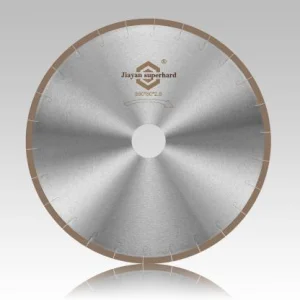
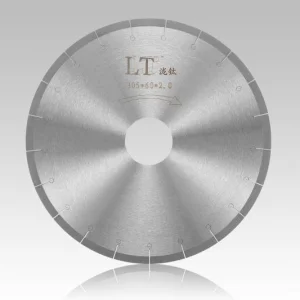
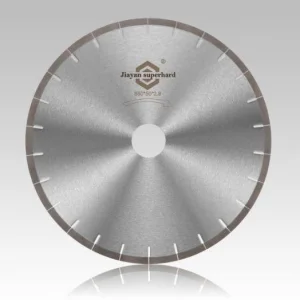
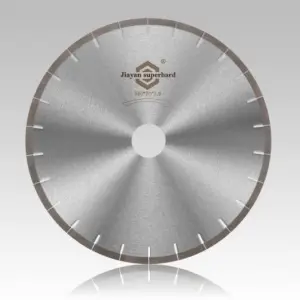
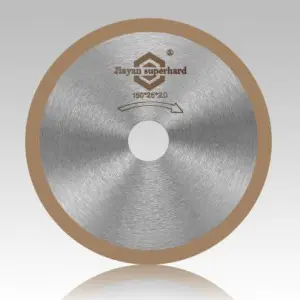
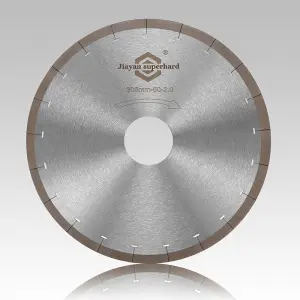
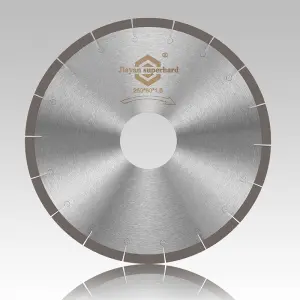
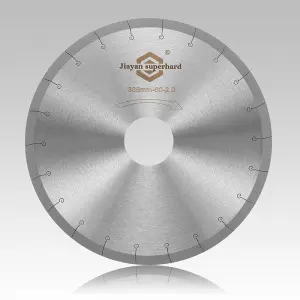
Featured high-performance diamond saw blades engineered for high-rpm industrial cutting, minimal kerf loss, and zero-chipping edge quality.
Strategic overview of structural shifts in global glass processing, architectural glazing, photovoltaics, and display glass manufacturing.
The global demand for high-precision custom glass cutting discs is undergoing a fundamental transformation driven by advancements in architectural ultra-clear float glass, automotive laminated safety glass, photovoltaic solar substrates, and sub-millimeter optoelectronic display panels. As industrial automation accelerates across tier-1 manufacturing facilities, procurement directors and tooling engineers face rigorous performance benchmarks: minimizing micro-chipping (edge flaking), reducing kerf loss to optimize material yields, and extending diamond abrasive tool life under continuous high-duty cycles.
Selecting reliable custom glass cutting disc suppliers & companies is no longer merely a commodity purchasing decision; it is a core operational strategy directly impacting gross margin efficiency. Traditional abrasive wheels frequently fail under the thermal and mechanical stresses imposed by modern high-silica, low-expansion borosilicate and tempered glass compositions. Modern industrial processing demands engineered synthetic diamond grit matrices, advanced metallization bonding, and laser-slotted stress relief cores capable of maintaining dynamic balance at rotational velocities exceeding 10,000 RPM.
Processing double/triple-glazed insulated units, laminated acoustic facades, and structural glass requires ultra-clean cutting edges to prevent thermal stress fractures during tempering cycles.
Thin-film glass used in OLED/LCD displays, touch panels, and semiconductor carrier wafers demands micro-abrasive diamond discs with kerf widths below 0.3mm and chip dimensions under 20 micrometers.
High-speed continuous cutting lines for textured anti-reflective solar glass panels require thermal-resistant matrix bonds to prevent tool loading and edge spalling under heavy coolant flow.
Deep-dive technical evaluation of metal sinter, electroplated nickel matrix, vacuum brazing, and resinoid formulations for glass cutting.
Electroplated diamond discs utilize a precisely controlled single or double-layer nickel matrix that embeds high-grade synthetic diamond (MBD/SDA series) crystals at maximum exposure heights. This architecture delivers exceptional sharpness and minimum initial cutting resistance, making it ideal for thin glass tubes, optical prisms, and delicate quartz components. However, for extreme durability and heavy section cuts, vacuum brazed diamond tools form a chemical carbide bond between the diamond substrate and the steel core, permitting diamond exposure up to 70% of particle height while resisting grit pull-out under intense shear forces.
Multi-layer sintered metal bond blades combine bronze, cobalt, iron, and nickel powders with calibrated diamond grit sizes ranging from FEPA D46 (325/400 mesh) to D181 (80/100 mesh). The self-sharpening mechanism of sintered matrices relies on controlled bond erosion: as outer diamond crystals wear flat (glaze), the surrounding metal alloy degrades at an equivalent rate to expose fresh, sharp micro-cutting edges. For ultra-smooth edge finishing where micro-cracks cannot exceed 10 microns, resin-bonded glass cutting discs incorporate elastic phenolic or polyimide resins that cushion impact forces and suppress high-frequency chatter.
| Bond Technology Type | Diamond Grit Range (FEPA) | Primary Suitable Glass Substrates | Cutting Edge Quality | Relative Tool Life Index |
|---|---|---|---|---|
| Electroplated Single Layer | D46 – D91 (Fine / Medium) | Thin Float Glass, Borosilicate Tubes, Optical Lenses | Ultra-Clean (< 15μm chipping) | Standard (1.0x) |
| Continuous Rim Sintered Metal | D107 – D151 (Medium / Coarse) | Thick Architectural Glass, Laminated Panels, Quartz | High Smoothness (< 30μm chipping) | Exceptional (3.5x) |
| Vacuum Brazed Segmented | D151 – D252 (Coarse) | Wire Glass, Reinforced Fire Glass, Cast Block Glass | Moderate Edge Finish | Extreme Wear (4.0x) |
| Resinoid Matrix Polishing Disc | D15 – D46 (Micro Fine) | Display Edge Profiling, Beveling, Edge Smoothing | Mirror Surface Finish | High Elasticity (2.2x) |
Understanding the physics of brittle material removal: how controlled lateral cracking yields chip-free glass cut surfaces.
Cutting glass differs fundamentally from cutting ductile metals or soft stone. Glass exhibits high hardness (Mohs 5.5–7) coupled with extreme brittleness and low fracture toughness ($K_{IC} \approx 0.7-0.8 \text{ MPa}\cdot\text{m}^{1/2}$). When a diamond abrasive grain contacts the glass surface under rotational velocity, material removal occurs via a combination of plastic deformation, median vent cracking, and lateral crack propagation.
If the normal force exerted by individual diamond particles exceeds the critical threshold, uncontrolled median cracks propagate deep into the glass substrate, resulting in structural weakening and post-cut thermal shattering. Modern J-Slot and continuous rim diamond cutting discs engineered by specialized manufacturers utilize high-density synthetic diamond mesh sizes with controlled concentration indices (typically 75 to 100 concentration, corresponding to 3.3 to 4.4 carats/cm³) to distribute cutting loads evenly across tens of thousands of active micro-points.
Continuous contact generates intense friction, raising local temperatures above 600°C. Engineered coolant slots (J-Slots, Keyhole slots) flush debris dynamically, preventing thermal shock cracking along the cutting path.
Radial and axial runout exceeding 0.02mm induces severe vibration (chatter), causing micro-flaking along the top edge of the glass. Premium blades undergo dynamic balancing according to ISO 1940 G2.5 standards.
Ultra-thin steel cores (down to 0.8mm) stiffened by laser-welded structural tensioning rings drastically lower material loss per cut, delivering huge cost savings in high-volume solar panel cutting lines.
Comprehensive customization specifications tailored for machinery OEMs, automated CNC cutting lines, and specialized processing plants.
Leading global glass manufacturing companies require bespoke tool geometry tailored to specific machine parameters—such as spindle horse-power, maximum peripheral linear speed ($V_c$), coolant pressure, and feed velocity ($V_f$). As an authority in superhard tool manufacturing, custom blade configuration covers every physical dimension:
Bore diameters are precision-machined with H7 tolerances, available in standard metric sizes (20mm, 22.23mm, 25.4mm, 30mm, 50mm, 60mm) as well as custom multi-pinhole configurations (e.g., 2/10/60, 4/12/90) for compatibility with Bottero, Bystronic, Lisec, Hegla, and Intermac automated glass cutting systems.
Steel cores utilize high-grade 75Cr1 or 65Mn spring steel, hardened to 42-46 HRC. Cores are laser-cut and subjected to computer-controlled tensioning processes to ensure stiffness under heavy lateral loads, preventing disc dishing and dynamic deflection.
| Outer Diameter (mm / inch) | Segment Thickness (mm) | Rim Height (mm) | Bore Size Options (mm) | Recommended RPM Range |
|---|---|---|---|---|
| 100mm / 4" | 1.0mm – 1.4mm | 5mm – 10mm | 16 / 20 / 22.23 | 8,000 – 13,000 RPM |
| 150mm / 6" | 1.2mm – 1.6mm | 7mm – 10mm | 20 / 25.4 / 30 | 5,500 – 9,000 RPM |
| 200mm / 8" | 1.4mm – 1.8mm | 8mm – 12mm | 25.4 / 30 / 50 | 4,000 – 6,800 RPM |
| 250mm / 10" | 1.6mm – 2.2mm | 8mm – 12mm | 30 / 50 / 60 | 3,200 – 5,200 RPM |
| 300mm / 12" | 1.8mm – 2.4mm | 10mm – 15mm | 30 / 50 / 60 | 2,600 – 4,400 RPM |
| 350mm / 14" | 2.0mm – 2.8mm | 10mm – 15mm | 50 / 60 / Custom Pinhole | 2,200 – 3,800 RPM |
Rigorous quality management systems, safety standard certifications, and global supply chain reliability protocols.
All diamond cutting discs adhere to European EN13236 safety requirements for superhard abrasive products, guaranteeing burst protection at operating speeds up to 80 m/s.
Every production batch undergoes 100% automated optical inspection (AOI) for concentricity, segment shear testing, and ultrasonic crack detection inside the metal matrix.
Dedicated enterprise fulfillment hubs across North America, Europe, and Southeast Asia ensure rapid buffer stock delivery, reducing operational downtime for industrial plants.
Complete batch traceability from raw synthetic diamond synthesis and alloy powder metallurgy to final packaging, supported by material inspection certificate (EN 10204 3.1).
Direct technical answers to common queries raised by tool engineers, factory operational directors, and purchasing agents.
Edge chipping is minimized by selecting a fine diamond grit size (FEPA D46 to D64), maintaining high linear cutting speeds ($V_c \approx 35-45 \text{ m/s}$), ensuring low radial runout (< 0.015mm), and applying continuous, high-volume water coolant directly at the blade-glass contact point to flush micro-chips immediately.
Continuous rim discs provide the smoothest surface finish with minimal vibration, making them perfect for thin or ultra-fragile glass. J-Slot discs feature precision laser-cut expansion slots along the perimeter that improve heat dissipation and coolant flow, enabling faster feed rates on thicker structural or laminated glass without thermal fracturing.
Yes. Sintered metal bond diamond discs can be dressed using aluminum oxide or soft silicon carbide dressing stones. Cutting into the dressing stone exposes sharp new diamond edges when the metal matrix becomes glazed due to cutting extremely hard glass grades.
Custom orders require specifying the target material (float glass, quartz, borosilicate, ceramic, granite), outer diameter, blade thickness, segment height, arbor bore diameter, pinhole placement, operating machine RPM, and preferred coolant (wet/dry).
Explore our full operational lineup of diamond cutting tooling certified for enterprise industrial deployment.