Engineered for precision tolerance, edge chip elimination, and optimized operational lifespan across natural stone, porcelain slabs, and sintered materials.
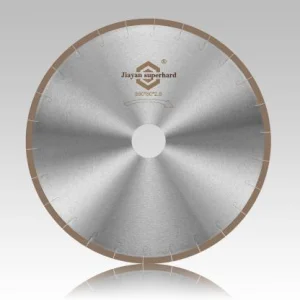
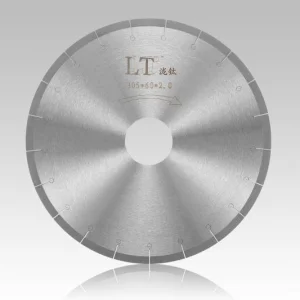
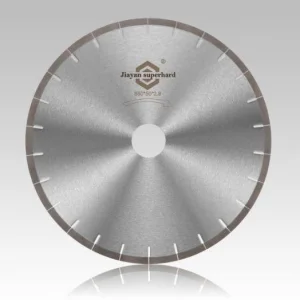
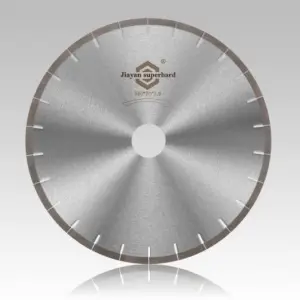
Analyzing global demand shifts, advanced synthetic diamond powder crystallization, and the rise of ultra-dense engineered surfaces.
The global construction and surface fabrication industries are undergoing a massive transformation. Traditional natural stones such as soft marble and standard granite are increasingly yielding market share to engineered porcelain slabs and sintered stone substrates (e.g., Neolith, Dekton, Lapitec). These next-generation materials exhibit extreme Mohs hardness ratings (7 to 8), high density, and near-zero porosity. Processing them without edge micro-chipping or blade glazing demands advanced cutting tools formulated with high-purity single-crystal synthetic diamonds, precise metal powder matrices, and engineered cooling geometries.
Global procurement teams can no longer rely on off-the-shelf, standardized cutting discs. Modern multi-axis CNC bridge saws, high-speed automated cutting lines, and manual fab-shop angle grinders require custom diamond saw blades calibrated to specific linear cutting speeds (m/s), motor horsepower, coolant delivery pressure, and material composition. As a prominent manufacturer situated in Wuhu, China, and an active member of the China Superhard Material Association, JIAYAN Superhard Tools bridges the gap between raw powder metallurgy science and field application reliability.
Integrating automated high-temperature sintering, automated laser welding robotics, and 100% dynamic balancing calibration to ensure zero core fatigue and maximum operator safety globally.
How metallurgical innovations, structural segment geometry, and noise mitigation are defining the next decade of superhard cutting disc production.
Traditional segment manufacturing relies on random diamond grit distribution, leading to premature matrix wear or uneven diamond loading. Modern high-end suppliers utilize automated 3D array placement (patterned diamond distribution). This ensures that every individual diamond crystal experiences uniform stress, increasing cutting efficiency by 30% and extending overall blade longevity under heavy continuous loads.
Safety regulations across Europe and North America have intensified. While high-frequency silver brazing remains suitable for wet cutting, industrial dry-cutting and heavy-duty structural operations require laser-welded diamond segments. Laser beam fusion creates a seamless atomic bond between the steel core and the metallic segment base, virtually eliminating segment detachment risks under thermal stress.
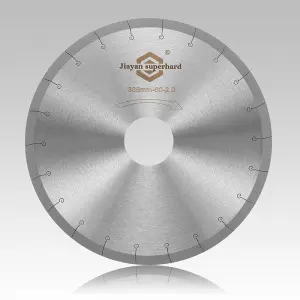
Fab-shop health standards require stringent decibel control. Leading exporters now manufacture Silent Sandwich Core saw blades—featuring copper or viscoelastic dampening layers laminated between dual steel plates, combined with laser-cut J-slots and keyhole stress expansion grooves. This reduces operating noise by 10 to 15 dB while dissipating lateral thermal stress.
Understanding what technical directors, stone fabricators, and commercial distributors prioritize during supplier evaluation.
When evaluating a Chinese manufacturer like JIAYAN Superhard, international buyers focus on verifiable engineering credentials:
Inside JIAYAN’s automated production facility in Wuhu: Advanced sintering, automated laser welding, and strict quality control protocols.
JIAYAN utilizes state-of-the-art volumetric automatic cold presses and multi-stage computer-controlled hot sintering furnaces. This exact temperature and pressure control guarantees optimal metal matrix density and prevents diamond graphitization during manufacturing.
Every batch of raw diamond grit undergoes magnetic susceptibility testing, thermal stability analysis, and grit size distribution profiling. Post-production inspection includes 100% laser runout scanning (< 0.02mm axial/radial tolerance) and dynamic high-RPM balance testing.
Located in Anhui Province, JIAYAN leverages China’s unparalleled superhard material raw material supply chain. Access to premium synthetic diamond powders and high-purity metal powders enables rapid mass production, competitive pricing, and immediate batch scalability.
Tailored tooling configurations designed to solve specific substrate cutting challenges in processing plants around the world.
Challenge: High internal stress within sintered slabs (e.g., 12mm-20mm thick Neolith/Dekton) often results in slab cracking or edge chipping when cut with standard granite blades.
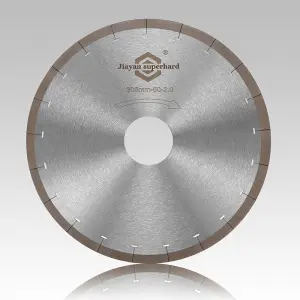
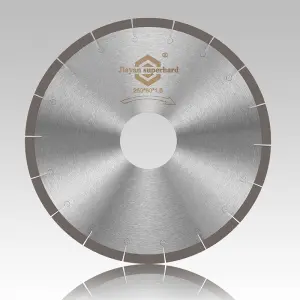
JIAYAN Solution: Our 14-Inch Specialized Sintered Stone Blade (260mm-350mm) features a continuous J-slot segment design with a soft cobalt-nickel bond. This allows fast diamond exposure and smooth water flushing, maintaining a clean finish at feed speeds up to 2.5 m/min.
Challenge: Automated continuous-duty tile processing requires extreme linear durability and ultra-thin kerf to minimize raw ceramic dust and material loss.
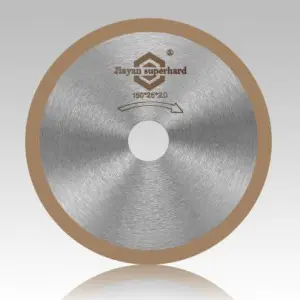
JIAYAN Solution: Our 1.0mm/1.2mm Ultra-Thin Diamond Segment Discs and Hot-Pressed Continuous Rim Blades utilize micro-grit diamond matrices (#100/#120 mesh) that deliver laser-smooth cuts without fracturing delicate tile glazes.
Challenge: High abrasive wear from quartz-heavy granite slabs (such as Black Galaxy or Indian Red) severely reduces segment life on high-horsepower bridge saws.
JIAYAN Solution: 350mm OEM Circular Saw Blades engineered with sandwich-style multi-layer segments and titanium-coated diamond crystals, delivering maximum wear resistance and consistent cutting speeds.
Challenge: Jobsite contractors using hand-held angle grinders or small masonry saws need versatile cutting tools capable of both wet and dry cuts on mixed ceramic, marble, and concrete.
JIAYAN Solution: Small Size Series Diamond Cutting Discs featuring keyhole cooling slots and reinforced flange cores to resist bending under manual side pressure.
Recommended operating parameters to maximize cutting productivity and ensure operational safety.
| Target Substrate | Recommended Blade Dia. | Segment Geometry | Diamond Grit Size | Matrix Bond Base | Optimal RPM (350mm) | Feed Speed (m/min) |
|---|---|---|---|---|---|---|
| Sintered Stone / Dekton | 260mm - 350mm | Continuous Rim J-Slot | #80 / #100 Fine Grit | Soft Cobalt-Nickel | 1,800 - 2,200 RPM | 1.5 - 2.5 m/min |
| Hard Granite (Class IV/V) | 300mm - 500mm | Keyhole / M-Shape Segment | #40 / #50 Coarse Grit | Hard Iron-Bronze | 1,400 - 1,800 RPM | 2.0 - 4.0 m/min |
| Glazed Ceramic / Porcelain | 105mm - 350mm | Ultra-Thin Continuous Rim | #100 / #120 Micro Grit | Medium Bronze-Cobalt | 2,000 - 2,800 RPM | 2.5 - 5.0 m/min |
| Soft Marble / Calcite | 250mm - 400mm | Narrow Slot Segment | #60 / #70 Medium Grit | Electroplated / Soft Bond | 1,600 - 2,000 RPM | 3.0 - 6.0 m/min |
Root Cause: Matrix bond too hard; diamond grit dulling without exposing new sharp points; arbor vibration.
Solution: Switch to a softer segment matrix; check spindle runout (<0.02mm); dress blade with abrasive refractory brick.
Root Cause: Matrix bond too soft for abrasive quartz content; insufficient coolant flow.
Solution: Increase matrix binder tungsten/iron content; verify water output reaches cutting zone directly.
Root Cause: Overheating causing steel core tension loss; excessive feed force.
Solution: Reduce forward feed speed; check arbor flange diameter balance; utilize silent sandwich core bodies.
Select your operational parameters below or request customized OEM segment formulations directly from our engineering team.
Comprehensive engineering insights into diamond tool sourcing, customization, operational safety, and quality verification.
The golden rule of diamond powder metallurgy is an inverse relation: Hard materials require soft bond matrices, while soft/abrasive materials require hard bond matrices.
When cutting extremely hard or dense substrates like sintered stone, Dekton, or quartz-dense granite, the diamond crystals dull quickly. A softer matrix (cobalt/nickel rich) wears away at a calculated rate, continuously exposing fresh, sharp diamond points. Conversely, when cutting abrasive sandstone or soft marble, a hard bond matrix (iron/bronze/tungsten carbide) is essential to prevent the matrix from eroding prematurely before the diamonds have fulfilled their cutting cycle.
J-Slot expansion grooves (laser-cut micro slots along the rim perimeter) serve three vital mechanical functions:
Silver brazing relies on a solder alloy (melting around 650°C–750°C) to join the segment to the steel core. Under severe dry cutting conditions or high friction, temperatures can exceed solder limits, risking fatal segment detachment. Laser welding uses a high-energy laser beam to melt the metallic segment base and steel substrate together into a unified solid weld zone. This metallurgical weld withstands temperatures over 1000°C, ensuring compliance with European EN13236 safety standards.
Consistency is guaranteed through automated Industry 4.0 control processes:
Yes. As a direct manufacturer, we offer full OEM/ODM customization. We precision-bore arbor holes to match global machinery specs (e.g., 50mm, 60mm, 25.4mm, 22.23mm, with custom drive pin holes). We also produce sound-dampened sandwich silent cores (steel-copper lamination) for low-decibel indoor fabrication workshops.
Miter cuts subject the blade to unequal lateral forces. To eliminate chipping:
Standard OEM custom orders are produced within 15 to 25 days. Every blade is coated with anti-rust oil, fitted with plastic edge guards over the diamond segments, vacuum-sealed in moisture-barrier bags, and packed into reinforced corrugated cartons or export-grade plywood crates to guarantee damage-free sea or air transit.
Global buyers can contact our international sales engineering department directly via Email at [email protected] or Call/WhatsApp at +86 15815923777. We welcome factory visits to our manufacturing site in Wuhu, Anhui Province, China, or video-call plant tours for instant quality audits.
Member of China Superhard Material Association | Certified Diamond Tooling Factory