Engineered for ultra-compact sintered stone, dense natural granite, porcelain slabs, and heavy architectural masonry.
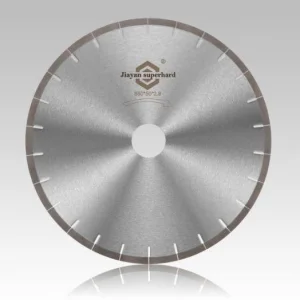
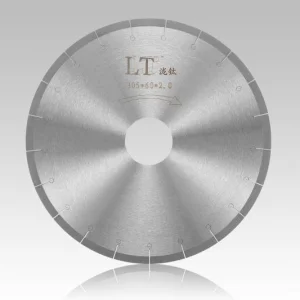
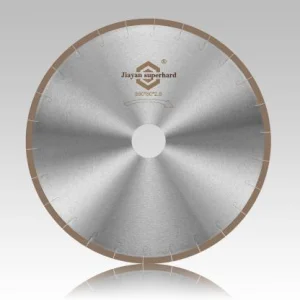
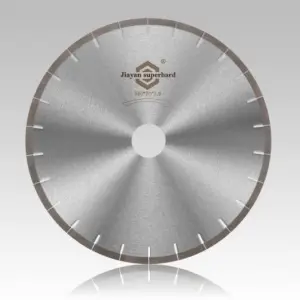
A technical synthesis of powder metallurgy, diamond matrix retention chemistry, and industrial superhard tool manufacturing.
In modern industrial stone fabrication, civil engineering, and porcelain panel processing, cutting tools are subjected to unprecedented mechanical stresses. The global market shift toward ultra-compact materials—such as sintered stone slabs (Dekton, Neolith, Lapitec), high-quartz granite, and ultra-dense technical ceramics—has rendered conventional cold-pressed and ambient-sintered diamond tools obsolete. To achieve chip-free cut edges, zero segment detachment risk, and cost-efficient linear meter yield, leading procurement organizations depend exclusively on advanced Custom Hot Pressed Sintered Factory & Companies.
Hot Pressed Sintering (HPS) represents the pinnacle of powder metallurgy in superhard tool manufacturing. Unlike standard cold compression followed by pressureless furnace sintering, HPS applies simultaneous uniaxial hydraulic pressure (ranging from 25 to 50 MPa) and intense inductive thermal energy (750°C to 1050°C) inside vacuum or inert-gas atmospheres. This thermodynamic environment forces metal matrix powders—comprising cobalt, bronze, nickel, iron, and tungsten carbide—to undergo solid-state diffusion and liquid-phase sintering at physical densities exceeding 99.8% of theoretical maximums.
As an active member of the China Superhard Material Association, JIAYAN Superhard Tools operates at the forefront of diamond synthesis and powder metallurgy innovation. Combining over a decade of OEM/ODM export history across 50+ countries with state-of-the-art multi-cavity automatic hot pressing units in Wuhu, China, JIAYAN engineered matrices solve the core industry challenge: preventing micro-chipping in ultra-hard sintered stone while extending blade operational lifespan by up to 40%.
Quantitative analysis evaluating structural integrity, diamond exposure rates, and performance across tool bonding processes.
| Manufacturing Parameter | Hot Pressed Sintering (HPS) | Cold Pressed Sintering | Laser Welded Segments | Vacuum Brazed Tools |
|---|---|---|---|---|
| Theoretical Matrix Density | 99.2% – 99.9% (Zero Porosity) | 88.0% – 93.5% (High Micro-Porosity) | 98.5% – 99.5% (In Segment Body) | N/A (Single Layer Monolayer) |
| Diamond Retention Mechanism | Mechanical Encapsulation + Active Chemical Bonding | Pure Mechanical Friction Interlocking | Mechanical Matrix Locking | Active Metallurgical Braze Alloy Chemical Bond |
| Thermal Degradation Protection | Maximum (Controlled Inert Gas / Vacuum Sintering) | Moderate (Air exposure during transfer) | High (Short heat-affected zone) | High (High temperature braze cycle) |
| Cut Edge Quality (Sintered Stone) | Flawless / Chip-Free Edge finish | Prone to Micro-Chipping & Flaking | Aggressive Cut / Moderate Edge Roughness | Fast initial cut / Rapid diamond loss |
| Segment Retention Reliability | Extremely High (Monolithic Co-Sintering) | Moderate (Risk of segment fracture) | Maximum Tensile / Shear Resistance | High single-layer shear strength |
| Cost-to-Lifespan Ratio | Optimal (Lowest Cost Per Linear Meter Cut) | Low Initial Cost / Short Operational Life | Higher Initial Cost / Heavy-Duty Use | High Cost / Specialty Applications |
How concentrated superhard material supply chains and automated factory hubs create unmatched commercial advantages for global buyers.
China synthesizes over 85% of the world's industrial monocrystalline synthetic diamond grit (MBD & SBD grades). Direct domestic sourcing from Henan and Anhui synth hubs guarantees access to ultra-tough, thermally stable diamond crystals at lower raw-material baseline costs.
Leading factories utilize PLC-controlled hydraulic hot presses capable of simultaneous multi-segment sintering. Digital feedback loops maintain temperature accuracy to within ±2°C and compaction pressure within ±0.2 MPa, ensuring perfect batch-to-batch uniformity.
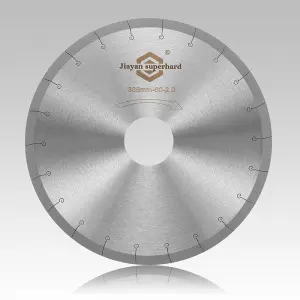
Chinese direct manufacturers offer modular custom manufacturing: custom matrix bond formulations, specialized rim slots (J-Slot, Turbo, Fish-Hook, Keyhole), custom color powder coating, laser engraving, and custom box packaging with fast turnaround times.
How customized metal powders and tailored diamond grit sizing resolve specific cutting challenges in hard substrates.
A fundamental principle of superhard tool engineering is matching the erosion rate of the metal bond matrix to the fracture rate of the synthetic diamond grit. If the matrix is too hard, the diamonds become dull and glazed without shedding, leading to severe blade friction, overheating, and slab cracking. Conversely, if the matrix is too soft, the diamonds are released prematurely, causing rapid blade wear and low linear-meter return on investment.
Ideal For: Class 5 Hard Granite, Quartzite, and Ultra-Compact Sintered Stone (Mohs Hardness 7–8).
Mechanism: High cobalt ductility allows controlled matrix erosion, continuously exposing fresh, razor-sharp diamond cutting edges under high-shear wet cutting conditions.
Ideal For: Ceramic Tiles, Vitrified Tiles, Marble, and Glazed Porcelain.
Mechanism: Lower sintering temperatures protect fine-mesh diamonds (100/120 to 140/170 mesh), enabling smooth, chip-free cuts on delicate vitreous surface coatings.
Ideal For: Highly Abrasive Sandstone, Green Concrete, Asphalt, and Refractory Bricks.
Mechanism: Incorporating ultra-hard WC micro-particles provides extreme abrasive wear resistance, preserving segment geometry against aggressive slurry erosion.
Precision tooling deployed across fabrication shops, civil infrastructure projects, and commercial masonry operations worldwide.
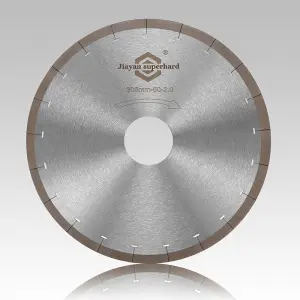
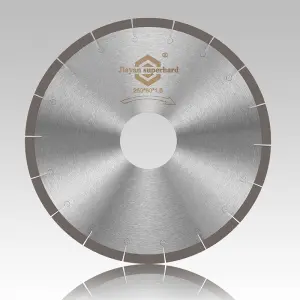
Modern kitchen countertop manufacturers using CNC bridge saws require blades that operate at high feed rates without blowing out sensitive slab edges. Hot-pressed J-Slot and narrow Turbo blades dissipate heat efficiently, preserving edge crispness on 6mm to 20mm sintered panels.
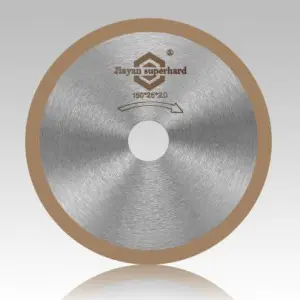
Flooring installation crews relying on handheld angle grinders and portable wet table saws utilize ultra-thin (1.0mm–1.2mm) hot-pressed continuous rim discs. The continuous hot-pressed rim prevents chipping while reducing motor strain and dust emissions.
For expansion joint cutting in reinforced concrete highways, bridges, and airport runways, heavy-duty hot-pressed segmented blades deliver structural integrity that prevents segment shear failure under severe dynamic loading.
Key technical audit criteria and quality verification steps for international tool distributors, OEMs, and industrial buyers.
When sourcing custom hot-pressed sintered products from global suppliers, enterprise procurement teams must implement rigorous quality assurance protocols to guarantee batch consistency and operational safety. Key technical audit metrics include:
Every steel core (typically 65Mn or high-strength alloy steel) must undergo precision tensioning and laser runout inspection. Total radial and axial runout must not exceed 0.05mm to prevent vibration, wobbling, and premature operator fatigue.
Using Archimedes water immersion testing or Scanning Electron Microscopy (SEM), verification must confirm matrix density above 99.5%. Zero internal voids ensure equal distribution of mechanical stresses across the segment body.
Destructive mechanical shear testing ensures that segment-to-core bonding strengths exceed safety requirements (such as EN 13236 standards), completely eliminating segment detachment risks during high-RPM operation.
Emerging metallurgical innovations reshaping the future of superhard diamond cutting tools.
The global superhard tools industry is undergoing rapid technological evolution driven by automation, material science, and environmental regulations. Over the next decade, three key trends will dominate the hot-pressed sintering landscape:
Due to health risks, supply chain volatility, and REACH compliance, leading factories are replacing cobalt binders with pre-alloyed Fe-Cu-Ni and nanostructured iron-based powders that match cobalt performance without environmental hazards.
Surface metallization of diamond grit using Ti or Cr chemical vapor deposition creates a protective carbide barrier. This prevents thermal graphitization during hot pressing and doubles chemical adhesion between matrix metal and diamond grit.
Next-generation factories are integrating real-time infrared thermography and AI pressure sensors directly into sintering presses. Closed-loop AI monitoring automatically adjusts heating profiles based on powder lot variation, achieving near-zero defect manufacturing.
Explore our full range of high-performance diamond saw blades and cutting discs for global procurement.
In-depth technical answers addressing engineering parameters, procurement considerations, and operational troubleshooting.
Cold-pressed sintering compresses powder into a shape at ambient temperatures before heating it separately in a furnace, often leaving micro-porosity (7–12%). Hot-pressed sintering applies high hydraulic pressure and thermal energy simultaneously, achieving near-zero porosity (>99.5% density), which dramatically enhances diamond retention and cut quality.
Sintered stone panels possess extreme density and high internal tension. Standard blades cause edge chipping or stress cracking. Hot-pressed continuous or J-Slot blades maintain extreme rim rigidity and consistent diamond exposure, ensuring smooth, chip-free cut edges.
Matrix hardness must inversely match material hardness. Hard materials (like quartzite or granite) require softer metal bonds (rich in cobalt/copper) so the matrix wears steadily to expose fresh diamond points. Soft or abrasive materials require hard metal bonds (rich in tungsten carbide) to prevent rapid matrix erosion.
For standard granite and sintered stone cutting using a 350mm (14") blade, target peripheral speed ranges between 25 m/s and 35 m/s. This corresponds to an operational spindle speed of approximately 1,750 RPM to 2,150 RPM with adequate water coolant flow.
Leading Chinese superhard material manufacturers utilize automated multi-station sintering presses, digital thermal sensors, pre-alloyed powder masterbatches, and automated laser radial check stations to ensure identical density, hardness, and dimensions across production batches.
Full OEM customization includes segment matrix formulation adjustment, specialized core laser slot designs, custom paint coatings, high-resolution laser branding on steel cores, barcode labeling, and customized packaging boxes.
Glazing occurs when diamonds dull without shedding due to an overly hard matrix. Operators can easily dress the blade by making 3–5 passes through an abrasive dressing brick or soft sandstone, exposing a new layer of sharp diamond grit.
Premium hot-pressed diamond blades comply with European Safety Standard EN 13236 and ISO 9001 quality system certifications, ensuring rotational structural safety, strict dynamic balance tolerances, and impact resistance.