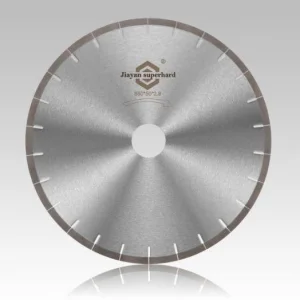
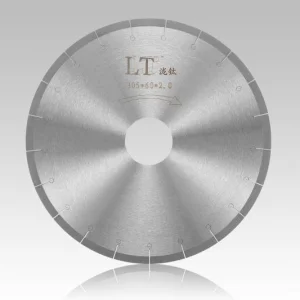
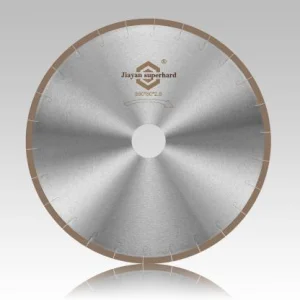
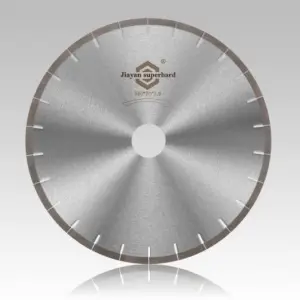
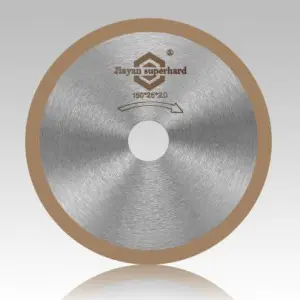
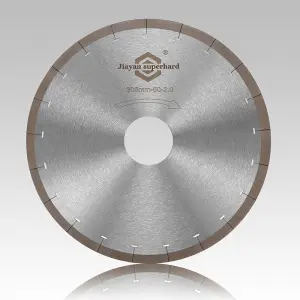
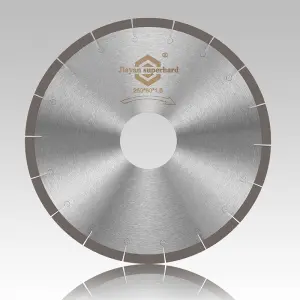
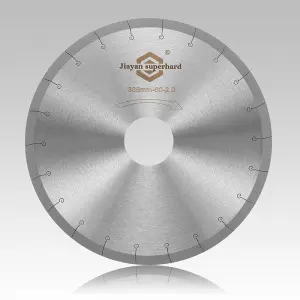
Explore our flagship OEM/ODM superhard diamond cutting tools engineered for high-precision bridge saws, CNC multi-axis cutters, and heavy-duty quarry machinery.
Understanding the structural shifts in global stone processing, material hardness metrics, and the engineering imperatives driving superhard diamond tooling innovations.
The global natural stone and engineered slab manufacturing industry is undergoing a monumental transformation. Architectural demands for larger ultra-compact surfaces—such as high-density sintered stone (Mohs hardness 7-8), ultra-hard quartzite, and reinforced quartz—have exposed the limitations of conventional cutting tools.
Fabrication plants using automated high-speed CNC bridge saws require diamond blades capable of delivering micro-chipping-free edges at elevated linear feed speeds (exceeding 8–15 meters per minute). Achieving this operational efficiency without inducing thermal fatigue or blade deflection requires radical advancements in powder metallurgy and diamond grit matrix design.
Choosing a diamond saw blade manufacturer is no longer just about selecting a blade size; it involves optimizing tribological parameters across hard materials. Key performance indicators (KPIs) include kerf loss minimization, segment retention under intense hydraulic pressure, and noise reduction.
JIAYAN Superhard Tools integrates advanced cobalt-bronze-tungsten matrix formulas with synthetic monocrystalline diamonds, establishing a new benchmark in edge quality and tool longevity across European, Middle Eastern, and American fabrication facilities.
Technical analysis of segment formulation, synthetic diamond grit selection, and steel core tensioning dynamics for high-rpm operations.
The cutting efficiency of a stone cutting blade depends heavily on diamond quality, grit sizing, and concentration:
The metal bond must wear down at a rate synchronized with diamond erosion:
Blade geometries are engineered to balance cooling performance, slurry removal, and acoustic dampening:
Engineering Insight on Sintered Stone Cutting: Ultra-dense slabs like Neolith, Dekton, and Lapitec require precise tensioning and low radial runout (≤0.02mm). Standard granite blades cause edge chipping or blade binding due to residual tension within the sintered slab matrix. Our custom J-Slot and ultra-thin 1.0mm–1.2mm diamond discs use specialized continuous rims and low-friction matrix bonds to ensure smooth, stress-relieved cutting.
| Target Substrate | Hardness (Mohs) | Recommended Bond Matrix | Grit Mesh Size | Optimal Slot Topology | Peripheral Speed (m/s) |
|---|---|---|---|---|---|
| Class 5 Granite / Quartzite | Mohs 6.5 – 7.5 | Cobalt-Tungsten Matrix (Soft/Medium) | 35/45 Mesh | Keyhole / Drop Segment | 25 - 30 m/s |
| Sintered Stone / Dekton | Mohs 7.0 – 8.0 | Soft Sintered Metal (Self-Sharpening) | 60/80 Mesh | J-Slot / Ultra-Thin Rim | 18 - 25 m/s |
| Calacatta / Carrara Marble | Mohs 3.0 – 4.0 | Hard Bronze Matrix (Abrasion Resistant) | 50/60 Mesh | Continuous Rim / Narrow Slot | 35 - 45 m/s |
| Porcelain & Ceramic Tiles | Mohs 6.0 – 7.0 | Cobalt-Bronze Micro-Sintered | 70/100 Mesh | 1.0mm Continuous J-Rim | 22 - 32 m/s |
| Abrasive Sandstone / Concrete | Mohs 4.0 – 5.5 | Ultra-Hard Iron-Tungsten Matrix | 30/40 Mesh | Deep Drop-Segment (Undercut Protection) | 30 - 40 m/s |
Backed by CSMA membership and certified ISO/EN compliance, JIAYAN Superhard Tools provides full-spectrum custom manufacturing for global importers and tool brands.
Our production facility in Wuhu, China, utilizes state-of-the-art automated manufacturing processes to ensure batch-to-batch consistency:
We provide full technical alignment tailored to your machinery and regional market demands:
Optimized cutting performance across diverse real-world industrial processing environments.
Large-diameter (1200mm – 3500mm) multi-blade cutting operations in granite and marble quarries require exceptional segment rigidity and heat dissipation to prevent core warping during deep passes.
High-precision 5-axis CNC bridge saws require blades that can handle 45-degree miter cuts without flexing. Our 350mm–450mm reinforced silent blades deliver clean mitered edges on porcelain and quartzite tops.
Cutting large-format ceramic and natural stone cladding panels requires chip-free dry and wet cutting discs. Our J-Slot and continuous rim series minimize micro-cracking during on-site fabrication.
Heavy-duty diamond blades for asphalt, reinforced concrete road expansion joints, and masonry walls feature laser-welded drop segments to protect the core from premature abrasive wear.
Ensuring seamless international procurement, stringent safety standard alignment, and responsive technical services across key regional hubs.
All JIAYAN superhard diamond blades comply with EN 13236 European safety requirements. Our laser-welded segments undergo torque and bend testing to eliminate the risk of segment detachment during high-speed operation.
With structured warehousing and export workflows, we provide optimized shipping routes, customs declaration clearance documentation, flexible container consolidation, and real-time shipment tracking for overseas buyers.
Our engineering team provides comprehensive technical support, guiding client machinery setup on linear feed speeds (RPM/SFPM), optimal water coolant flow rates, and dressing brick schedules for specific stone hardness levels.
Pioneering next-generation superhard tooling technologies through AI matrix design, micro-engineered segment topographies, and eco-friendly manufacturing.
Integrating machine learning algorithms to simulate atomic-level metal matrix erosion rates. By analyzing stone density, quartz concentration, and operating speeds, AI optimizes bond compositions for maximum diamond utilization.
Applying multi-layer nanostructured chemical vapor deposition (CVD) coatings to diamond particles. This enhances thermal barrier protection up to 1300°C, extending tool life during dry or low-coolant cutting operations.
Developing eco-friendly cobalt-reduced bond matrices and zero-emission vacuum sintering processes, alongside noise-dampened sandwich steel cores to create quieter, safer quarry and fabrication working environments.
Comprehensive engineering and procurement solutions for industrial buyers, factory managers, and equipment operators.
The inverse rule of thumb applies: Use a soft metal bond matrix (e.g., cobalt-bronze) for hard materials like granite and sintered stone, as it wears away quickly to expose fresh, sharp diamond crystals. Conversely, use a hard metal bond matrix (e.g., iron-tungsten) for abrasive, softer stones like sandstone or green concrete to prevent premature segment erosion.
Laser welding directly fuses the diamond segment's steel base to the steel core, providing structural integrity capable of enduring intense heat without melting. This makes it ideal for dry cutting or demanding heavy industrial wet cutting. High-frequency silver brazing uses a silver solder layer to bond the segment; it requires continuous water cooling to prevent solder softening, but allows for economical re-segmenting of large steel cores.
Segment loss or core cracking typically stems from four main causes: inadequate coolant flow (thermal stress), incorrect RPM/linear feed speed matching, mismatched matrix bond hardness, or arbor misalignment causing radial runout. Ensure proper water volume (minimum 15-25 L/min for 350mm blades), inspect arbor flanges for wear, and verify operating parameters against your blade's technical specification sheet.
The J-Slot geometry provides thermal expansion relief and efficient slurry discharge along ultra-thin cutting discs (1.0mm-1.2mm). When cutting dense porcelain or sintered slabs, heat buildup causes standard steel cores to expand unevenly, leading to rim cracking and slab edge chipping. The J-Slot absorbs thermal expansion and prevents blade binding.
When cutting dense materials, the metal bond can glaze over the diamond points, drastically reducing cutting speed. Operators can easily "dress" or open the blade by making 3 to 5 passes through a highly abrasive material, such as an alum-oxide dressing block, firebrick, or soft sandstone. This wears away the excess metal bond matrix and re-exposes fresh diamond cutting edges.
We provide end-to-end custom tooling services, including custom diamond segment formulations, blade diameters from 105mm to 3500mm, arbor hole dimensions, drive pinhole patterns, silent core sandwich structures, custom laser-etched branding, customized color coatings, and FEPA/EN compliant packaging for private label distributions.
For standard granite cutting, the optimal peripheral speed ranges from 25 to 30 meters per second (m/s). For harder, quartzite-rich Class 5 granites, reducing peripheral speed to 20-25 m/s prevents diamond thermal degradation. For softer marble, peripheral speeds can safely increase to 35-45 m/s for faster production rates.
Every steel core undergoes dual-plane computerized dynamic balancing and digital runout tensioning. Radial and axial runout tolerances are strictly maintained within ≤0.02mm. This eliminates spindle vibration on CNC machines, extends arbor bearing lifespans, and guarantees clean, straight cuts across long slab dimensions.
Select your operational parameters and request factory-direct quotations for custom OEM manufacturing.
Looking for reliable OEM/ODM diamond blade manufacturing, competitive direct factory pricing, and tailored metallurgical formulations for your regional market?