Engineered for extreme hardness, high thermal stability, and maximum material removal efficiency across demanding metallurgical and stone applications.
In modern industrial manufacturing, the demand for precision tooling capable of enduring extreme shear stresses, elevated temperatures, and aggressive abrasive wear has positioned Carbide Inserts for Hard Alloy at the center of mechanical engineering advancements. As global production shifts toward tighter tolerances and harder workpieces (exceeding 55–65 HRC), understanding the grain structures, binder systems, PVD/CVD nanolayer coatings, and chipbreaker dynamics of indexable carbide inserts is paramount for optimized Total Cost of Ownership (TCO).
JIAYAN Superhard Tools, located in Wuhu, China, stands as a premier manufacturing power and an active authority within the China Superhard Material Association. By engineering indexable inserts and composite diamond/carbide cutting matrices utilizing sub-micron tungsten carbide (WC) grain sizes bound with optimized Cobalt (Co) phases, our facility bridges the gap between high fracture toughness and ultra-high hardness.
Grain sizes refined to 0.4µm–0.8µm provide superior edge clarity, resistance to micro-chipping, and exceptional compressive strength under severe interrupted cutting loads.
Advanced AlTiN, TiSiN, and Diamond-Like Carbon (DLC) physical/chemical vapor deposition layers offer thermal barriers exceeding 1,100°C oxidation thresholds.
Hot Isostatic Pressing during the sintering phase eliminates internal micro-porosity, yielding 99.99% theoretical density and uniform mechanical behavior.
China commands over 80% of global upstream tungsten ore reserves and processing infrastructure. Sourcing directly from premier Chinese suppliers such as JIAYAN Superhard Tools offers international industrial buyers unmatched structural advantages:
Consistently controlled spray drying towers ensure spherical granule morphology, optimal press-filling behavior, and precise green-compact density distribution.
Honing, micro-blasting, and laser-assisted edge rounding (K-factor control) prevent early flank wear and edge chipping under heavy chipping loads.
The manufacturing landscape is undergoing a digital and metallurgical transition driven by Industry 4.0, green manufacturing initiatives, and the rise of difficult-to-cut materials like sintered stone, carbon fiber reinforced polymers (CFRP), and titanium aluminides. Five major trends are shaping the future of hard alloy tooling and carbide insert production:
Transitioning from binary PVD coatings to multi-component gradient coatings (e.g., TiAlSiN/AlCrN nanolayers) that adapt dynamically to cutting temperatures, reducing thermal conductivity to the tool body.
With environmental regulations curbing flood coolant usage, inserts are now engineered with self-lubricating DLC and MoS2 coatings optimized for Minimum Quantity Lubrication (MQL) and dry cutting.
Custom carbide tool holders and specialized inserts feature internal 3D-printed fluid channels that direct micro-jets of coolant precisely at the chip-tool interface for maximum thermal extraction.
Global procurement teams prioritize vendors offering eco-friendly tungsten recycling schemes, reclaiming spent carbide inserts to reduce carbon footprints and raw material costs.
Select the appropriate carbide insert grade based on ISO material codes, substrate composition, and cutting parameters.
| ISO Code | Material Category | WC Grain Size (µm) | Co Binder (%) | Recommended Coating | Typical Applications |
|---|---|---|---|---|---|
| ISO P (P10-P40) | Steels, Alloy Steels, Cast Steels | 1.0 - 2.5 | 6% - 9.5% | CVD TiCN + Al2O3 + TiN | Heavy roughing, general turning of medium carbon steels. |
| ISO M (M10-M30) | Stainless Steel, Austenitic Alloys | 0.6 - 1.2 | 8% - 11% | PVD AlTiN / TiSiN | Prevent work hardening in duplex and austenitic stainless steels. |
| ISO K (K05-K30) | Cast Iron, Hardened Materials | 0.4 - 0.8 | 4.5% - 7% | Uncoated / PVD TiAlN | Abrasive grey cast iron, ductile iron, and stone cutting segments. |
| ISO S (S05-S25) | Heat-Resistant Superalloys (Inconel, Ti) | 0.4 - 0.6 | 9% - 12% | PVD Micro-Grain AlCrN | Aerospace turbine components, high-temperature alloy turning. |
| ISO H (H05-H20) | Hardened Steels (> 55 HRC) | 0.2 - 0.5 | 6% - 8% | PVD High-Nano Diamond / TiSiN | Hard turning replacing traditional grinding operations. |
Whether performing high-speed face milling in automotive powertrain lines or wet-sawing dense sintered stone and granite in structural stone fabricating plants, selecting the correct hard alloy tool geometry determines project success.
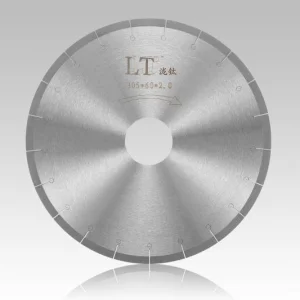
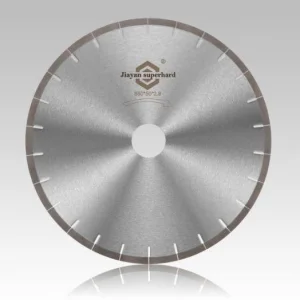
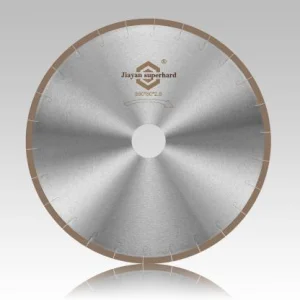
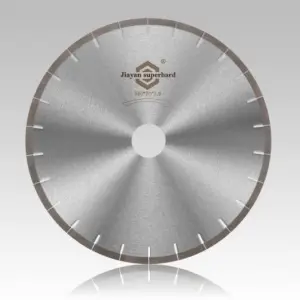
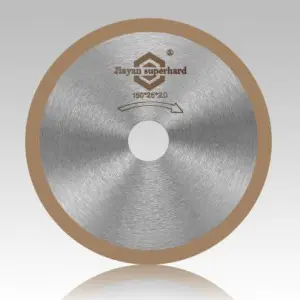
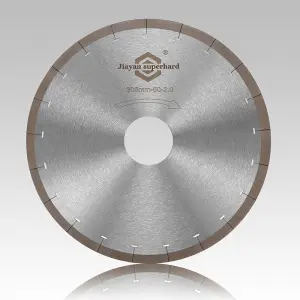
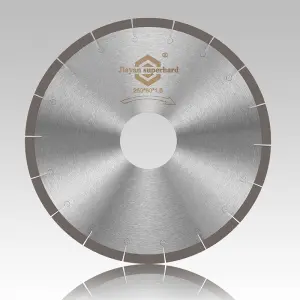
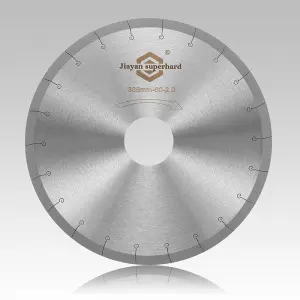
Natural granite, porcelain slabs, and quartz surfaces demand cutting edges that combine extreme abrasion resistance with vibration-damping fracture toughness. JIAYAN's continuous rim and segment diamond blades incorporate hard-alloy tungsten matrix bases engineered to maintain tension even under heavy feed rates.
In die and mold fabrication, indexable carbide inserts featuring complex 3D chipbreakers reduce cutting forces by up to 25%, preventing chatter and delivering mirror-smooth surface finishes (Ra < 0.4 µm) without requiring manual secondary polishing.
Machining titanium alloys (Ti-6Al-4V) and Nickel-based alloys creates intense localized heat at the cutting edge. Our thermal-shield coated carbide inserts dissipate heat rapidly into the chip, preserving tool geometry over extended cut times.
Get clear, authoritative answers regarding quality assurance, custom OEM tooling, tool failure diagnosis, and international shipping.
Factory-direct supply of high-performance cutting discs, diamond saw blades, and specialized hard alloy tooling.
Partner with China's leading supplier of carbide inserts, hard alloy cutting blades, and custom powder metallurgy tooling.