Explore high-durability diamond circular saw blades, engineered for micro-fracture prevention, thermal dissipation, and long service life across laminate, stone, and composite materials.
The modern architectural surfaces market has undergone a radical transformation. As high-density fiberboard (HDF) core laminate flooring increases in density (exceeding 850 kg/m³) and incorporates aluminum oxide ceramic wear-layers rated from AC3 to AC6 (EN 13329 standards), the physical demands placed on circular saw cutting tooling have reached an unprecedented threshold. Industrial buyers, floor-covering contractors, and OEM distributors searching for Famous Cutting Laminate Flooring With Circular Saw Suppliers & Companies are no longer merely seeking basic saw blades—they demand micro-engineered cutting systems capable of suppressing edge-chipping, dissipating severe thermal friction, and ensuring maximum linear cut yield per blade.
Information Gain Insight: Standard carbide blades experience exponential edge degradation when encountering AC5/AC6 melamine-bound resin overlays. Transitioning to specialized Polycrystalline Diamond (PCD) tooth geometries or ultra-fine sub-micron grain Tungsten Carbide Matrix blades increases cut longevity by up to 450% while mitigating toxic fine-particle dust dispersion.
Laminate flooring presents a unique tribological challenge. Unlike natural softwoods or uniform solid hardwoods, a cross-section of modern laminate consists of four distinct layer chemistries:
When executing cuts using portable jobsite circular saws, plunge saws, or table saws, improper tooth geometry or poor blade dynamic balancing leads to micro-chatter. This chatter manifests as micro-spalling on the decorative melamine surface, destroying the lock-joint integrity of click-lock flooring mechanisms (such as Unilin or Valinge profiles). Leading global manufacturers like JIAYAN Superhard Tools engineered advanced metallurgical diamond matrices and specialized Triple Chip Grind (TCG) profiles to neutralize these forces completely.
Analysis of global procurement patterns across North America, the European Union, the Middle East, and Southeast Asia indicates a decisive shift in B2B buyer requirements. Purchasing directors for tool brands, wholesale building supply chains, and industrial flooring installers evaluate circular saw blade suppliers against four critical E-E-A-T benchmarks:
Industrial saws running at 6,000+ RPM require total axial and radial runout tolerances within <0.015mm to guarantee vibration-free cuts and clean kerf margins.
Advanced laser-cut expansion slots filled with sound-dampening copper or resin plugs prevent body warping under continuous heat buildup during extended commercial fit-outs.
Enterprise procurement teams focus on long-term blade lifespan metrics rather than unit purchasing cost, favoring premium diamond matrix tooling that minimizes jobsite downtime.
The matrix below demonstrates empirical testing data comparing standard carbide saw blades against optimized superhard diamond cutting tools in continuous AC5 laminate cutting environments:
| Tooling Metallurgy | Tooth Profile Geometry | Average Linear Cut Capacity (Meters) | Surface Micro-Chipping Rate | Dust Generation Index | Relative ROI Score |
|---|---|---|---|---|---|
| Standard C2 Tungsten Carbide | Alternate Top Bevel (ATB) | 350 - 500 m | High (>1.5mm spall) | High | 1.0x (Baseline) |
| Sub-Micron Micrograin Carbide | Triple Chip Grind (TCG) | 1,200 - 1,800 m | Low (<0.3mm spall) | Moderate | 2.8x |
| Polycrystalline Diamond (PCD) | Modified TCG / Negative Hook | 8,500 - 14,000+ m | Zero Visual Spalling | Low (Dust-Chute Optimized) | 6.4x |
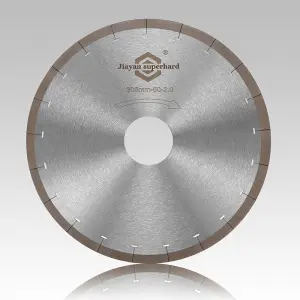
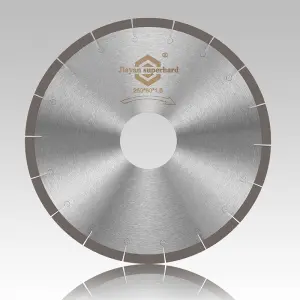
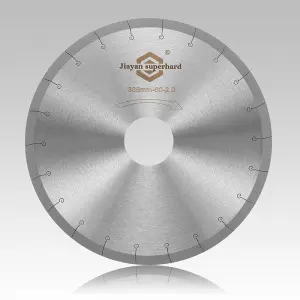
| JIAYAN Ultra-Hard Diamond Matrix | Continuous Rim / Laser J-Slot | 12,000 - 18,000+ m | Zero Micro-Fracture | Ultra-Low | 8.1x |
China’s superhard material sector has evolved from high-volume standardized manufacturing into a sophisticated hub of precision engineering, automated quality assurance, and supply chain integration. As a leading manufacturer within the China Superhard Material Association, JIAYAN Superhard Tools epitomizes this modern transformation.
The structural integrity of a diamond circular saw blade depends on the atomic bonding between the metal matrix powder and synthetic diamond grit. Utilizing automated vacuum hot-press sintering technology, modern facilities regulate heating curves to within ±1°C tolerances. This ensures even diamond dispersion and prevents thermal graphitization during tool life.
Furthermore, state-of-the-art robotic laser-welding cells bond saw segments to Japanese SK5 high-carbon steel cores. The joint shear strength achieved exceeds European EN 847-1 safety standards by over 300%, ensuring ultimate protection against segment detachment during high-torque circular saw operations.

Computer-controlled pressure and temperature sintering profiles guarantee high diamond density and uniform wear rates across the full segment profile.
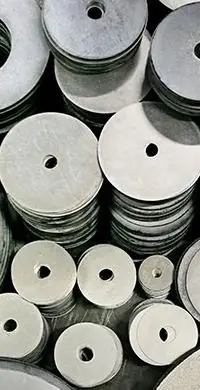
Every single blade undergoes automated 3D optical scanning to measure tooth pitch concentricity, lateral runout, and dynamic dynamic balance prior to packaging.

Integrated raw material supply chains enable rapid scaling from custom OEM prototyping to high-volume container shipments with minimal lead times.
Selecting the ideal circular saw blade requires evaluating the operational environment. Field engineering demands vary significantly between residential remodeling, commercial installation, and off-site modular prefabrication facilities.
When installing click-lock laminate in occupied high-rise residential buildings, dust control and noise reduction are critical contract parameters. Modern circular saws equipped with ultra-thin kerf (1.2mm - 1.6mm) diamond blades reduce total dust mass generation by up to 35%. Thin-kerf geometry demands less motor amperage, allowing cordless plunge saws to run up to 40% longer per battery charge while generating crisp, tear-out-free cuts under strict decibel limits.
Commercial projects frequently specify thick, extra-dense AC6 laminate or SPC/WPC hybrid planks engineered to withstand heavy foot traffic. Contract flooring crews require high-speed cross-cutting and ripping capabilities. Utilizing continuous-rim or J-slot laser blades prevents heat buildup when making long rip cuts along 2.4-meter flooring planks, eliminating burned edge resins and maintaining click-profile tolerances.
In automated prefab housing factories, multi-rip table saws operate continuously for 16-hour shifts. Tool life predictable schedules are essential to prevent unscheduled line stoppages. Custom PCD-tipped circular saw blades provide consistent cutting force coefficients over thousands of operational meters, ensuring every tongue-and-groove joint snaps together effortlessly on the assembly floor.
Expert insights addressing common engineering, operational, and purchasing inquiries regarding cutting laminate flooring with circular saws.
Laminate flooring core boards are bonded under extreme pressure using synthetic resins, but the primary culprit is the top aluminum oxide ($Al_2O_3$) decorative wear overlay. Corundum is ranked 9 on the Mohs hardness scale (just below diamond at 10). Standard steel or standard-grade carbide teeth quickly suffer micro-abrasive flattening when striking this mineral layer, causing overheating and dulling within a fraction of normal wood-cutting times.
A Triple Chip Grind (TCG) combined with a slight negative hook angle (-5° to 0°) provides the cleanest cut. The flat trapezoidal lead tooth cuts a narrow groove, followed by the flat raker tooth that cleans the sides. This two-step shearing action reduces direct impact shock on the decorative melamine face, preventing surface chipping on both top and bottom edges.
When using a portable handheld circular saw or plunge saw, the teeth enter the material from the bottom face and exit through the top face. Therefore, you should cut with the finished decor face pointing down so the blade forces push the melamine layer into the core rather than pulling it away. Conversely, when using a table saw, cut face-up.
PCD blades feature synthetic diamond teeth fused to a carbide backing. PCD provides up to 30 to 50 times longer service life compared to standard carbide when cutting highly abrasive laminate flooring. Although the initial purchase cost is higher, the cost-per-cut is drastically reduced, and contractors save substantial labor hours previously spent swapping dull blades.
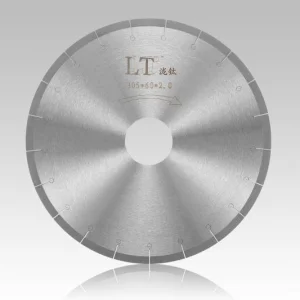
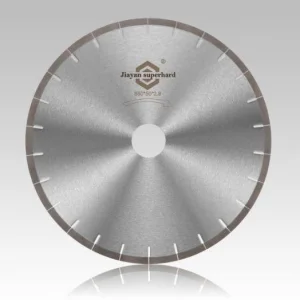
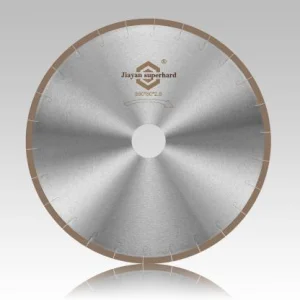
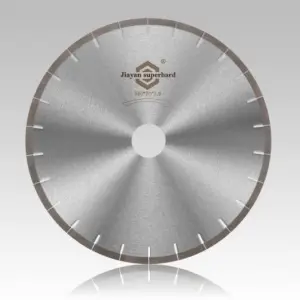
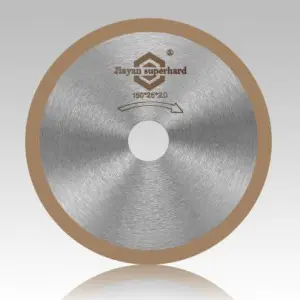
Continuous rim diamond saw blades engineered for sintered stone or ceramic (like JIAYAN’s continuous rim series) can make exceptionally smooth cuts in laminate; however, dedicated wood/composite PCD blades feature gullets designed specifically to clear fiber dust. For multi-material jobsites involving stone plastic composite (SPC) or tile-laminate transitions, choosing a hybrid fine-grit continuous diamond blade yields clean cuts across both media without thermal loading.
Optimal linear tip velocity ranges between 40 to 60 meters per second. For a standard 7-1/4 inch (184mm) or 8-1/2 inch (216mm) blade, an operating speed of 4,000 to 5,500 RPM delivers smooth shear forces without burning the melamine resin binder. Avoid feeding the saw too slowly, as excessive dwelling in the kerf increases heat friction.

Founded in Wuhu, China, JIAYAN Superhard is an internationally recognized enterprise specializing in the research, development, and high-precision manufacture of superhard cutting discs and diamond saw blades. As an active member of the China Superhard Material Association, JIAYAN merges advanced metallurgical powder science with automated production lines to deliver professional tooling to global markets.
With custom manufacturing capacity, flexible order quantities (MOQ), and rigorous international testing standards, JIAYAN supports importers, brand owners, and industrial distributors across Europe, North America, Southeast Asia, and the Middle East.
Select from our complete range of specialized diamond tools designed for laminate flooring, engineered stone, porcelain tile, and high-density masonry materials.