Engineered for chip-free acrylic, sintered stone, quartz, and dense polymer substrate cutting with optimized thermal dissipation.
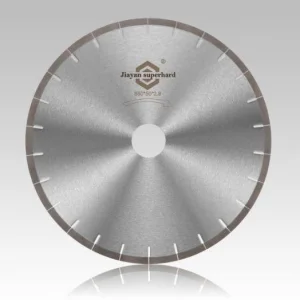
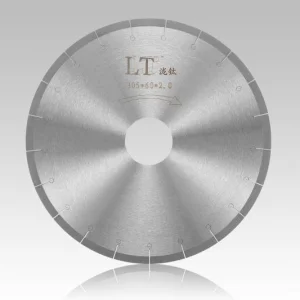
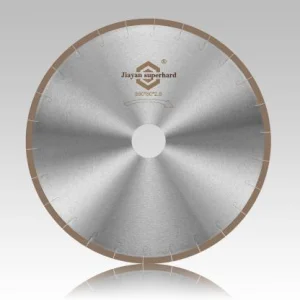
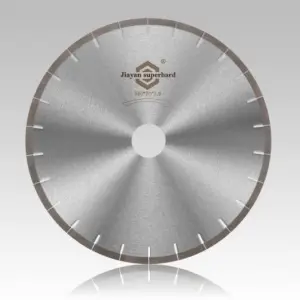
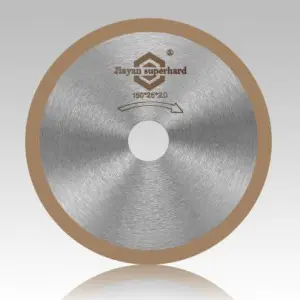
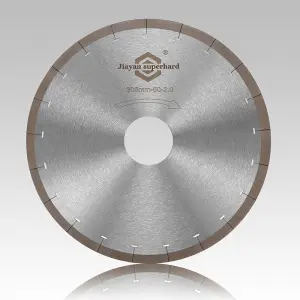
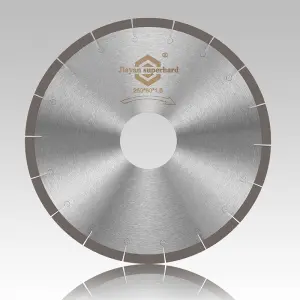
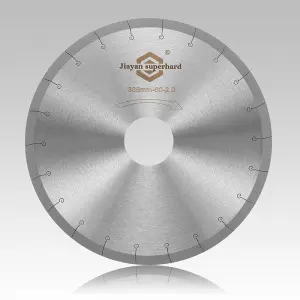
Understanding polymethyl methacrylate (PMMA) micro-fracturing, thermal softening thresholds, and saw blade tooth geometry for chip-free edge finishing.
Plexiglass (PMMA) possesses a glass transition temperature ($T_g$) between 100°C and 105°C. Standard wood or metal circular saw blades generate extreme frictional heat, causing localized melting, chip re-welding, and heavy edge burring. High-end circular saw manufacturers engineer custom gullets and laser-etched cooling vents to suppress thermal buildup during continuous automated cutting operations.
Optimal PMMA circular saw blades utilize a Triple Chip Grind (TCG) configuration coupled with a modified hook/rake angle ranging from 0° to +5° (or slightly negative -5° for thin sheets). This geometry prevents the saw teeth from aggressive grabbing, reducing impact shock and eliminating surface micro-cracking across cast and extruded acrylic sheets.
Leading companies like JIAYAN Superhard Tools combine fine micro-grain carbide tips with electroplated synthetic diamond rims. This hybrid sintering technology yields maximum axial stiffness, near-zero dynamic runout (<0.02mm), and superior edge retention, maintaining optical transparency along the cut boundary without post-polish grinding.
An in-depth analysis of how aerospace, medical, architectural, and retail display verticals rely on specialized circular saw blade manufacturers for high-precision PMMA processing.
The global demand for acrylic sheet cutting circular saws has witnessed accelerating growth driven by industrial automation, cleanroom architecture, soundproof transportation barriers, and high-clarity electronic display panels. Standard woodworking blades fail when cutting thick acrylic sheets (such as 15mm–50mm structural acrylic blocks), resulting in thermal stress cracking, violent kickback, or clouding along the saw line. As a result, manufacturing enterprises across North America, Western Europe, and Asia-Pacific are increasingly migrating toward high-tier specialized circular saw manufacturers that provide engineered diamond and carbide blade solutions.
In North America and Europe, rigorous environmental standards and labor cost pressures mandate automated table saws, CNC panel saws, and beam saws operating at high feed speeds (12 to 20 meters per minute). Tools must maintain extreme durability to minimize production downtime during continuous 24/7 industrial fabrication.
| Blade Metric / Feature | Standard Wood Circular Blade | Carbide TCG Acrylic Blade | JIAYAN Superhard Diamond Rim Blade |
|---|---|---|---|
| Tooth Geometry | Alternate Top Bevel (ATB) | Triple Chip Grind (TCG) | Continuous Electroplated Diamond Rim / J-Slot |
| Rake / Hook Angle | +15° to +20° (Aggressive) | 0° to +5° (Neutral/Controlled) | 0° Non-Hook Precision Segment |
| Edge Finish Quality | Chipped, Burred & Rough | Clean, Smooth Satin Finish | Polished-Grade Transparent Finish |
| Blade Lifespan Index | 1.0x (Base Level) | 4.5x Lifespan | 18.5x Extended Lifespan |
| Thermal Distortion Risk | High (Re-welding Common) | Moderate (Requires Air Blow) | Low (Laser Heat-Expansion Slots) |
How JIAYAN Superhard Tools leverages advanced metallurgical clusters, automated sintering furnaces, and ISO-certified QC to redefine global B2B procurement economics.
Located in the heart of China’s superhard materials industrial hub, JIAYAN Superhard Materials Co., Ltd. (Member of the China Superhard Material Association) benefits from localized raw material integration, including synthetic diamond powder synthesis, high-purity cobalt alloy matrix production, and laser-cutting plate steel suppliers. This spatial clustering yields a 30%–45% direct cost efficiency over European OEM counterparts without compromising structural integrity or tolerances.
JIAYAN incorporates automated vacuum sintering hot-press machines and robotic laser-welding units. Every single circular saw blade intended for Plexiglass, stone, or ceramic cutting undergoes computerized dynamic balancing and digital runout verification down to 0.015mm. This guarantees smooth operation on high-speed spindles (3,000–6,000 RPM) with zero operational vibration or blade chatter.
Real-world engineering implementations across specialized commercial sectors requiring precision cuts, high feed rates, and mirror-finished acrylic edges.
Large-format acrylic sheets (20mm to 40mm thick) are widely installed along high-speed rail lines, highways, and modern building facades as transparent noise barriers. Circular saws fitted with JIAYAN's 350mm continuous rim diamond blades enable fast, single-pass longitudinal cuts without thermal stress micro-fractures, ensuring 30+ year structural weatherproofing.
High-end retail brands demand crystal-clear acrylic showcases and cosmetic displays. Blade deflection or chipped edges require hours of secondary flame polishing or chemical edge smoothing. Utilizing ultra-thin (1.0mm–1.2mm) diamond circular cutting discs delivers a factory-polished edge right off the table saw, slashing labor costs by up to 60%.
Medical isolators, glove boxes, and semiconductor cleanroom partition walls require specialized PMMA sheet cutting under dust-free conditions. Circular saws integrated with J-slot diamond blades permit high-velocity cutting with minimal static particulate emission, preventing contamination during production.
A strategic blueprint for industrial procurement officers, plant operations managers, and international distributors evaluating cutting equipment manufacturers.
When sourcing circular saw blades for cutting plexiglass, stone, or ceramic composites, procurement directors must evaluate manufacturers based on strict quantitative benchmarks rather than unit price alone:
How laser expansion slotting, ultra-thin diamond kerfs, and smart sensor integration are transforming polymer cutting productivity.
Next-generation circular saw blades feature laser-cut expansion slots filled with sound-dampening resin polymers. This technological advancement attenuates high-frequency cutting noise by up to 12 dB while dampening structural resonance that causes edge chipping on brittle extruded plexiglass.
With high material costs for specialty optical PMMA, engineered plastic fabricators are demanding ultra-thin kerf circular saw blades. Reducing kerf width from 3.2mm down to 1.0mm–1.2mm yields a 20% savings in material scrap while drastically reducing motor power consumption on CNC panel saws.
Polycrystalline Diamond (PCD) tipped circular saw blades represent the pinnacle of long-life polymer cutting. Offering up to 50 times the lifespan of standard carbide tools, PCD tips engineered by advanced manufacturers like JIAYAN eliminate downtime in automated industrial manufacturing plants.
Expert engineering insights for operators, fabricators, and equipment buyers seeking optimal cutting parameters and tooling setup.
The ideal circular saw blade for plexiglass features a Triple Chip Grind (TCG) tooth configuration with carbide or fine diamond grit segments, a 0° to +5° hook angle, and a high tooth count (e.g., 60 to 80 teeth on a 10-inch/250mm blade or continuous rim layout). This setup shears the plastic smoothly without grabbing, preventing edge chipping and material cracking.
Acrylic melts when friction elevates the surface temperature beyond 105°C. To stop melting: (1) Use a blade engineered specifically for plastics/composites, (2) Maintain a steady, rapid feed rate so heat cannot build up in one spot, (3) Use compressed air or vortex cooling tubes aimed directly at the cut line, and (4) Ensure your circular saw RPM is matched to the blade diameter (typically 3,450 to 4,500 RPM).
Yes! Electroplated or continuous rim diamond saw blades (such as JIAYAN's J-slot or continuous rim series) excel at cutting dense, thick acrylic blocks (10mm to 50mm). Diamond particles micro-abrade the PMMA sheet cleanly, producing a near-transparent edge finish that reduces or eliminates the need for secondary hand polishing.
Set the circular saw blade height so that the tips of the teeth extend approximately 6mm to 10mm (1/4" to 3/8") above the top surface of the acrylic sheet. Setting the blade too low increases friction and melting; setting it too high increases entry shock and potential chipping.
Cast acrylic has a higher molecular weight, making it significantly easier to cut with circular saws as it resists melting and chips cleanly. Extruded acrylic has a lower melting point and tends to gum up or re-weld if cut with an improper blade or slow feed rate. Using high-grade TCG or diamond blades from specialized manufacturers prevents issues on both acrylic grades.
Chinese superhard material manufacturers offer world-class metallurgical engineering, strict ISO quality control, and direct factory pricing. JIAYAN Superhard provides full OEM/ODM customization, flexible MOQs, laser-welding sintering technology, and complete certification, giving global buyers up to 45% cost savings without sacrificing edge quality or blade durability.
For standard 3mm to 6mm PMMA sheets, maintain an automated feed rate of 8 to 15 meters per minute at 4,500 RPM. Rapid, continuous feed prevents dwell time heat generation. Adjust downward slightly for extra thick structural acrylic slabs above 20mm.
Enterprises can submit custom technical drawings or parameter requirements (outer diameter, bore size, pinhole layout, kerf thickness, tooth profile, and diamond grit size) directly to JIAYAN's engineering department via email at [email protected] or WhatsApp/Phone at +86 15815923777. OEM samples are typically produced within 7–10 days.
Premium superhard cutting tools certified for global industrial applications in acrylic, granite, sintered stone, and ceramic processing.
Member of China Superhard Material Association. Providing precision engineering circular saw blades, diamond cutting discs, and custom tooling solutions to buyers worldwide.


Download technical blueprints, complete RPM matching matrices, and factory pricing guidelines for bulk circular saw blade orders.
Download Engineering Catalog