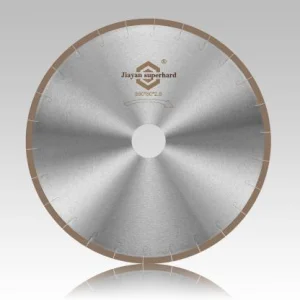
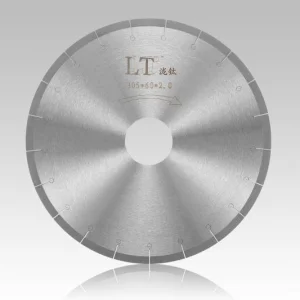
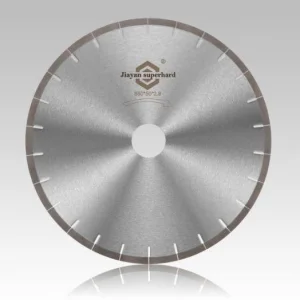
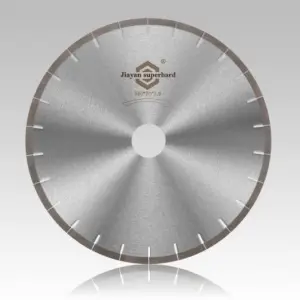
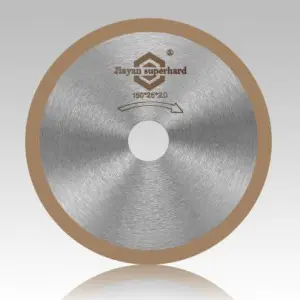
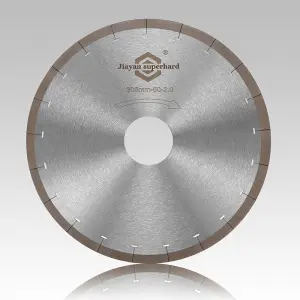
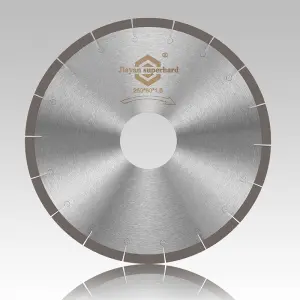
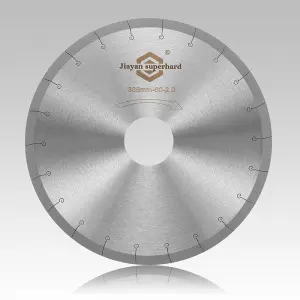
Direct factory-engineered superhard tools for heavy concrete, granite, porcelain, and engineered stone applications.
In high-stress civil infrastructure, masonry construction, and quarry stone processing, structural failure of cut-off blades presents severe operational hazards and costly downtime. As a premier Famous Laser Diamond Saw Blade Supplier & Factory, top-tier global manufacturers solve these operational friction points through advanced metallurgy, automated laser beam welding, and high-density powder sintering. Unlike conventional silver-brazed circular blades—which rely on low-melting-point cadmium or silver alloys susceptible to thermal degradation above 350°C—high-energy laser welding forms an atomic-level metallurgical bond directly between the diamond-impregnated segment matrix and the high-tensile alloy steel core (such as 75Cr1 or 50Mn2).
The laser welding process utilizes a targeted CO2 or YAG laser beam focused precisely on the transition zone. This creates a deep penetration weld pool, fusing the steel core's nickel-chromium matrix with the segment’s transition layer (devoid of diamond synthetic grit to prevent graphite contamination). This process completely eliminates the risk of segment detachment during dry cutting operations, where peripheral frictional temperatures routinely exceed 600°C.
Precision pulse laser calibration minimizes the Heat-Affected Zone (HAZ) within the steel core. By restricting thermal dispersion to under 0.5mm, the structural tensioning, core hardness (42-45 HRC), and runout tolerances are perfectly preserved, preventing core warping under intense feed pressure.
Selecting single-crystal synthetic diamond grains with tailored micro-friability ensures controlled self-sharpening. Metal matrix formulations (combining Cobalt, Nickel, Iron, and Tungsten Carbide powders) wear at a rate precisely matched to the abrasiveness of the target substrate.
Laser welding removes the mandatory requirement for constant water cooling. Jobsite operations on remote highway repairs, utility trenching, and indoor masonry refurbishment benefit from instant dry-cutting capability without structural segment shear risk.
The international market for diamond cutting tools has undergone a massive shift toward specialized laser-welded consumables. Industrial buyers, large-scale construction equipment distributors, and OEM tool brands demand strict consistency in segment matrix density, diamond grit distribution, and core dynamic balancing. Leading Chinese superhard tool manufacturing hubs—such as JIAYAN Superhard Material facilities in Anhui—combine economies of scale with automated sintering presses to meet these global commercial demands.
Commercial procurement directors face distinct trade-offs between unit acquisition costs and total cost per meter cut (CPM). While standard sintered or brazed saw blades offer lower initial purchase prices, their operational lifespan on heavily reinforced concrete or high-density quartzite granite is significantly shorter. Laser-welded diamond blades provide up to 300% longer operational life under severe abrasive stress, delivering unmatched economic returns for heavy civil contractors.
| Manufacturing Technology | Joint Bond Mechanism | Max Temp Resilience | Primary Substrate Application | Safety Certification Compliance |
|---|---|---|---|---|
| Laser Welded (Industrial Grade) | Atomic Fusion (Steel Core to Transition Alloy) | > 800°C (Dry Cutting Compliant) | Cured Reinforced Concrete, Granite, Asphalt, Masonry | EN13236, ANSI B7.1, OSHA Silica Standard |
| Hot-Pressed Sintered | Direct Powder Solidification under Pressure | 350°C - 450°C (Requires Water Jet) | Ceramic Tiles, Porcelain Slabs, Marble, Slate | EN13236 (Wet Operating Parameters) |
| Silver Brazed (Traditional) | Capillary Action of Silver/Copper Filler Matrix | < 300°C (Strictly Wet Cutting Only) | Quarry Granite Slabs, Large Block Dressing | EN13236 (Wet Operational Safeguards) |
| Electroplated Diamond | Single-Layer Nickel Electro-Deposition | < 200°C (Low Thermal Tolerance) | Fiberglass, Composites, Soft Marble, Glass | Light Industrial Safety Norms |
Securing stable supplies of high-grade synthetic diamond monocrystals (MBD/SDB grade) and refined metal powders (Cobalt, Tungsten, Nickel) is critical for consistent cutting speeds. Top manufacturers utilize automatic cold pressing machines and high-vacuum multi-stage sintering kilns to eliminate internal micro-voids, ensuring every batch meets international shear strength parameters.
Deploying high-speed diamond tools globally requires compliance with strict safety directives and localized regional engineering frameworks. A world-class Laser Diamond Saw Blade Factory ensures that every production lot adheres to international safety standards, including the European Standard EN 13236 ("Safety requirements for superabrasive products") and the American National Standards Institute ANSI B7.1.
Every laser-welded saw blade segment undergoes destructive or non-destructive hydraulic shear torque testing. The weld seam must withstand minimum bending stresses of 10.5 MPa (exceeding standard EN 13236 thresholds) to guarantee safety under high impact loads.
To help contractors comply with North American OSHA silica regulations, blades are engineered with integrated water-channeling key slots (or J-slots) for high-efficiency wet suppression, as well as optimized dry-cutting chip ejection geometries.
Laser-cut steel cores feature expansion slots and noise-reduction sandwich layers (copper-damped cores). Computer-controlled dynamic balancing keeps runout within 0.05mm, reducing operator fatigue and hand-arm vibration syndrome (HAVS).
Selecting the correct tool matrix involves analyzing the physical properties of the target material: compressive strength, Mohs hardness, quartz content, and reinforcement density. Laser-welded diamond blades perform exceptionally well across demanding jobsite conditions:
Green concrete (uncured slab cut within 4 to 8 hours of pouring) contains highly abrasive loose sand particles. Standard blade bonds erode prematurely, causing segment loss. Laser-welded asphalt/green concrete blades use tungsten carbide drop-segment protection ("undercut protection") alongside hard iron-based metal bonds to prevent steel core erosion at the weld line.
Bridge demolition, nuclear facility decommissioning, and high-rise building modification require cutting through high-density rebar (e.g., Grade 60 steel rebar). High-energy laser blades formulated with titanium-coated synthetic diamond grains (30/40 mesh) slice cleanly through rebar without glazing over or suffering thermal degradation.
Large-format sintered stone (Dekton, Neolith) features extreme internal stress and high Mohs hardness (7+). Specialized 14-inch (350mm) J-slot and key-slot laser/hot-pressed blades utilize ultra-fine diamond powders (100/120 mesh) to achieve chip-free edge finishing at high feed speeds.
The superhard material tooling industry is undergoing a major technological transformation. Leading manufacturing facilities are advancing key R&D initiatives to boost cutting efficiency and operational lifespan:
Moving away from random diamond grit distribution, precise 3D spatial alignment places individual diamond particles in uniform grid rows throughout the segment matrix. This ensures constant crystal exposure, resulting in up to 50% faster cutting speeds and 30% longer blade lifespan.
Upgrading from standard CO2 laser systems to multi-axis fiber wobble lasers improves weld seam bridge density while minimizing thermal stress on thin-kerf cores. This enables ultra-thin laser-welded blades down to 1.2mm thickness.
In response to global raw material volatility and environmental compliance directives, R&D labs are engineering iron-nickel-copper nano-alloys. These matrices match cobalt’s diamond retention capabilities while significantly reducing production energy footprints.
Select high-durability diamond tooling designed for enterprise procurement and global distribution networks.
Partnering with a recognized Famous Laser Diamond Saw Blade Supplier & Factory offers significant operational advantages. When establishing high-volume supply contracts or custom OEM product lines, enterprise procurement teams should evaluate suppliers against these core metrics:
Leading manufacturers perform X-ray fluorescence (XRF) testing on raw metal powders (Cobalt, Copper, Nickel, Iron) to ensure chemical purity exceeds 99.5%. Purity directly governs sintering density, joint bond consistency, and wear resistance under high thermal stress.
Every core is pre-tensioned using automated computer roller systems. Blades are checked across radial and axial displacement zones to guarantee radial runout stays under 0.05mm and axial wobble remains under 0.03mm. This precise alignment prevents blade jamming and protects operator safety.
Quality-managed production facilities assign a unique laser-engraved batch code to every blade core. This serial number links back to raw material powder logs, diamond grit lot certificates, laser beam power logs, and hydraulic torque test records.
Whether configuring custom diamond blade parameters for regional stone quarries or establishing private-label distribution across European or North American markets, our technical engineering team provides end-to-end support—from matrix formulation R&D to ISO-compliant volume manufacturing.