Engineered for high-speed cutting efficiency, extended tool lifespan, and structural vibration dampening across diverse hard substrates.
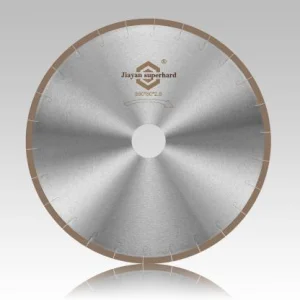
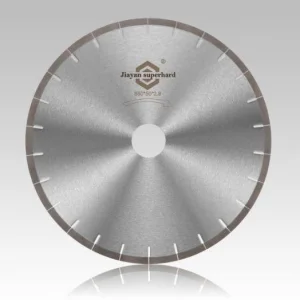
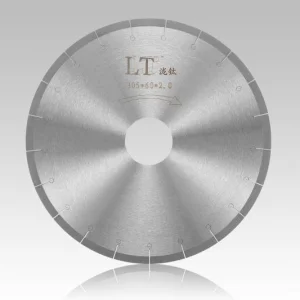
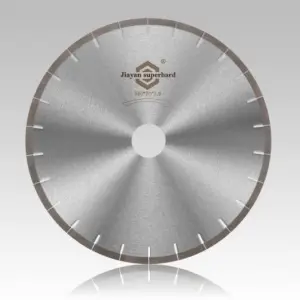
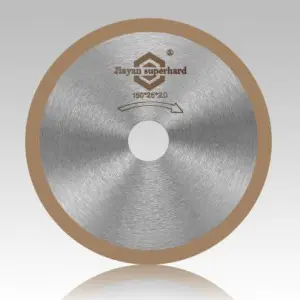
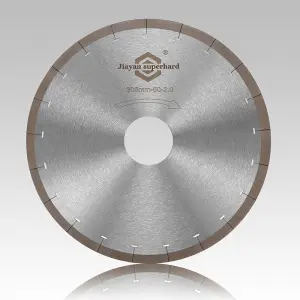
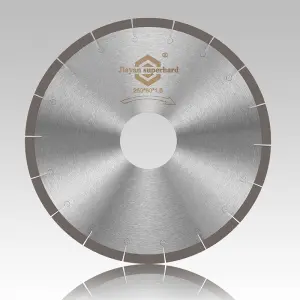
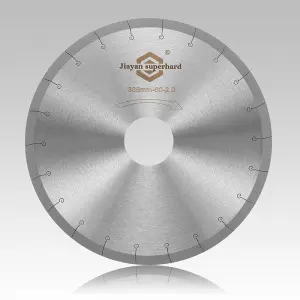
Modern industrial fabrication demands multifunctional circular saws and diamond blades capable of transitioning across disparate material matrices without compromising edge integrity, cutting velocity, or operational safety. Whether cutting through high-silica natural granite, ultra-compact sintered stone slabs (such as Dekton® or Neolith®), or heavily reinforced pre-cast concrete structures, tool performance depends on matching abrasive bond hardness with substrate mechanical characteristics.
At JIAYAN Superhard Materials, our R&D lab systematically categorizes cutting solutions based on micro-fracturing wear mechanics. By tailoring the synthetic diamond grit mesh density, crystal friability, and metallic binder matrix (combining Cobalt, Bronze, Iron, and Tungsten Carbide powders), we eliminate common field failures such as blade glazing, segment loss, kerf deviation, and surface edge chipping.

High-density compact slabs exhibit extreme internal tension. Our J-Slot and narrow continuous rim blades utilize fine-mesh diamonds (50/60 to 70/80 grit) with soft bronze matrices to deliver chip-free edge finishes at speeds exceeding 1.8 m/min.
Abrasive, high-hardness stone types require self-sharpening segment structures. Our sandwich-structured 3D diamond array segments maintain controlled wear rates, ensuring consistent feed rates across Class 4 and 5 granite varieties.
Laser-welded circular saw blades designed for heavy infrastructure. Utilizing high-temperature solid-state diffusion bonding, segments withstand extreme lateral shear stress and thermal shocks up to 600°C during dry cutting.
Pioneering advancements in superhard diamond tooling physics, automated laser cladding, and acoustic damping core architectures.
Rather than random grit distribution, our 3D patterned layout places each synthetic diamond particle at precise volumetric intervals. This ensures equal workload per crystal, boosting cutting speed by 30% and extending blade operational longevity by 40%.
Automated high-power fiber lasers fuse diamond segments directly to high-tensile 75Cr1 steel cores. Shear testing confirms joint integrity exceeding 15 MPa, eliminating segment detachment under intense mechanical stress.
Integrated multi-layer steel bodies with copper or viscoelastic dampening foils significantly attenuate acoustic harmonics. Operates at noise levels 8–12 dB lower than standard solid steel blades, satisfying strict EU occupational health standards.
Transitioning from heavy cobalt matrix reliance toward advanced iron-copper-tin ultra-fine pre-alloyed powders. Delivers superior wear resistance while reducing environmental impact and stabilizing production costs against global cobalt price volatility.
Situated in Wuhu, China, JIAYAN Superhard leverages fully automated hot-pressing sintering lines, digital quality monitoring, and domestic rare-metal material ecosystems to deliver high-capacity industrial tooling.

Computer-controlled vacuum hot-pressing furnaces maintain sintering temperature profiles within ±2°C. Ensures identical matrix density, pore distribution, and diamond retention across every production batch.
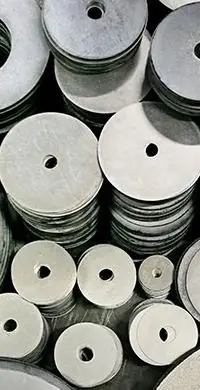
Every circular blade undergoes optical non-contact inspection for flatness, tensioning integrity, and dynamic balancing at speeds up to 12,000 RPM, eliminating field chatter and uneven blade wear.

Direct partnerships with domestic synthetic diamond manufacturers allow strict selection of single-crystal grit strength, thermal stability index (TSI), and particle aspect ratios for specialized applications.

Rapid custom formulation of segment shapes (Turbo, Keyhole, W-segment, J-Slot) and arbor sizing. Prototyping lead times compressed to under 7 working days for global commercial buyers.
Commercial buyers must evaluate circular saw blades beyond initial unit purchase price. Strategic total cost of ownership accounts for cutting linear meters per hour, power consumption, machine downtime, and workpiece yield margins.
| Evaluation Parameter | Standard Commercial Blade | JIAYAN Superhard Industrial Blade | Operational Impact & Benefit |
|---|---|---|---|
| Diamond Grit Technology | Random distribution, variable quality | Controlled 3D Diamond Array (Arix) | +35% Faster linear feed rate; lower amperage draw on saw motors. |
| Steel Core Steel Spec | 50Mn / Standard Carbon Steel | 75Cr1 German Standard Alloy Steel | Prevents blade distortion under high thermal load; reusable core. |
| Segment Joint Strength | High-frequency silver brazing | Automated Fiber Laser Welding | Zero segment loss under dry cutting conditions up to 600°C. |
| Edge Chipping Rate | High on sensitive slabs (> 4%) | Ultra-Low (< 0.5%) | Saves thousands of dollars in high-value sintered stone slabs. |
| Effective Lifespan (Meters) | Baseline (1.0x) | Extended (1.8x – 2.4x) | Reduces blade changeover frequency and worker downtime. |
To ensure consistent performance across volume shipments, JIAYAN provides comprehensive batch certificate reporting, including destructive shear testing, dynamic balance metrics, and diamond grit concentration verification. Enterprise buyers can request tailored private-label branding, customized packaging, and direct factory-audit documentation for full supply chain compliance.
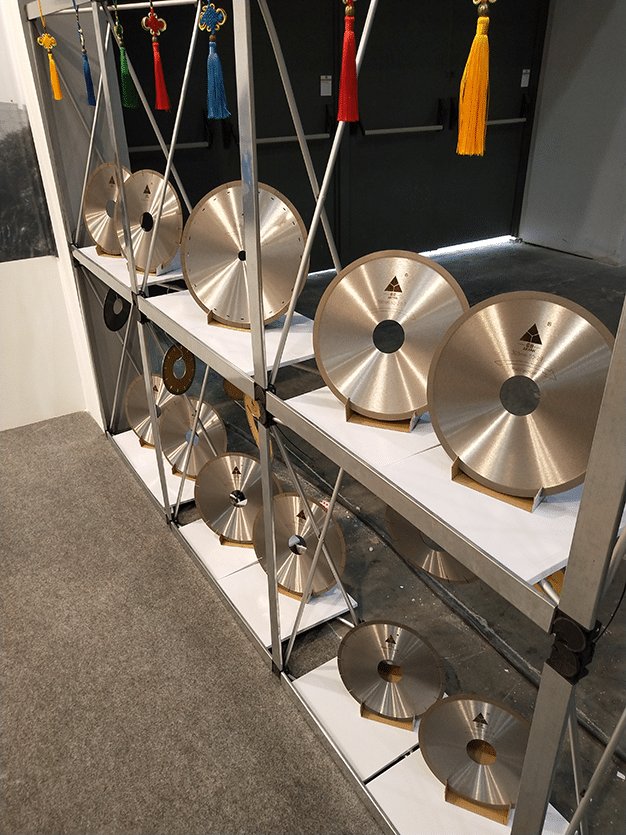
Operating safely with rotating tools at peripheral speeds exceeding 40 m/s requires total compliance with international safety codes. JIAYAN superhard circular saw blades conform strictly to:
In-depth answers to critical operational, geometric, and material questions encountered by project managers and tool operators.
J-Slot cutouts incorporate a smooth radius curve at the base of the expansion slot, effectively distributing thermal and mechanical stress concentrations. Traditional keyhole slots can experience stress fatigue cracks during high-RPM cuts on dense porcelain or quartzite slabs. J-slots also optimize water coolant delivery straight into the cutting kerf, improving slurry flush rates.
Glazing occurs when the metallic binder matrix is too hard for the target stone, preventing worn diamond crystals from releasing to expose fresh sharp diamond points. The blade polish-smears rather than cuts. To re-sharpen or "dress" a glazed blade, make several passes through an abrasive material such as soft sandstone, firebrick, or a green silicon carbide dressing block.
This core metallurgical principle dictates that extremely hard materials (e.g., Mohs 7–8 quartzite or sintered stone) require a softer metal matrix (bronze/tin alloy) so the bond wears away consistently to expose diamond edges. Conversely, soft abrasive materials (e.g., green concrete or soft sandstone) require hard matrices (tungsten carbide/iron alloy) to resist erosion.
Wet cutting uses water streams to reduce friction, lubricate the cut, flush abrasive slurry, and suppress dust particles. Dry cutting relies strictly on ambient airflow and expansion slots for heat dissipation. Dry blades require high-temperature laser welding, as standard high-frequency brazed joints can soften and drop segments if temperatures exceed 300°C.
During manufacturing, steel blade cores are mechanically hammered or roll-tensioned to establish internal tension zones. This counteracts centrifugal expansion forces encountered at operational speeds (2,000–4,000 RPM). Proper tensioning ensures the rim remains perfectly planar, preventing binding, chatter marks, and uneven kerf wear.
Arbor shafts must be free of burrs, rust, or debris. Mounting flanges must be identical in diameter, flat, and cover at least one-third of the blade diameter for large bridge saw installations. Tightening arbor nuts unevenly or over-torquing can warp the blade core, causing micro-vibrations and premature diamond loss.
Select from our standard industrial specifications or request custom OEM segment engineering.