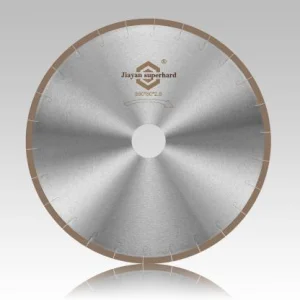
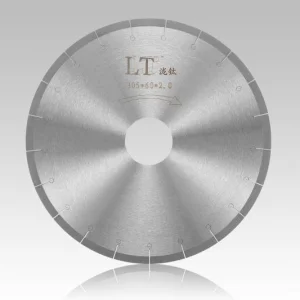
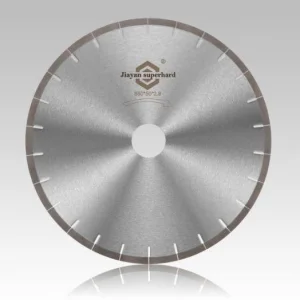
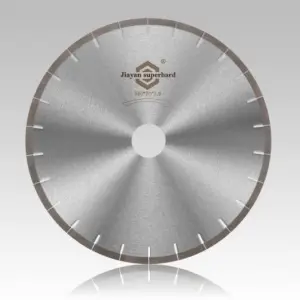
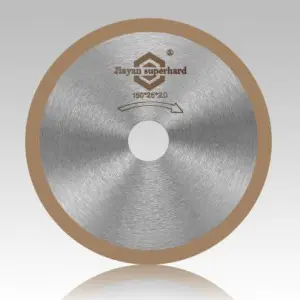
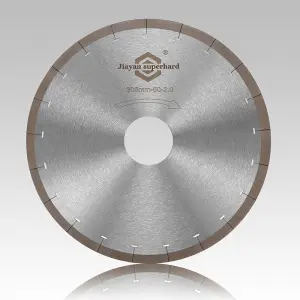
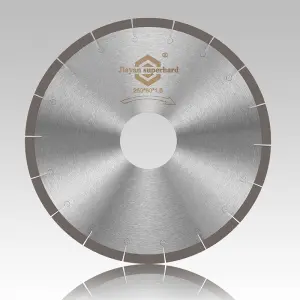
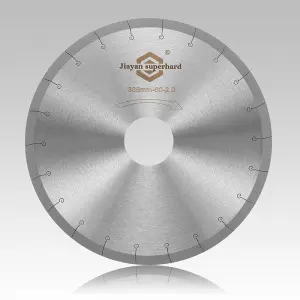
High-performance continuous rim, J-slot, and laser-welded diamond cutting discs optimized for chip-free performance on dense porcelain and sintered stone.
Why conventional diamond saw blades fail on modern sintered porcelain, and how enterprise-grade metal-matrix powder metallurgy delivers micro-chip-free edge perfection.
In modern architectural surfaces, porcelain and sintered stone slabs (such as Dekton, Neolith, Laminam, and Lapitec) represent the pinnacle of material density. Formed under ultra-high pressures exceeding 400 bar and vitrified in kilns at temperatures past 1200°C, these materials feature a Mohs hardness of 7 to 8, zero internal porosity (<0.1% water absorption), and intense residual internal tension. Cutting these vitreous matrices without micro-chipping or catastrophic slab fracture requires a fundamental shift in diamond tooling mechanics.
At JIAYAN Superhard Tools, our R&D team—operating as a core manufacturing member of the China Superhard Material Association—has re-engineered the micro-structural breakdown of saw blade segments. Traditional granite or marble blades use hard iron-based or cobalt-tungsten bonds designed to retain coarse diamond grains (40/50 mesh) for abrasive shearing. When applied to porcelain, these rigid matrix bonds fail to expose fresh diamond edges rapidly enough, leading to extreme thermal build-up, blade glazing, blade wander, and edge spalling.
Our famous porcelain saw blade factory utilizes an ultra-soft, cobalt-bronze-nickel alloy matrix engineered for dynamic self-sharpening. By embedding premium synthetic diamond crystals (MBD grade) at fine mesh distributions (80/100 to 120/140 mesh) under precision vacuum hot-pressing sintering, our blades maintain a continuous micro-abrading contact zone. As diamond points dull under high tangential resistance, the soft bronze-nickel matrix wears at an identical rate, continuously exposing razor-sharp diamond facets without causing thermal shock to brittle porcelain glazes.
Manufactured using imported 75Cr1 high-carbon alloy steel cores, cold-rolled and tension-stress relieved. Laser-cut expansion slots and J-slots eliminate high-frequency acoustic resonance and thermal warping during high-speed wet cutting.
Specifically designed J-slot and laser keyhole segment geometries break hydraulic drag pressure, accelerating coolant flow directly into the cutting kerf while preventing stress concentrations at the segment weld line.
Utilizing 3D volumetric diamond distribution technology, every millimeter of the continuous rim features uniform diamond concentration, mitigating localized friction hot-spots and preventing edge blowouts on 45° miter cuts.
Analyzing the architectural movement toward mega-format porcelain slabs and how B2B buyers can optimize tool longevity and operational expenditure.
The global surface material landscape is undergoing a monumental transition. Ultra-large porcelain slabs (typically 3200mm × 1600mm with thicknesses ranging from 6mm to 20mm) have rapidly expanded from commercial flooring into residential kitchen countertops, exterior ventilated facades, and heavy-footprint public infrastructure. According to recent architectural market intelligence, the demand for sintered stone surfaces is expanding at an annual CAGR exceeding 11.4% through 2030.
This macro shift introduces severe operational challenges for stone fabricators, ceramic processing plants, and B2B tool distributors:
To support global tool brands, regional stone machinery suppliers, and ceramic fabrication workshops, JIAYAN provides scalable OEM/ODM production lines in Wuhu, China. We supply custom diamond saw blades engineered for specific regional stone hardness variations—from soft ceramic tiles in Southern Europe to high-density sintered slabs in North America and Australia.
A technical breakdown of segment bond formulations, diamond mesh parameters, and cutting speed parameters across various ultra-hard materials.
| Application Target | Recommended Rim Type | Diamond Mesh Size | Matrix Bond Composition | Optimal RPM (350mm Blade) | Coolant Requirement |
|---|---|---|---|---|---|
| Porcelain & Sintered Stone (6-12mm) | Ultra-Thin J-Slot / Mesh Continuous Rim | 100/120 – 140/170 Fine Mesh | Bronze-Nickel Soft Alloy Matrix | 2,200 – 2,800 RPM | High-Pressure Wet Coolant (15-25 L/min) |
| Heavy Sintered Slabs (15-20mm) | Narrow Turbo J-Slot Segmented | 80/100 Mesh Synthetic Diamond | Cobalt-Bronze Balance Bond | 1,800 – 2,200 RPM | Continuous Flood Wet Coolant |
| Ceramic Floor & Wall Tiles | Continuous Rim Hot-Pressed | 70/80 Fine Diamond Grit | Bronze-Iron Sintered Bond | 2,500 – 3,200 RPM | Wet or Specialized Dry Cutting |
| Hard Granite & Quartzite | Keyhole Laser-Welded Segmented | 40/50 – 50/60 Coarse Mesh | Cobalt-Tungsten Hard Bond | 1,400 – 1,800 RPM | Standard Water Flow |
| Marble & Soft Limestone | Electroplated / Vacuum Brazed Rim | 50/60 Coarse Diamond | Copper-Nickel Matrix | 1,800 – 2,400 RPM | Wet Coolant Recommended |
From state-of-the-art volumetric hot-pressing to automated non-destructive weld testing, explore how our famous porcelain saw blade factory guarantees batch-to-batch consistency.
Founded in Wuhu, China, JIAYAN Superhard Materials Co., Ltd. has established an integrated production complex spanning raw diamond powder processing, cold-pressing, vacuum hot-press sintering, laser welding, automatic blade leveling, and dynamic balance calibration. As a accredited corporate member of the China Superhard Material Association, our manufacturing facility adheres to strict ISO9001:2015 quality management benchmarks.

Equipped with multi-cavity automatic hot-pressing machines, generating uniform density across all segments to eliminate soft spots and premature blade degradation.

Microprocessor-controlled temperature and pressure sintering cycles lock high-purity synthetic diamond crystals into cohesive metallic matrices with minimal diamond oxidation.
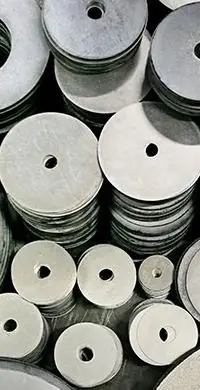
100% inspection of core runout, segment shear strength, arbor alignment, and dynamic rotational stability. Every blade undergoes rigorous torque testing prior to dispatch.

Comprehensive OEM services including laser logo etching, custom color coating, bespoke arbor bushings, and customized retail packaging for worldwide B2B partners.
Meeting rigorous global safety standards, environmental protocols, and seamless supply chain integration for industrial diamond tools.
Purchasing superhard cutting tools for global distribution requires strict adherence to international safety standards. Uncertified diamond circular saw blades operating at peripheral speeds exceeding 80 m/s pose severe safety hazards, including segment detachment and catastrophic steel core cracking.
At JIAYAN, our manufacturing engineering processes comply fully with key global abrasive tool regulations:
We provide dedicated support for international trade terms including FOB, CIF, DDP, and DAP. With robust logistics channels serving North America, Europe, the Middle East, Southeast Asia, and South America, JIAYAN ensures fast lead times, flexible Minimum Order Quantities (MOQ), and complete customs clearance documentation.
Pioneering advancements in diamond segment architecture, AI-guided grain distribution, and hybrid bonding matrices.
Transitioning from random volumetric diamond dispersion to 3D precise grid-patterned diamond positioning. This ensures every diamond crystal receives equal cutting torque, doubling tool life and increasing linear cutting speeds by 35%.
Applying ultra-thin TiN/TiC surface coatings on synthetic diamond grit. The titanium barrier prevents micro-graphitization during sintering at high temperatures, dramatically boosting diamond retention inside the metal matrix.
Integrating micro-laser cuts filled with sound-absorbing copper foil and viscoelastic polymers into the blade core, reducing operating noise below 82 dB(A) for quieter fabrication shop environments.
Connecting with global stone and ceramic leaders at premier international trade fairs and publishing cutting-edge technical insights.
Understanding critical testing procedures for laser-welded diamond saw blade joints—covering visual inspection, metallurgical microstructure analysis, and hydraulic bending shear tests.
Read Full ArticleHighlighting our continuous rim J-slot diamond blades and high-speed ceramic cutting discs at the Canton Fair Complex in Guangzhou.
Read Exhibition RecapPresenting our superhard diamond cutting solutions tailored for European sintered stone manufacturers and automated stone fabrication machinery.
Explore Global HighlightsExpert answers regarding diamond saw blade selection, cutting parameters, dressing techniques, and OEM procurement workflows.
Porcelain and sintered stone are dense, hard, and vitreous materials under high internal stress. Standard granite blades utilize hard metal bonds and coarse diamond grains that cause intense vibration and micro-chipping on delicate glazed surfaces. Porcelain saw blades feature specialized soft bronze-nickel alloy bonds, ultra-fine diamond mesh (100/120+ grit), and thin continuous rim or J-slot geometries to ensure smooth, chip-free cuts without cracking the slab.
When cutting extremely hard porcelain, the diamond points can flatten, causing the blade to wander or slow down. To dress the blade, perform 3 to 5 passes through a highly abrasive, low-density material such as an aluminum oxide dressing stone, soft firebrick, or abrasive sandstone. This wears back the metallic bond alloy and exposes sharp, fresh diamond crystals.
Continuous wet cutting with flood coolant is strongly recommended for thick porcelain slabs and sintered stone (such as 12mm or 20mm Dekton/Neolith) to dissipate thermal friction and flush micro-slurry from the kerf. For small-format ceramic tiles, ultra-thin continuous rim blades can be used for short dry cuts, but continuous water flow drastically extends blade lifespan and eliminates harmful silica dust emissions.
For 350mm (14 inch) diamond blades on CNC bridge saws, set peripheral rotation to 2,000–2,400 RPM with a linear feed rate of 1.2 to 2.5 meters per minute for 45° miter beveling. Lowering the feed rate slightly upon entry and exit prevents corner blowout and ensures seamless edge joining.
We offer comprehensive OEM customization including laser etching of custom brand logos, customized blade body paint colors, tailored segment formulas for specific local stones, bespoke arbor bore sizes (e.g., 50mm, 60mm, 25.4mm, 22.23mm with reducing bushings), and fully customized cardboard or plastic blister retail packaging.
Standard OEM order lead times range from 15 to 25 working days from technical sample approval. Samples can be prepared within 5-7 days for customer field testing. We support flexible payment terms (T/T, L/C) and full export compliance documentation.
Select a product below to request technical specification sheets, factory-direct wholesale pricing, or custom OEM samples.
Connect directly with our engineering team for factory audits, OEM customization consultations, or technical product catalogs.