Premium sintered saw blades engineered for high-speed cutting, zero-chipping performance, and extreme wear resistance across ultra-hard materials.
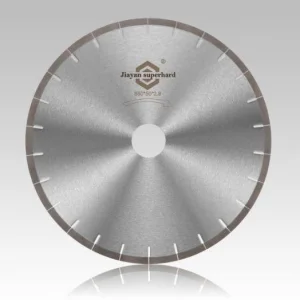
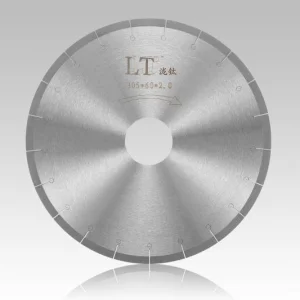
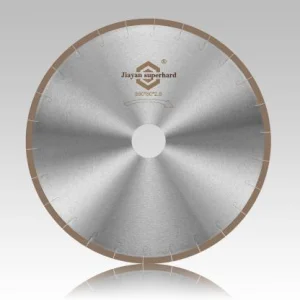
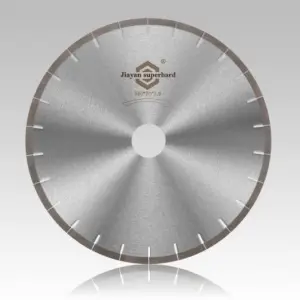
Analyzing global demand shifts, superhard abrasive manufacturing benchmarks, and industrial material science advancements across international markets.
The global construction, architectural cladding, and surface fabrication industries are undergoing a massive technological pivot. Modern architectural specifications increasingly favor high-density materials—such as ultra-compact sintered stone slabs (Dekton, Lapitec, Neolith), vitreous porcelain mega-slabs, hard quartzite, and reinforced granite. These advanced materials exhibit extreme Mohs hardness (ranging from 6.5 to 8) and possess high internal mechanical stress, presenting unprecedented challenges to traditional diamond tooling.
As premier sintered saw blade exporters and specialized manufacturing companies like JIAYAN Superhard Tools lead this transition, the benchmark for tool performance has shifted from basic material removal to complex fracture mechanics management, zero-chipping edge retention, thermal stress distribution, and extended operational lifespan. Electroplated or standard brazed tools fail under sustained industrial high-speed processing because their surface diamond bonds rapidly degrade under friction-induced heat. In contrast, hot-pressed sintered diamond saw blades establish a 3D metallurgical matrix that wears dynamically, continuously exposing fresh synthetic diamond crystals to ensure uniform cutting performance.
Global procurement directors and industrial plant operators face stringent operational requirements. Beyond pure speed, total cost of ownership (TCO) drives purchasing decisions. Sintered saw blade suppliers must provide engineered solutions capable of operating at high feed rates ($v_f \ge 2.5 \text{ m/min}$) while maintaining acoustic damping, minimizing kerf loss ($1.0\text{mm} - 1.2\text{mm}$ ultra-thin profiles), and complying with strict safety standards such as EN 13236.
Deep technical insight into Powder Metallurgy, Liquid Phase Sintering, Diamond Graphitization Prevention, and Steel Core Tension Dynamics.
The manufacturing of premium sintered saw blades relies on precise powder metallurgy. Synthetic diamond crystals (typically high-grade MBD or SDB series with high Thermal Toughness Index) are thoroughly blended with transition metal powders (Cobalt, Copper, Iron, Nickel, and Tungsten Carbide). Under simultaneous high temperature ($850^\circ\text{C} - 1050^\circ\text{C}$) and hydraulic pressure ($25 - 40 \text{ MPa}$), liquid-phase sintering compacts the matrix to near-theoretical density.
This process encapsulates each diamond particle within a tough, wear-controlled metallic matrix. The mechanical retention forces are reinforced by chemical bonding agents, such as Titanium (Ti) or Chromium (Cr) additives, forming micro-carbide interfaces ($TiC$) that prevent premature diamond pull-out during high-torque cutting operations.
At temperatures exceeding $750^\circ\text{C}$ in oxygenated atmospheres, synthetic diamond crystals begin graphitizing, transitioning from hard $sp^3$ bonded carbon to soft $sp^2$ graphite structures, leading to rapid blade failure. Leading sintered saw blade exporters utilize vacuum sintering or inert gas shielding (Nitrogen/Argon atmospheres) to protect diamond integrity.
Additionally, active metal chemical coating (Ti-coating or Co-coating) on synthetic diamond particles serves a dual purpose: acting as a thermal barrier against oxygen diffusion and increasing interfacial shear bond strength between the diamond crystal and the metal matrix.
A diamond saw blade's performance is governed equally by its segment quality and its core steel plate engineering. Industrial blades utilize 75Cr1 (AISI 1075) or 50Mn2 high-carbon spring steel, heat-treated to HRC 42–46. Precision tensioning ensures the blade remains flat and avoids wobble under thermal expansion. For noise-sensitive environments, silent cores—featuring a laminated sandwich structure of steel-copper-steel—dampen acoustic harmonics by up to 15 dB.
| Target Substrate Material | Material Hardness (Mohs) | Recommended Matrix Composition | Diamond Grit Size (Mesh) | Diamond Concentration | Coolant Requirement |
|---|---|---|---|---|---|
| Sintered Stone / Dekton | 7.0 – 8.0 | Soft Co-Cu-Fe Matrix (High wear rate for continuous sharpening) | 50/60 – 60/70 Mesh | 12% – 18% (Volumetric) | High-Volume Wet Cutting |
| Hard Granite (Class IV / V) | 6.5 – 7.5 | Medium-Hard Fe-Cu-WC Alloy Matrix | 40/50 – 50/60 Mesh | 18% – 22% (Volumetric) | Wet Cooling Required |
| Porcelain & Ceramic Tiles | 6.0 – 7.0 | Bronze-Nickel Soft Matrix (Ultra-Thin Kerf) | 60/80 – 80/100 Mesh | 15% – 20% (Volumetric) | Wet / Specialized Dry |
| Abrasive Sandstone / Concrete | 4.5 – 6.0 | Hard WC-Reinforced Matrix (Resistant to abrasion) | 30/40 – 40/50 Mesh | 22% – 28% (Volumetric) | Dry or Wet Operation |
Real-world engineering implementations across high-volume slab processing facilities, mega-project facades, and precision tile installation.
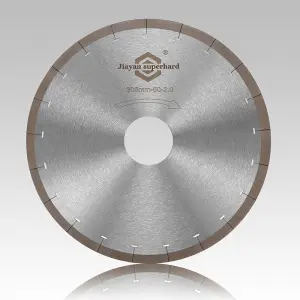
Processing large-format sintered stone slabs (3200mm × 1600mm, thicknesses 6mm–20mm) requires specialized tooling. High internal stresses in sintered slabs can cause catastrophic cracking if cut with rigid, aggressive blades. JIAYAN's 14-inch (350mm) J-Slot sintered blades feature stress-relieving slot geometries and a softer bond matrix, allowing precise 45-degree miter cuts for waterfall kitchen countertops and architectural features without edge micro-chipping.
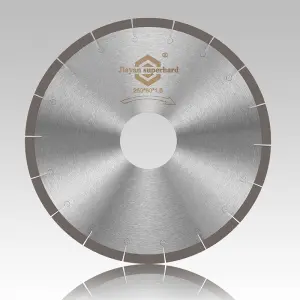
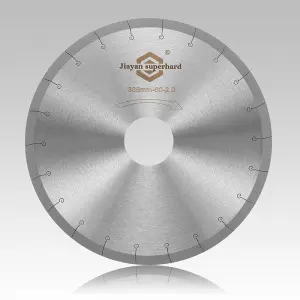
Industrial bridge saws cutting dense Class IV granite demand sustained torque and continuous diamond exposure. Sintered continuous rim and keyhole segment blades utilize cobalt-nickel alloy bonding to achieve high feed speeds ($v_f = 2.0 - 3.5 \text{ m/min}$) while maintaining square cut geometry. This minimizes downstream edge grinding labor and optimizes plant throughput.
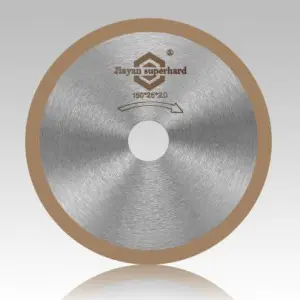
Ultra-thin ($1.0\text{mm} - 1.2\text{mm}$) continuous mesh turbo sintered blades cater to high-end interior wall cladding and floor tile installations. The fine mesh segment pattern generates low cutting forces, preventing micro-fractures in delicate glaze coatings and delivering smooth, factory-grade edge finishes directly on job sites.
Ensuring operational reliability through rigorous international safety compliance, certified metallurgical standards, and seamless procurement logistics.
Superhard diamond cutting tools operate under intense centrifugal and thermal stresses. A segment shear failure at high rotational speeds ($n \ge 4300 \text{ RPM}$) presents significant safety hazards. Export-grade sintered saw blade manufacturers adhere strictly to European Safety Standard EN 13236 ("Safety requirements for superhard abrasive products").
Quality control protocols include dynamic balance testing, axial runout checks within $\pm 0.02\text{mm}$, dynamic side-load testing, and destructive shear strength verification to ensure every segment bond withstands forces far exceeding normal operating thresholds.
For international tooling distributors, commercial blade brands, and industrial processing hubs, stable manufacturing partners are essential. JIAYAN Superhard Tools provides comprehensive white-label production services, tailored matrix engineering, and custom packaging support:
Forecasting the next generation of superhard abrasive developments: Nanostructured alloys, AI-optimized cooling channels, and smart core integration.
Emerging research focuses on incorporating nano-grained cobalt and tungsten powders into the sintering mixture. Nano-matrix structures increase mechanical toughness without sacrificing hardness, delivering a 30% reduction in diamond pull-out rates under high-impact cutting loads.
Next-generation blade designs feature laser-engraved micro-fluidic channels along segment surfaces. These channels optimize water flow across the cutting interface, accelerating slurry removal, lowering frictional temperatures by up to 120°C, and doubling blade operational life.
Future industrial bridge saw blades will incorporate micro-piezoelectric sensors within silent sandwich cores. These sensors provide real-time feedback on vibration harmonics, thermal expansion, and segment wear, enabling automated CNC feed speed adjustments for optimal cutting efficiency.
Clear, technical answers to critical questions regarding sintered saw blade selection, operation, troubleshooting, and enterprise sourcing.
Sintered Saw Blades: Diamond particles are mixed throughout a metallic powder matrix and compressed under heat and pressure. As the metal matrix gradually wears away during use, new sharp diamond crystals are continuously exposed, making them ideal for hard, abrasive materials like stone and porcelain.
Electroplated Blades: A single layer of diamond grit is electrochemically bonded to the steel core with nickel. They offer high initial sharpness but shorter lifespan, making them best suited for specialized or soft materials.
Laser-Welded Blades: Sintered segments are joined to the steel core using high-energy laser beams, creating a high-strength thermal joint suitable for heavy-duty dry cutting in construction applications.
Edge chipping is primarily caused by structural vibration, improper blade tension, or excessive feed pressure. To achieve clean, chip-free miter cuts:
Glazing occurs when the metal bond matrix is too hard for the target substrate, preventing it from wearing away to expose fresh diamond crystals. The exposed diamonds wear smooth, causing the blade to rub instead of cut, which leads to overheating and deflection.
Dressing Procedure: Sharpen a glazed blade by making several passes through a highly abrasive material, such as an orange dressing stone, sandstone, or an abrasive concrete block. This abrades the metal matrix and re-exposes sharp diamond points.
Optimal linear speed ($v_c = \frac{\pi \cdot D \cdot n}{60000}$) varies depending on the material:
When sourcing custom tooling, suppliers analyze physical stone samples or hardness/abrasiveness data from target quarries. Engineering teams then tailor the bond metallurgy (adjusting Cobalt/Copper/Tungsten ratios), diamond mesh size, and concentration. Test batches undergo automated lab trials to confirm cutting speed, service life, and acoustic metrics before full-scale manufacturing.
Explore our full lineup of OEM/ODM diamond cutting tools, certified for precision performance across stone, ceramic, and granite processing operations.