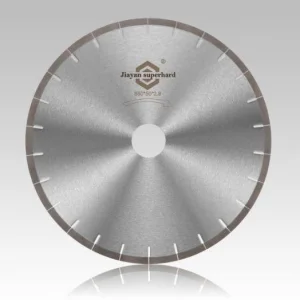
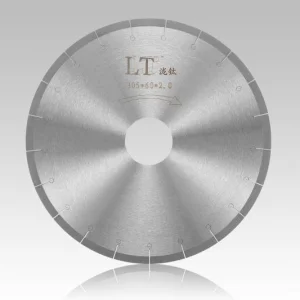
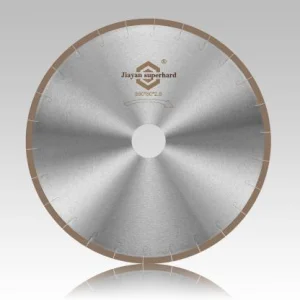
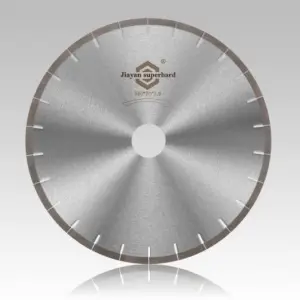
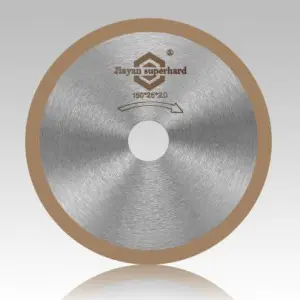
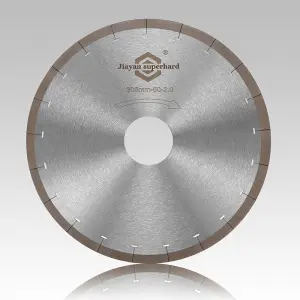
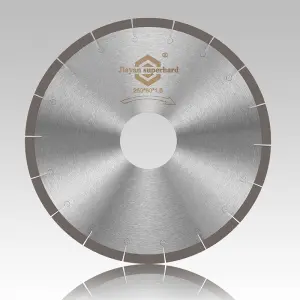
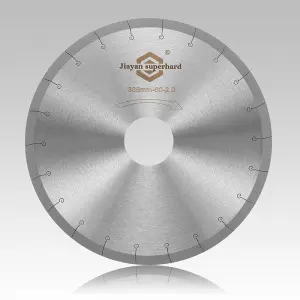
Engineered for maximum cut speed, extended wear resistance, and minimal kerf loss across ultra-hard masonry, ceramic, granite, and composite stone applications.
An authoritative analysis of diamond grit concentration, alloy matrix bonding, runout tolerance, and heat dissipation dynamics in 160mm saw blade manufacturing.
In modern industrial fabrication, construction, and precision joinery, the 160mm circular saw blade represents a critical sweet spot between portable versatility and high-torque mechanical performance. Operating typically within speed ranges of 4,000 to 9,500 RPM, a 160mm blade demands meticulous engineering. At high angular velocities, minute defects in dynamic balance, tensioning, or segment bond integrity are amplified exponentially, resulting in blade chatter, thermal distortion, rapid diamond attrition, or catastrophic segment detachment.
As an industry-leading high-quality 160mm circular saw blade manufacturer, JIAYAN Superhard Tools leverages advanced metallurgy, automated laser welding, and proprietary hot-pressing sintering technology to engineer saw blades capable of enduring extreme mechanical shear and elevated thermal loads. This whitepaper details the structural dynamics, powder matrix formulation, and quality control protocols required to produce world-class 160mm cutting tooling.
The operational lifespan and cut-rate of a diamond circular saw blade depend entirely on maintaining a synchronized rate of wear between the metal bond matrix and the embedded synthetic diamond crystals (SDA grade). If the bond is overly resistant, micro-diamonds become dull and polished without releasing, leading to friction and overheating. If the matrix erodes too quickly, unspent diamonds dislodge prematurely, drastically shortening blade service life.
The core steel disc (substrate) serves as the structural foundation of the 160mm circular saw blade. JIAYAN utilizes premium 75Cr1 (1.2003) and 65Mn spring steel, cold-rolled and vacuum heat-treated to a uniform hardness of HRc 42–46. This structural resilience prevents core warping when subjected to heavy radial torque and lateral deflection forces.
The teeth and cutting segments of high-performance 160mm saw blades are fabricated using synthetic diamond monocrystals synthesized at pressures exceeding 5.5 GPa. Depending on target application density, JIAYAN employs two primary metallurgical joining methods:
Hot-pressing simultaneously applies high hydraulic pressure (20-30 MPa) and elevated sintering temperatures (800°C–1050°C) to cobalt-nickel-iron matrix powders inside inert vacuum chambers. This process achieves near-100% theoretical density, minimizing internal porosity and maximizing diamond mechanical retention strength.
For heavy-duty dry cutting in reinforced concrete, granite, and abrasive masonry, laser welding fuses the diamond segment directly to the alloy steel core at a molecular level. A high-energy CO2 or fiber laser beam deep-melts the transition zone without thermally degrading the diamond crystals.
China commands over 70% of the world’s superhard materials supply chain. Sourcing directly from top-tier Chinese manufacturers yields strategic advantages in cost efficiency, technological innovation, and scalable production capacity.
China is home to the world's largest synthetic diamond synthesis hubs (e.g., Henan and Anhui provinces). Direct, localized access to high-purity single-crystal synthetic diamonds, cobalts, tungsten carbides, and nickel alloys cuts raw material procurement lead times and minimizes market price volatility for international buyers.
Leading Chinese plants feature end-to-end automated cold-pressing, continuous belt hot-sintering, 6-axis robotic laser welding, and automated side/radial grinding lines. This high level of automation guarantees batch-to-batch consistency, allowing JIAYAN to produce over 500,000 unit saw blades monthly with zero quality degradation.
Quality standard compliance is fundamental. Premier Chinese blade manufacturers operate under ISO9001 certified quality management systems and strictly test products against European Safety Standard EN13236. Every batch undergoes strict rotational speed safety testing (up to 1.5x maximum RPM) prior to dispatch.
Stay ahead of the competition by understanding the key technological disruptions shaping the next generation of diamond cutting tools and circular saw blades.
With the global rise of 18V/20V/36V battery-powered portable cordless plunge saws and circular saws (such as Festool, Makita, Milwaukee, and Bosch systems), reducing cutting resistance has become paramount. Modern 160mm blades are shifting toward ultra-thin kerfs (1.2mm–1.6mm compared to traditional 2.2mm blades).
Benefits: Reduces motor strain, extends battery run-time per charge by up to 35%, generates significantly less material dust, and minimizes wasteful stock removal on high-value materials like engineered sintered stone slabs.
Leading manufacturers are replacing manual inspection with high-speed AI machine vision systems. Camera sensors analyze synthetic diamond particle sizes, shape regularity, and magnetic susceptibility prior to powder mixing, ensuring precise grit density distribution throughout every segment matrix.
Impact: Completely eliminates structural weak spots in segment rims, preventing localized overheating, premature dislodgement, and uneven blade wear.
Environmental regulations and supply volatility surrounding cobalt have driven R&D into alternative iron-copper-nickel (Fe-Cu-Ni) alloy matrices. Advanced nano-particle additions allow these eco-friendly bonds to equal or exceed the hardness and thermal conductivity of traditional high-cobalt bonds.
Impact: Lower manufacturing costs passed to wholesale buyers while meeting strict European REACH and RoHS environmental standards.
Rather than continuous uniform rim segments, 160mm saw blades are increasingly adopting engineered J-slots, turbo-mesh edges, and pre-sharpened multi-layer segment geometries. This geometry enhances water flushing during wet cuts and air cooling during dry cuts, dramatically improving chip removal velocity.
Impact: Increases cutting speed by 25–40% on ultra-hard porcelain and quartzite while virtually eliminating edge chipping.
Matching the right 160mm circular saw blade engineering parameters to specific material hardness, machine specs, and jobsite environments.
Challenge: Sintered stone slabs (e.g., Dekton, Neolith, Lapitec) exhibit extreme internal material tension and Mohs hardness levels above 7. Standard blades cause edge blowouts, hair-line fracture cracks, and immediate blade glazing.
JIAYAN Solution: 160mm continuous rim mesh turbo blades with specialized soft iron-bronze bond matrices and high-grade 40/50 mesh diamond particles. Provides flawless, chip-free 45-degree miter cuts for countertop fabricators.
Challenge: High-speed ripping and cross-cutting of melamine-faced particle board, MDF, and hardwood require zero micro-chipping on delicate top laminates.
JIAYAN Solution: 160mm micro-grain tungsten carbide tipped (TCT) blades featuring Alternate Top Bevel (ATB) geometry, anti-vibration laser slots, and Teflon non-stick coatings to prevent pitch buildup and thermal burn marks.
Challenge: Dry cutting brick, reinforced concrete lintels, roof tiles, and granite pavers using handheld 160mm circular saws in dusty site conditions.
JIAYAN Solution: Laser-welded 160mm keyhole segment blades designed for dry operation. Micro-segment design maintains clean cutting force under variable manual operator feed pressure.
Critical evaluation metrics for industrial distributors, OEM brand managers, and large-scale procurement directors when evaluating saw blade manufacturers.
When procuring 160mm circular saw blades in bulk quantities (5,000 to 100,000+ units), sophisticated procurement managers look far beyond initial unit price. The true measure of procurement success is the Total Cost of Ownership (TCO), which includes cut speed efficiency, tool change downtime, freight efficiency, and warranty claim rates.
A lower-cost blade that wears out after 50 linear meters of cutting in 20mm granite yields a significantly higher cost-per-meter than a premium engineered blade costing 25% more that achieves 200 linear meters. JIAYAN provides certified lab test reports quantifying linear meter performance on standard benchmark substrates.
Global markets require distinct arbor bore dimensions (e.g., 20mm for European cordless saws, 5/8" (15.88mm) with diamond knockout for North America, and 25.4mm for Asian bench machinery). Manufacturers must offer precise CNC reaming, reduction rings, and custom drive-pin hole configurations.
From custom laser-etched logos, color-coded blade coatings, and barcode serialization to retail-ready blister packs or eco-friendly corrugated box packaging, JIAYAN provides complete OEM turnkey solutions for international tool brands.
Maintaining stable production schedules with flexible Minimum Order Quantities (MOQ starting at 200 units per spec) allows distributors to optimize inventory turnover while safeguarding against stockouts during seasonal demand peaks.
Comprehensive engineering comparison across JIAYAN 160mm blade configurations to guide your technical selection.
| Blade Series Type | Kerf Width / Core Thick | Target Substrate Materials | Segment Manufacturing Method | Optimal RPM Range | Cutting Mode |
|---|---|---|---|---|---|
| Ultra-Thin Continuous Rim | 1.2mm / 0.9mm | Porcelain, Ceramic, Glass Tiles, Thin Sintered Slabs | Vacuum Hot-Pressed Sintering | 6,500 – 9,500 RPM | Wet / Light Dry |
| J-Slot Turbo Mesh | 1.4mm / 1.0mm | Hard Granite, Sintered Stone, Quartzite, Marble | Hot-Pressed Sintering + J-Slot Laser Relief | 5,500 – 8,500 RPM | Wet Preferred / Dry |
| Laser Welded Masonry | 2.0mm / 1.4mm | Reinforced Concrete, Brick, Block, Asphalt, Stone | Automatic Laser Beam Welding | 4,500 – 7,500 RPM | Dry / Wet Operation |
| Professional TCT Woodworking | 1.8mm / 1.2mm | Hardwood, Softwood, MDF, Melamine Laminates | Tungsten Carbide Braze (ATB Tooth) | 5,000 – 9,000 RPM | Dry Operation Only |
In-depth technical answers addressing common procurement, mechanical, and operational inquiries.
Select from our comprehensive lineup of diamond saw blades and cutting discs certified for industrial performance.