Explore our top-tier precision diamond continuous rim blades and industrial cutting discs, manufactured with advanced hot-pressed sintering technology for global commercial applications.
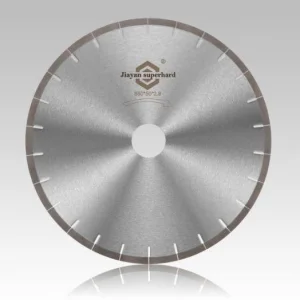
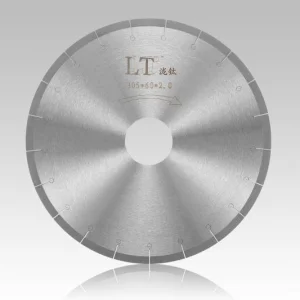
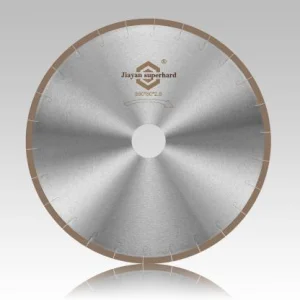
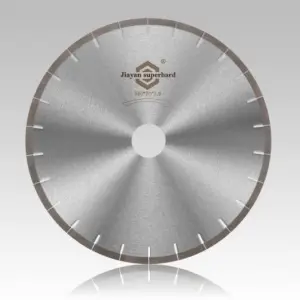
An exhaustive analysis of global architectural surface fabrication, precision cutting dynamics, and B2B procurement trends across high-density synthetic substrates.
The rapid global transition toward large-format porcelain slabs, ultra-compact sintered surfaces (such as Dekton®, Neolith®, and Lapitec®), and dense vitrified tiles has created unprecedented challenges for traditional cutting tools. Material hardness ratings exceeding Mohs 7, combined with high internal tension, demand precision cutting media that prevent edge micro-fracturing, structural stress relief cracking, and surface spalling.
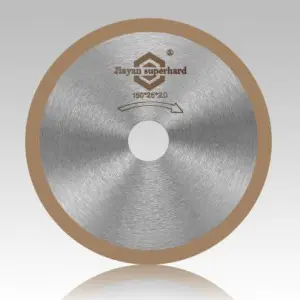
Industrial buyers, stone fabricator networks, and regional distributors require 7″ (180mm) diamond blades that deliver a low total cost per linear meter cut. The 7-inch outer diameter (OD) format represents the global standard for manual bridge saws, heavy-duty tile saws, and variable-speed power angle grinders used in residential cladding and commercial fit-out projects.
While segmented blades excel in rapid debris evacuation during rough granite or green concrete cutting, continuous rim geometry provides an uninterrupted contact zone. This smooth, continuous contact prevents the hammer-effect inherent in segmented designs, protecting delicate glass matrix surfaces and preventing catastrophic slab shattering during high-RPM operations.
An in-depth technical exploration into the metallurgical formulations, micro-crystalline synthetic diamond selection, and automated hot-pressing parameters developed by JIAYAN Superhard Tools.
The performance of a 7″ continuous diamond blade is fundamentally dictated by the thermal stability and mechanical friability of its diamond abrasive crystals. JIAYAN utilizes premium industrial synthetic diamonds (MBD-8 series and titanium-coated synthetic crystals) characterized by complete cubo-octahedral geometry.
By controlling the mesh size distribution (typically 60/70 mesh for heavy ceramic cutting and 80/100 mesh for ultra-fine porcelain glazing work), the cutting edge maintains a self-sharpening mechanism. As individual diamond crystals fracture at micro-scale under shear stress, new sharp cutting points are continuously exposed without shedding the crystal prematurely.
The metal matrix powder formulation serves as the holding bond for diamond crystals. Traditional low-cost blades rely on simple bronze-copper alloys that suffer from rapid thermal erosion under dry or high-speed cutting conditions.
JIAYAN’s proprietary continuous rim matrix combines high-purity Cobalt (Co), Fine-Grain Iron (Fe), Nickel (Ni), and Tungsten Carbide (WC) additives. This advanced metallurgical matrix undergoes computer-controlled hot-pressing at temperatures exceeding 820°C under 35 MPa of hydraulic pressure, locking diamond crystals into a dense, non-porous metallic structure with zero internal voids.
The central steel plate (65Mn spring steel, hardened to HRC 44±2) undergoes multi-stage tensioning and precision laser flat-grinding. Dynamic balance testing ensures that peripheral runout is held within ≤0.02mm.
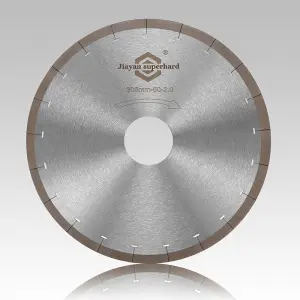
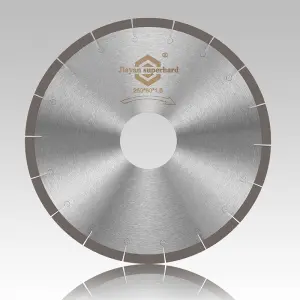
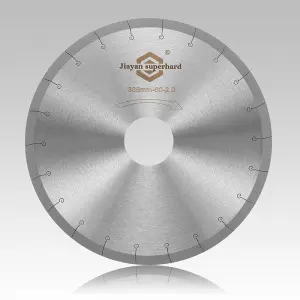
This rigid core construction eliminates blade wobble, wandering, and harmonic chatter during deep miter cuts. Laser-cut thermal expansion slits (J-slots and keyhole slots) are strategically positioned to dissipate localized heat generation and accommodate radial thermal expansion during intensive continuous cutting cycles.
To maximize fluid flow and debris removal in wet cutting operations, continuous rim geometries are engineered with micro-grooved patterns (such as mesh-turbo continuous profiles and ultra-thin continuous borders).
These hydro-dynamic channels pump coolant liquid directly into the cutting zone, flushing micro-ceramic slurry out of the kerf. This lowers operating temperatures, prevents diamond matrix glazing, and extends tool operational lifespan by up to 45% compared to conventional flat-rim continuous blades.
Detailed technical specifications for B2B procurement managers, machine operators, and OEM tool distributors.
| Blade Diameter | Rim Type & Profile | Rim Height | Rim Thickness | Arbor Hole (Bore) | Optimal Substrates | Operation Mode |
|---|---|---|---|---|---|---|
| 7″ (180 mm) | Ultra-Thin Continuous Smooth Rim | 8.0 mm / 10.0 mm | 1.2 mm / 1.4 mm | 22.23 mm / 25.4 mm | Porcelain Slabs, Vitrified Tiles, Glass Mosaics | Wet / Light Dry |
| 7″ (180 mm) | Mesh-Turbo Continuous Hybrid Rim | 10.0 mm / 12.0 mm | 1.4 mm / 1.6 mm | 22.23 mm / 25.4 mm (with ring) | Sintered Stone, Ultra-Compact Surfaces, Dekton® | Wet Recommended |
| 7″ (180 mm) | J-Slot Continuous Expansion Rim | 10.0 mm | 1.6 mm / 2.0 mm | 22.23 mm / 25.4 mm / 50 mm | Marble Slabs, Quartzite, Hard Ceramic Panels | Wet Cutting |
| 10″ (250 mm) | Heavy-Duty Continuous Bridge Saw Rim | 10.0 mm / 12.0 mm | 2.0 mm / 2.2 mm | 50.0 mm / 60.0 mm | Commercial Engineered Quartz & Granite Slabs | Wet Cutting Only |
| 14″ (350 mm) | Industrial Sintered Continuous Segment | 12.0 mm / 15.0 mm | 3.0 mm / 3.2 mm | 50.0 mm / 60.0 mm | Granite Blocks, Thick Porcelain Slabs, Ceramic | Heavy Wet Cutting |
Real-world operational guidelines for stone fabricators, ceramic tile processing facilities, and construction job sites.
Sintered stone panels possess extreme density and high internal stress. Cutting 12mm or 20mm kitchen countertop slabs requires a 7″ continuous mesh blade operated under continuous water coolant flow at 4,500 - 6,000 RPM. Feed rate should be maintained at 1.2 to 1.8 meters per minute to prevent edge blowout during exit cuts.
Modern architectural projects utilize 6mm ultra-thin porcelain sheets measuring up to 1600x3200mm. Achieving chip-free 45-degree miter cuts for corner profiling demands a 7″ continuous ultra-thin rim blade (1.2mm thickness) mounted on a precision sliding table saw or guide-rail cutter.
Brittle glass mosaic tiles and high-gloss vitrified ceramics require a soft bronze-metal matrix continuous rim blade that wears away smoothly. This prevents crystal friction overheating, eliminating micro-cracking and chipping along delicate top surface glazes.
How JIAYAN Superhard ensures absolute product reliability, operational safety, and international regulatory compliance for global buyers.
All 7″ diamond continuous rim blades produced by JIAYAN strictly conform to European Safety Standard EN13236 for superhard abrasive products. Every batch undergoes destructive testing, bursting speed testing (up to 1.5x max rated RPM), and bending strength verification of the sintered continuous rim segment.
As an active member of the China Superhard Material Association, JIAYAN operates fully certified ISO 9001:2015 production lines in Wuhu, China. Automated powder weighing, cold compression molding, vacuum sintering, and automatic robotic sharpening guarantee identical performance across every batch.
To protect motor bearings on high-speed saws and prevent operator fatigue, 100% of finished 7″ diamond blades undergo dual-axis laser runout inspection. Blades exceeding 0.02mm lateral displacement are automatically rejected before final packaging.
Pioneering advancements in diamond matrix synthesis, silent dampening cores, and AI-driven laser inspection.
JIAYAN’s R&D division is actively developing next-generation nanocrystalline metal powders. By refining matrix grain sizes down to sub-micron scales, the retention force holding synthetic diamond crystals increases by over 30%. This innovation allows thinner rim profiles (down to 1.0mm) without compromising structural integrity or tool longevity.
Noise pollution on industrial job sites remains a critical health concern. Our upcoming continuous rim line integrates laser-cut sound-dampening slots injected with specialized copper-elastomer resins. This sandwich-core design reduces high-frequency cutting noise by up to 15 decibels while absorbing harmonic vibrations during deep miter cuts.
Select from our comprehensive inventory of high-performance diamond continuous saw blades, OEM discs, and superhard stone tools.
Answers to critical questions regarding 7-inch continuous diamond saw blade selection, operation parameters, and maintenance protocols.
A 7″ continuous rim diamond blade features an uninterrupted, smooth matrix edge around its entire perimeter. Unlike segmented blades (which have open gullets for fast material removal on concrete/granite) or turbo blades (which have corrugated ridges), continuous rim blades distribute cutting force smoothly without impact shock. This makes continuous rim blades essential for delicate, brittle, or high-density substrates like sintered stone, glass, glazed ceramic, and vitreous porcelain where edge micro-chipping or top-surface cracking cannot be tolerated.
When cutting ultra-dense materials like vitreous porcelain, the metallic matrix can occasionally glaze over, covering the exposed diamond sharp points. To restore cutting speed and sharpness, make 3 to 5 shallow passes through an abrasive dressing stone, soft sandstone brick, or dense silicon carbide block. This wears away the excess metal matrix bond and exposes fresh, sharp diamond crystals.
Standard 7″ (180mm) continuous diamond blades are manufactured with standard 22.23mm (7/8″) or 25.4mm (1″) inner arbor bores, compatible with angle grinders and circular tile saws. OEM custom arbor sizes up to 50mm or 60mm with brass reduction rings are available upon request. Recommended operating speed ranges from 4,500 RPM to 8,500 RPM depending on substrate density and machine rigidness.
While JIAYAN’s hot-pressed continuous blades are engineered with high-thermal stability cobalt matrices that permit light dry cutting on standard ceramic tiles, continuous wet cutting is strongly recommended for dense sintered stone, Dekton, and thick porcelain slabs. Water cooling flushes out abrasive slurry, prevents core warping from thermal expansion, and extends blade life by 30% to 50%.
Blade deflection during miter cuts is usually caused by excessive feed pressure, an under-tensioned steel core plate, or worn mounting flanges. To eliminate wobble, ensure flange diameter is at least 1/3 of the blade diameter, maintain constant moderate feed pressure without forcing the machine, and verify that the core steel thickness (e.g., 1.4mm to 1.6mm) is appropriate for deep beveling.
JIAYAN Superhard Tools offers comprehensive OEM/ODM programs including custom laser engraving (brand logo, part numbers, safety warnings), customized color coating, customized color box/blister packaging, and tailored matrix formulas designed specifically for regional stone or tile characteristics.
Connect directly with our engineering team in Wuhu, China to request product samples, factory audits, or custom technical OEM quotes for high-quality 7″ diamond continuous rim blades and industrial cutting tooling.