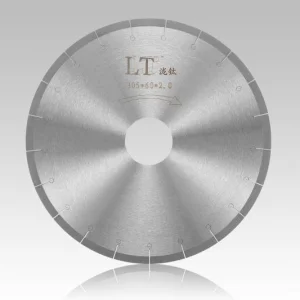
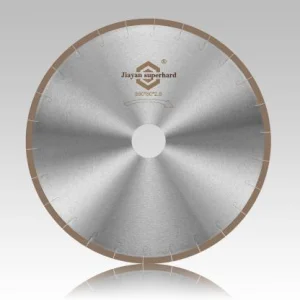
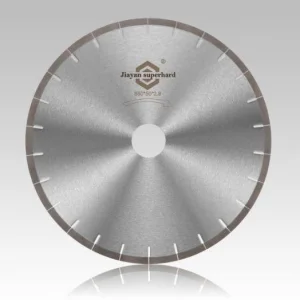
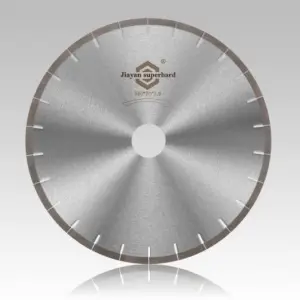
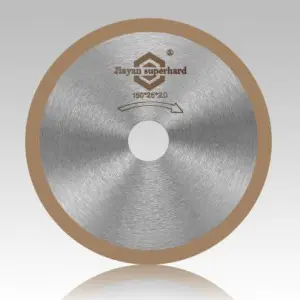
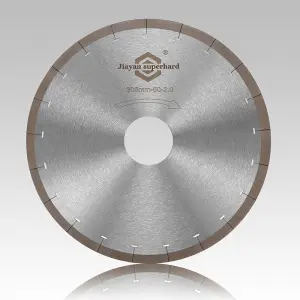
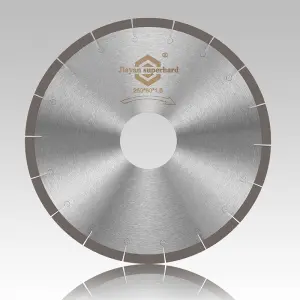
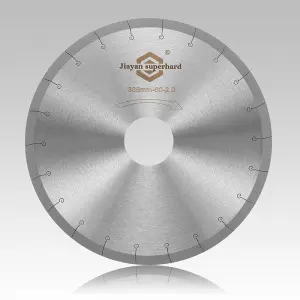
Engineered for extreme wear resistance, fast chip clearance, and clean edge quality across hard timber, laminated wood, and synthetic composites.
An authoritative analysis of tooth geometry, steel metallurgy, thermal dissipation dynamics, and fatigue-resistant body design for professional woodworking manufacturers.
Selecting the ideal substrate steel dictates blade operational longevity. High-Carbon Steel (HCS 65Mn / SK5) provides exceptional elasticity and tooth sharpness for softwoods, while Bi-Metal (BIM - electron-beam welded M42 high-speed steel teeth bonded to a spring-steel body) delivers superior flex fatigue resistance when cutting dense hardwoods, laminated timbers, and wood containing hidden fasteners.
The cross-cutting dynamics depend heavily on tooth configurations. Side-set and milled teeth deliver rapid, aggressive plunge cuts in rough construction timber. Conversely, taper-ground, cross-bevel precision teeth produce tear-free, splinterless kerfs across delicate melamine veneers, solid oak, and decorative hardwood joinery.
Modern high-performance jigsaw systems require maximum force transmission without chuck slippage. Industry-standard single-lug T-shank designs ensure seamless power transfer, minimal vibration amplitude, and tool-free quick-change capabilities compatible with leading global power tool brands such as Bosch, Makita, DeWalt, and Milwaukee.
| Blade Material Grade | Hardness Rating (HRC) | Recommended Wood Substrates | Teeth Per Inch (TPI) Range | Kerf Width & Cut Quality |
|---|---|---|---|---|
| High-Carbon Steel (HCS SK5) | HRC 48 - 52 | Softwood, Pine, MDF, Plywood, Fiberboard | 6 TPI - 10 TPI (Progressive) | Fast Rough Cut (1.2mm - 1.5mm kerf) |
| Chrome Vanadium Steel (CrV) | HRC 52 - 55 | Hardwoods, Beech, Birch, Construction Timber | 8 TPI - 12 TPI | Clean Medium Cut (1.3mm kerf) |
| Bi-Metal (BIM M42 + D6A) | HRC 65 - 67 (Tooth Tip) | Nail-Embedded Wood, Teak, Laminate, Parquet | 10 TPI - 14 TPI | Ultra-Clean Splinter-Free (1.1mm kerf) |
| Tungsten Carbide Tipped (HM/TCT) | HV 1500 - 1800 | High-Density Fiberboard (HDF), Cement Composite Wood | 6 TPI - 8 TPI Carbide Strips | Extreme Wear Resistant (1.4mm kerf) |
Examining the scale, vertical integration, automated CNC grinding technology, and strict quality control standards driving the global supply chain.
Chinese manufacturing centers utilize multi-axis CNC laser cutting and automated tooth grinding lines. This eliminates dimensional variance, guaranteeing pitch-to-pitch consistency within ±0.005mm tolerances across million-unit production batches.
State-of-the-art continuous vacuum heat-treatment furnaces perform computerized quenching and tempering cycles. This ensures uniform internal martensitic grain refinement, dramatically boosting fatigue limit and impact resistance.
Direct integration with premier domestic strip steel suppliers and superhard material manufacturers like JIAYAN Superhard streamlines raw material sourcing, reducing procurement overhead while enforcing rigorous metallurgical purity standards.
Chinese suppliers offer comprehensive white-label and OEM solutions—from custom laser-etched branding and high-definition blister cards to specialized multi-pack blade assortments tailored for industrial distributors worldwide.
Discover how advanced surface coatings, cordless power optimization, and vibration damping slot geometries are reshaping wood cutting performance.
Modern cutting applications increasingly employ Fluoropolymer, TiN, and Black Oxide non-stick coatings. These ultra-thin protective barriers prevent pitch and resin accumulation during continuous hardwood cutting, reducing heat buildup by up to 35% and preventing blade binding.
With the rapid adoption of lithium-ion cordless jigsaws, battery efficiency is paramount. Ultra-thin kerf profiles engineered with progressive TPI spacing lower cutting resistance, enabling up to 45% more cuts per battery charge while preserving structural rigidity.
Strategic laser expansion slots filled with sound-dampening polyurethane resin eliminate high-frequency harmonics during high-speed reciprocating action. This results in smoother cut surfaces, lower decibel output, and reduced operator hand fatigue.
Selecting the exact jigsaw blade parameter set tailored for specialized woodworking trades, architectural joinery, and heavy construction framing.
Challenge: Preventing top-face chip-out on double-sided melamine veneers and solid hardwood countertops.
Solution: Reverse-tooth HCS or BIM blades (T101BR series) where down-thrust cutting force compresses decorative surface fibers into the core material, resulting in clean, tear-free top edges.
Challenge: Binding and blade deformation when navigating sharp curves and intricate artistic cuts.
Solution: Narrow-body scroll saw blades (width < 4.5mm) with back-bevel tooth clearance, allowing tight turning radiuses down to 5mm without blade scorching or binding.
Challenge: Rapidly cutting thick structural beams (up to 100mm) with straight perpendicular accuracy.
Solution: Extra-thick (1.7mm) high-carbon steel blades featuring large side-set teeth (6 TPI) engineered to purge thick sawdust rapidly and maintain straight alignment.
A decision-maker's guide to vendor qualification, quality assurance compliance, and global supply chain risk mitigation.
Enterprise buyers must demand compliance with international safety standards such as EN847-1 (safety requirements for rotary woodworking tools) and ISO 9001:2015 manufacturing certifications to ensure operational safety and batch repeatability.
Leading manufacturers implement automated Rockwell (HRC) and Vickers (HV) micro-hardness testing across raw material coils and finished teeth. Random sampling protocols guarantee that every blade batch conforms to specified elasticity limits.
Robust enterprise procurement relies on full traceability from raw steel melt heats to packaged goods. Partnering with suppliers with flexible shipping agreements ensures resilience against global supply chain disruptions.
Direct answers to crucial questions asked by tool distributors, OEM buyers, and industrial procurement managers.
High-Carbon Steel (HCS) blades are constructed from monolithic high-carbon spring steel, making them cost-effective and flexible for softwoods, pine, and fiberboard. Bi-Metal (BIM) blades feature a high-speed steel (M42) tooth strip electron-beam welded to a spring steel backing. BIM offers over 2x to 3x the lifespan of HCS when cutting dense hardwoods, abrasive particleboard, or wood with embedded nails.
Standard jigsaw blade teeth cut on the upward stroke, pulling wood fibers upward against the saw footplate, which can chip delicate top laminates. Reverse-tooth blades (down-cutting blades) feature teeth pointing downward, cutting on the stroke into the workpiece. This pushes decorative face fibers downward into the core, guaranteeing a clean, tear-free top kerf edge.
China's superhard tool manufacturing hubs provide complete supply chain integration. From specialized strip steel heat-treatment to automated multi-axis tooth grinding and custom laser etching, Chinese manufacturers deliver high dimensional accuracy, flexible MOQs, competitive cost structures, and certified quality controls (ISO 9001, CE, EN847).
For dense hardwoods like Oak, Maple, and Teak, a medium tooth pitch of 8 TPI to 10 TPI with taper-ground teeth provides the optimal balance between cutting speed and chip ejection, preventing overheating and blade burning while maintaining smooth cut surfaces.

Select from our benchmark product line designed for extreme durability and precise kerf control.