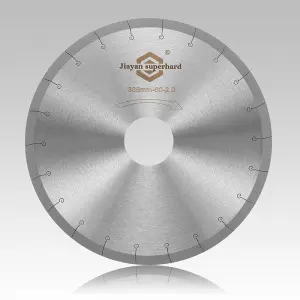
Direct from top-tier Chinese superhard materials manufacturing facilities — optimized for high speed, chipless cutting, and extended blade lifespan.
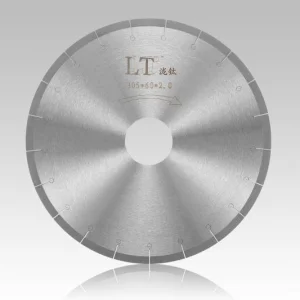
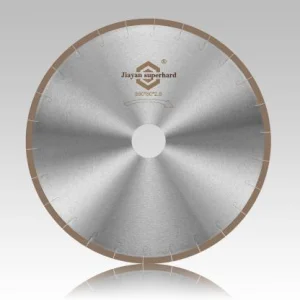
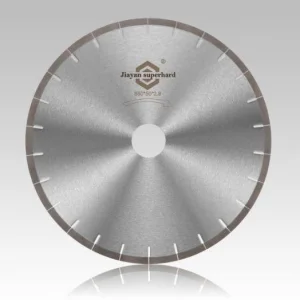
An in-depth metallurgical analysis on diamond grit synthesis, bond matrices, thermal hydrodynamic cooling, and structural stability for global stone fabricators.
In high-performance industrial cutting, the performance of a wet cut circular saw blade is primarily determined by the synthesis between synthetic diamond crystals and the supporting metallic matrix. Premium factories utilize synthetic diamond grit (typically SDA-100 grade or higher) featuring well-defined cubo-octahedral crystalline structures. This geometry ensures controlled micro-fracturing—a process where worn diamond facets flake off under stress to expose sharp, unpassivated cutting edges.
The metallic matrix powder composition (comprising varying ratios of Cobalt, Copper, Iron, Nickel, and Tungsten Carbide) must be matched precisely to the abrasion profile of the target substrate:
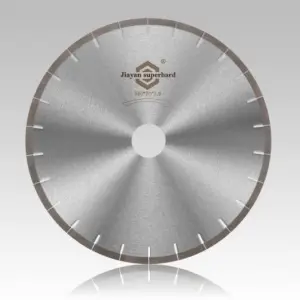
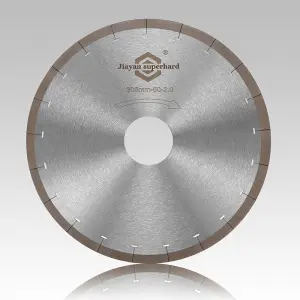
Wet cutting relies on continuous water flow to flush slurry out of the cut zone. Engineered J-slots, keyhole gullets, and custom fluting rapidly discharge abrasive stone slurry, preventing secondary wear on the steel core.
Water cooling keeps operating temperatures below the thermal degradation limit of diamond grit (approx. 700°C). This prevents thermal expansion of the steel core, eliminating blade wobble and radial runout.
Industrial wet saws feature a multi-layer steel core sandwich construction (Steel-Copper-Steel). This sandwich dampens acoustic resonance, reducing operating noise levels by up to 15 dB during fabrication.
Select the optimal blade geometry, segment height, matrix hardness, and operating parameters for your specific industrial machinery.
| Target Substrate | Mohs Hardness | Recommended Bond Type | Segment Geometry | Optimal RPM (350mm) | Water Flow Rate |
|---|---|---|---|---|---|
| Sintered Stone / Dekton / Neolith | 7 - 8+ | Ultra-Soft Bronze/Nickel Matrix | J-Slot Continuous Rim | 1,800 - 2,200 RPM | 12 - 15 L/min |
| Hard Granite (Class 4 & 5) | 6.5 - 7 | Soft Cobalt-Iron Alloy | Keyhole Segmented Rim | 1,450 - 1,800 RPM | 15 - 20 L/min |
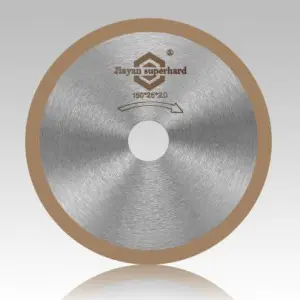
| Porcelain & Ceramic Tiles | 6 - 7 | Medium-Soft Sintered Bond | Super-Thin Continuous Mesh | 2,500 - 3,200 RPM | 8 - 10 L/min |
| Calcite Marble & Limestone | 3 - 4 | Hard Iron-Tungsten Matrix | Laser-Welded Keyhole | 1,600 - 2,100 RPM | 10 - 14 L/min |
| Reinforced Bridge Concrete | 5 - 6 | Extra-Hard Abrasion Resistant | Deep Drop-Segment Protection | 1,200 - 1,600 RPM | 20+ L/min |
Why Tier-1 OEM/ODM factories in Anhui and Zhejiang dominate global diamond saw blade exports through technological scale and vertical integration.
China accounts for over 70% of the world's synthetic diamond production and superhard tool manufacturing. As an established wet cut circular saw manufacturer and exporter, modern Chinese facilities leverage end-to-end industrial integration—from raw synthetic diamond crystallization to automated hot-press sintering and laser segment welding.
Fully automated computer-controlled hot-pressing sinter units maintain uniform temperature and pressure vectors across all segment molds. This eliminates density micro-voids, guaranteeing 100% segment structural integrity.
Laser welding creates a metallurgical bond between the diamond segment and the high-alloy steel core that far surpasses traditional silver brazing. Laser-welded joints resist high thermal spikes even during temporary coolant pressure drops.
Every industrial circular saw blade undergoes double-axis dynamic balancing. Radial and axial runout tolerance is maintained below 0.05mm to ensure vibration-free cutting and perfectly smooth cut surfaces.
Evaluating diamond tool procurement beyond unit price—calculating linear cost-per-meter, machine downtime, and edge re-work overhead.
For large-scale stone fabricators, ceramic processing plants, and construction distributors, purchasing saw blades solely based on initial unit price leads to inflated long-term operational costs. High-quality wet cut circular saws engineered with superior diamond concentration lower the total operational expense per cut meter.
Total Cost Per Meter = (Blade Purchase Cost + Labor & Power Cost During Cutting + Downtime Cost During Blade Swap) / Total Meters Cut
By upgrading from low-tier economy blades to premium engineered wet blades from certified exporters:
Ensuring compliance with international safety norms, noise reduction laws, and crystalline silica dust exposure standards.
All exported wet circular saw blades conform strictly to European Standard EN 13236. This dictates safety requirements for superhard abrasive products, ensuring extreme resistance against segment detachment during high-RPM operations.
Wet cutting systems comply directly with OSHA's Respirable Crystalline Silica Standard (29 CFR 1926.1153). Continuous water delivery suppresses hazardous airborne silica dust by over 99%, safeguarding operator health.
From batch incoming raw material spectral testing to post-sinter shear testing, every production run is logged under ISO 9001 certified quality controls, giving global buyers full batch-level traceability.
Tailored cutting solutions engineered for specific regional stone varieties, workshop machinery, and architectural construction jobs.
Modern architectural countertops use engineered slabs (e.g., Dekton, Neolith) that possess high internal tension. Our specialized 14-inch J-Slot wet cut blades release material tension smoothly during cutting, preventing catastrophic slab cracking and micro-chipping along finished edges.
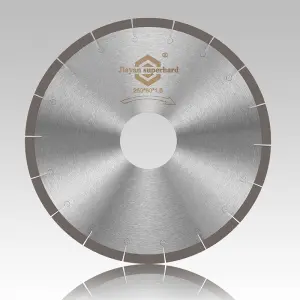
Heavy-duty bridge saw machinery operating in natural granite processing plants require large-diameter (350mm–800mm) laser-welded segmented blades. These tools withstand continuous multi-shift wet cutting in dense Brazilian, Indian, and Chinese granite grades.
Precision tile installers require ultra-thin continuous rim blades for 45-degree miter cuts (Jolly cutting). Ultra-thin 1.0mm-1.2mm profiles ensure minimal cutting resistance, crisp clean lines, and zero glaze blowout on polished porcelain tiles.
Expert insights addressing key technical, operational, and procurement queries from global buyers and stone fabricators.
Wet cut blades utilize water to continuously cool the blade matrix, flush away abrasive slurry, and reduce friction. This prevents thermal degradation of synthetic diamonds, eliminates steel core warping, extends tool lifespan by up to 3x compared to dry cutting, and completely suppresses dangerous airborne silica dust.
Glaze occurs when the metal bond is too hard for the target substrate, preventing the matrix from eroding to reveal fresh diamonds. The blade rubs instead of cutting. To fix this, "dress" the blade by making several cuts into an abrasive material like soft sandstone or an orange dressing stone to wear back the bond and re-expose sharp diamond grit.
For standard 350mm (14-inch) bridge saw blades, a continuous flow rate of 12 to 18 Liters per minute at a pressure of 2 to 3 bar is recommended. Water jets must be directed squarely at the point of contact between the blade segment and the stone material on both sides of the core.
Tier-1 factories offer comprehensive OEM/ODM customization, including custom segment formula matching for local stone types, laser-etched branding, custom arbor hole diameters (e.g., 50mm, 60mm, 25.4mm with drive pin holes), specialized slot geometries (J-slot, keyhole, silent core), and custom packaging.
Laser welding melts the segment metal matrix directly onto the steel blade core, creating a bond with exceptionally high shear strength that resists intense thermal spikes. Silver brazing uses a filler solder alloy; while cost-effective for wet cutting applications, it can detach if water flow fails and temperatures exceed the solder melting point (600°C+).
Factory QA protocols include: 1) Segment Shear Test (verifying minimum weld strength per EN13236 standards); 2) Acoustic Resonance & Core Tensioning Check; 3) 100% Dynamic Balance Inspection; 4) Axial/Radial Runout Measurement under dial indicators.
Explore our export-ready range of high-performance superhard cutting discs for global industrial distributors and stone fabrication yards.