Engineered with proprietary metal bond matrices and high-grade synthetic diamond crystals for zero-chipping, maximum linear cut speeds, and extended thermal wear resistance.
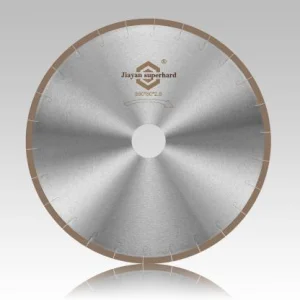
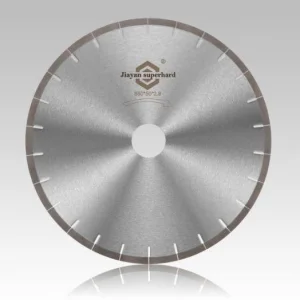
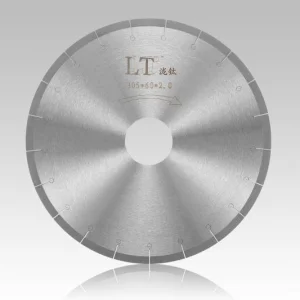
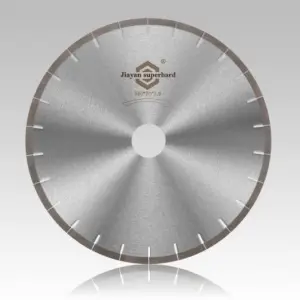
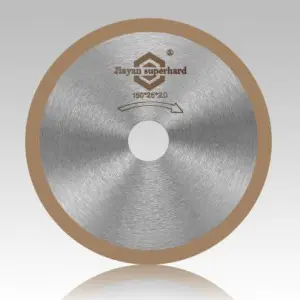
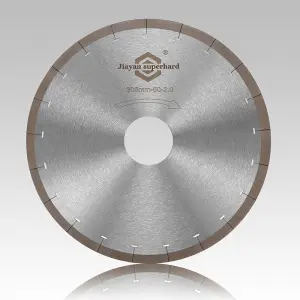
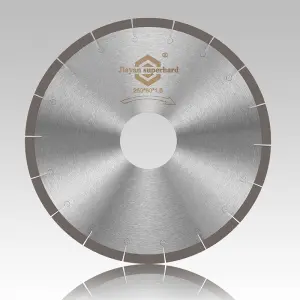
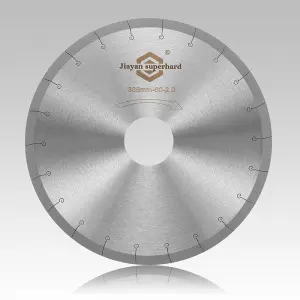
In modern high-speed stone fabrication, architectural ceramic manufacturing, and heavy infrastructure masonry, the diamond saw blade is no longer treated as a simple consumable; it is a precision-engineered tribological tool. As hard materials evolve—transitioning from soft natural marbles to highly dense ultra-compact sintered stones (such as Dekton, Neolith, and porcelain mega-slabs)—the stress placed upon cutting tools has scaled exponentially. Achieving clean edge geometry without micro-chipping while sustaining elevated linear cut speeds requires sophisticated control over metallurgy, synthetic diamond synthesis, and hydrodynamic coolant delivery.
Key Engineering Insight: Wet cutting diamond tools rely on a continuous fluid film (water under controlled pressure) to achieve three vital functions: dynamic thermal dissipation at the segment-material interface, rapid slurry ejection, and friction reduction. This prevents premature diamond graphitization (which occurs at temperatures above 700°C) and prevents steel core thermal warping.
Moving beyond random diamond distribution, 3D automated array technology aligns synthetic diamond grit in precise mathematical spatial grids, maintaining identical diamond exposure and cutting pressure per grain throughout the segment's lifespan.
Industrial bridge saw operations in urban zones require strict decibel control. Modern blades incorporate laser-welded multi-layer steel cores embedded with viscoelastic copper dampening layers to reduce operational noise by up to 15 dB.
J-slot geometry combined with sub-1.2mm kerf profiles reduces mechanical resistance, allowing clean, burst-free cuts on fragile, high-tension porcelain tiles without causing edge chipping or core flexing.
As global environmental regulations crack down on hazardous silica dust emissions (OSHA silica dust standards), industrial fabricators are rapidly transitioning from dry cutting to fully enclosed, automated wet cutting setups. This shift has elevated the demand for customized diamond blades designed to handle high-flow water slurries while resisting matrix erosion.
For international procurement directors, OEM distributors, and high-volume stone processing plants, evaluating a diamond blade solely on purchase price is a costly mistake. Professional purchasing decisions are governed by the **Total Cost per Meter Cut ($/m)** or **Total Cost per Square Foot ($/sq.ft)**.
Choosing a low-grade diamond cutter blade often results in frequent tool downtime, core wobble, premature segment loss, edge blowouts on high-value stone slabs, and increased labor cost per cut. JIAYAN Superhard tools are engineered to optimize the balance between wear resistance, cut velocity, and energy consumption.
| Performance Parameter | Standard Commercial Blades | JIAYAN High-Performance Wet Blades | Impact on Industrial Buyer TCO |
|---|---|---|---|
| Diamond Concentration | 15% - 20% Low-Grade Synthetic | 30% - 40% High-Purity Single-Crystal Premium Grit | Extends operational wear life by 250%–300% |
| Matrix Bond Options | Generic Iron-Bronze Alloys | Custom Cobalt-Titanium-Tungsten Matrix Alloys | Matches specific Mohs hardness of target materials |
| Welding Integrity | High-Frequency Silver Brazed | Fully Automated Laser Welded (EN13236 Standard) | Zero segment detachment risk during 24/7 high-RPM cuts |
| Core Runout Tolerance | ≤ 0.08 mm | ≤ 0.02 mm Dynamic Balancing | Prevents machine spindle wear & eliminates edge chipping |
| Edge Quality on Sintered Stone | Frequent Micro-Chipping (>1.5mm) | Mirror-Finish Edge (<0.1mm Chipping) | Eliminates secondary edge grinding/polishing labor |
Through advanced thermal sintering and vacuum hot-pressing techniques, JIAYAN delivers diamond cutter blades that reduce overall tooling overhead by 18% to 32% across continuous industrial cutting production lines.
Operating from Wuhu, China, JIAYAN Superhard Materials integrates advanced robotics, digital powder metallurgy, and strict ISO9001 quality controls to set global benchmarks in superhard tool manufacturing.
Computerized micro-dispensing ensures exact metal powder (Co, Ni, Cu, Fe, Sn, W) ratios combined with precise synthetic diamond concentration per matrix batch.
State-of-the-art sintering presses deliver ultra-high density segment compaction, preventing air micro-voids and maximizing diamond retention strength under severe shear load.
High-power laser beam welding fuses the diamond segment to the manganese steel blade core with a joint strength exceeding European EN13236 safety standards.
Every single blade undergoes automated dynamic balancing, tension verification, and ultrasonic segment shear testing before final anti-rust coating and packaging.
Member of China Superhard Material Association: JIAYAN leverages China's complete industrial chain advantage—sourcing premium raw synthetic diamond crystals directly from top domestic producers while operating lean, highly efficient automated assembly facilities to guarantee competitive pricing, 7-day sample turnarounds, and robust global delivery timelines.
Matching blade specifications to target substrate characteristics is critical for achieving optimal cutting speeds and chip-free finishes. JIAYAN manufactures specialized wet diamond blades for diverse commercial, architectural, and industrial cutting environments.
Substrate Challenge: High internal material tension, extreme density, Mohs hardness 7+, prone to instant cracking if blade vibrates.
JIAYAN Solution: Continuous rim J-slot wet blades featuring a soft bronze/cobalt bond matrix infused with ultra-fine grain high-grade diamond grit (120/140 mesh). Delivers crisp 45-degree miter cuts with zero edge spalling on Dekton and porcelain slabs.
Substrate Challenge: Highly abrasive silica content, Mohs hardness 6-7, severe diamond tool wear and high heat generation.
JIAYAN Solution: Laser-welded segmented blades equipped with keyhole slots for enhanced water injection. Utilizes a tough, wear-resistant iron-cobalt matrix designed to erode steadily, continually exposing fresh diamond points during deep bridge saw plunge cuts.
Substrate Challenge: Soft material (Mohs 3-4), highly susceptible to severe staining if dirty coolant slurry accumulates, prone to edge crumbling.
JIAYAN Solution: Narrow-turbo and smooth continuous rim wet blades with ultra-hard matrix bonds that eliminate segment glazing while maintaining precise, glass-like edge finishes without stone micro-fractures.
Substrate Challenge: Mixed medium consisting of hard aggregate, rebar steel inclusions, and abrasive sand mortar requiring high-impact resistance.
JIAYAN Solution: Heavy-duty laser-welded blades featuring protective drop-segments to prevent undercut wear on the core, paired with high-tensile 75Cr1 steel bodies engineered to withstand heavy radial torque.
Expert answers addressing operational parameters, blade selection criteria, troubleshooting, and OEM manufacturing customization.
Wet cutting introduces continuous water flow that lubricates the cutting zone, cools the synthetic diamond matrix below critical thermal degradation points (700°C), and flushes out micro-chips. Without adequate water cooling, thermal shock causes micro-cracking along expensive porcelain slab edges and leads to blade core warping.
The fundamental rule of diamond powder metallurgy is inverse proportion: hard abrasive materials (Granite, Quartzite) require a **soft metal matrix bond** that wears away to continuously expose fresh sharp diamond grit. Soft materials (Marble, Limestone) require a **hard metal matrix bond** that resists abrasion and holds diamond crystals longer.
For standard 350mm (14 inch) bridge saw blades, recommended water flow rates range between **15 to 25 Liters per Minute (L/min)** delivered evenly to both sides of the blade core. Water pressure should remain stable at 2.0 to 3.5 bar to ensure effective slurry removal from the cut kerf.
Glazing occurs when the metal bond matrix does not wear fast enough, causing the exposed diamond points to smooth down and flatten. To re-sharpen or "dress" a glazed wet blade, perform 3 to 5 shallow cuts through a highly abrasive dressing stone or soft calcium silicate sand-brick to strip away the smooth outer alloy layer and expose fresh sharp diamonds.
J-slot keyway cuts in the steel core act as thermal expansion dampers. Under continuous cutting friction, steel expands. J-slots absorb lateral tension, preventing disk dishing, core wobble, and radial deformation while improving water circulation straight to the cutting contact point.
Yes. As an authentic China superhard tool manufacturer, JIAYAN offers complete OEM customization. We manufacture custom bore diameters (e.g., 50mm, 60mm, 25.4mm), custom segment heights (10mm, 12mm, 15mm, 20mm), specialized tooth profiles, dynamic silent cores, custom laser-etched logos, and client-branded packaging.
Order direct from JIAYAN Superhard Tools for guaranteed product consistency, certified EN13236 safety compliance, and direct factory pricing.