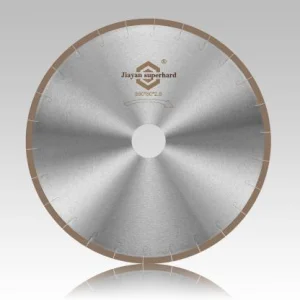
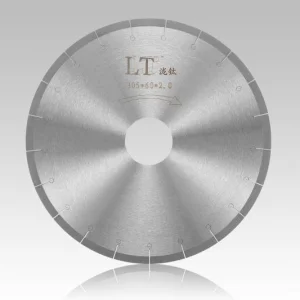
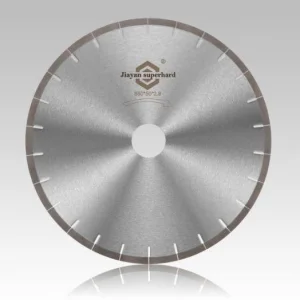
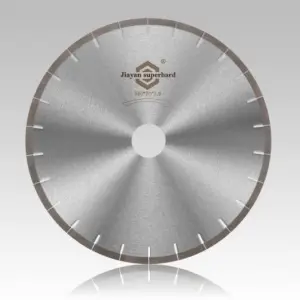
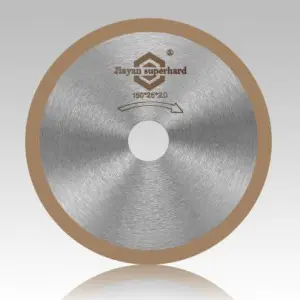
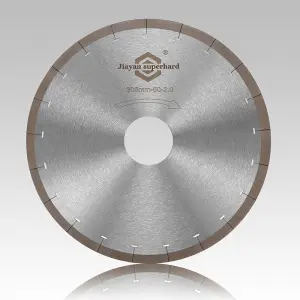
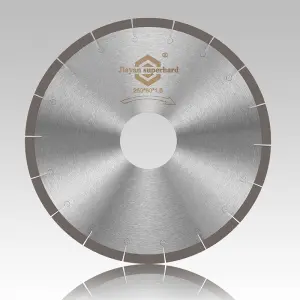
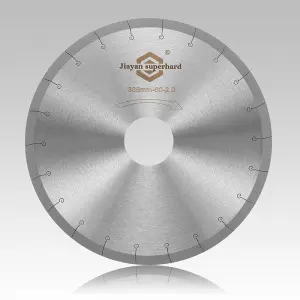
High-performance superhard cutting blades designed for rapid feed rates, minimal thermal distortion, and exceptional kerf precision.
An authoritative analysis of powder metallurgy sintering, crystal concentration control, and core tensioning in modern ODM continuous rim production.
Unlike segmented or turbo blades designed for fast stock removal in soft concrete or granite, continuous rim diamond blades feature an uninterrupted matrix smooth edge. This configuration distributes cutting forces uniformly, mitigating stress concentrations that cause edge micro-chipping in vitreous materials like ceramic, dense glass, and sintered porcelain slabs.
JIAYAN Superhard employs state-of-the-art volumetric hot-pressing sintering machines. By simultaneously applying hydraulic pressure (25–35 MPa) and elevated sintering temperatures (750°C–950°C) in a controlled atmosphere, we achieve maximum bond density, eliminating micro-porosity and maximizing synthetic diamond grit retention under severe mechanical shear.
Industrial procurement demands customized matrix formulations tailored to specific hard stone types. Our ODM engineering team formulates proprietary cobalt-copper-tin (Co-Cu-Sn) and iron-bronze alloy matrices, dialing in precise bond hardness (Rockwell HRB/HRC) to balance wear rate with diamond exposure frequency for optimized cost-per-meter ratios.
Quantitative operational parameters measured across high-speed CNC bridge saw operations and manual wet tile saw cutting rigs.
| Blade Series Category | Core Thickness | Diamond Mesh Size | Optimal Material Substrate | Recommended Linear Speed | Cooling Mode |
|---|---|---|---|---|---|
| Ultra-Thin Continuous Rim | 1.0mm - 1.2mm | 60/70 - 80/100 US Mesh | Vitreous Ceramic, Glass Tile, Thin Porcelain | 25 - 35 m/s | Wet Cutting Preferred |
| J-Slot / Laser Keyhole Rim | 1.4mm - 1.8mm | 50/60 - 60/70 US Mesh | Sintered Stone (Dekton/Neolith), Quartzite | 20 - 30 m/s | Continuous Wet Flow |
| Heavy Duty OEM Bridge Saw Rim | 2.2mm - 3.2mm | 40/50 - 50/60 US Mesh | Dense Granite, Engineered Quartz Slabs | 18 - 28 m/s | High Pressure Waterjet |
| General Purpose Hot-Pressed Rim | 1.6mm - 2.0mm | 50/60 US Mesh | Standard Ceramic Tile, Marble Slabs | 30 - 40 m/s | Wet / Dry Dual Use |
Unpacking the science of synthetic diamond crystal bonding, tensioning stress dynamics, and laser slot heat dissipation.
The fundamental operational lifespan of a continuous diamond blade hinges on the mechanical keying and chemical bonding between synthetic monocrystalline diamond grains and the surrounding metal powder matrix. JIAYAN utilizes premium grade titanium-coated diamond grit. During sintering, the thin titanium layer reacts with matrix alloys to form titanium carbide (TiC) micro-interfaces, elevating grain pull-out resistance by up to 40% compared to uncoated diamond tools.
High-speed rotation creates intense centrifugal forces and thermal expansion. If the inner core steel (65Mn or 75Cr1 high-carbon alloy steel) is improperly tensioned, the blade suffers lateral deflection, producing crooked cuts and premature arbor wear. Our manufacturing line uses computer-controlled tension rolling machines to induce precise internal stress profiles, guaranteeing runout tolerances within ≤0.03mm under operational speeds up to 10,000 RPM.
Cutting ultra-dense materials like porcelain slabs and sintered stone creates extreme localized friction heat. Standard continuous blades may warp or lose tension. JIAYAN’s proprietary J-slot and keyhole expansion slots engineered into the continuous rim allow for controlled thermal expansion while facilitating slurry flushing, protecting the integrity of both the cut edge and the inner blade core.
A common issue in diamond tooling is matrix glazing (where hard bond hides dull diamond grains) or rapid erosion (where soft bond sheds sharp diamonds prematurely). Our metallurgists customize matrix erosion rates based on the Mohs hardness and abrasiveness of the target substrate. Harder matrix bonds are paired with abrasive materials, while softer bronze-rich bonds are paired with vitrified, non-abrasive porcelain tiles.
Why leading global tool distributors, stone fabricators, and hardware brands partner with JIAYAN Superhard for high-volume ODM continuous blade manufacturing.
China commands over 80% of the world's synthetic diamond synthesis capacity. Located in Wuhu, JIAYAN leverages direct procurement contracts with top-tier HPHT crystal producers and micro-metal powder suppliers. This localized industrial cluster grants us raw material cost advantages and immediate access to tight grit size sorting (US Mesh 40 to 120), eliminating international supply chain bottlenecks.
Global brand owners often struggle with rigid Minimum Order Quantities (MOQs) from European manufacturers. JIAYAN provides agile ODM production lines capable of supporting pilot batch runs (100–500 units) with custom laser engraving, customized arbor bore dimensions (e.g., 20mm, 22.23mm, 25.4mm, 50mm, 60mm), and tailor-made retail packaging within 14-21 business days.
Every continuous diamond blade manufactured in our facility undergoes rigorous non-destructive quality testing. From dynamic balance checks to ultrasonic flaw detection in the core steel and shear strength test verification exceeding EN 13236 safety directives, our automated inspection cells maintain zero-defect export standards.
A strategic purchasing evaluation framework to help category managers calculate Total Cost of Ownership (TCO) and Cost-per-Meter (CPM) cutting economics.
Commercial stone fabrication facilities and tile installers often fall into the trap of evaluating diamond blades strictly by unit purchase price. However, high-performing procurement directors evaluate tools based on Cost-Per-Meter (CPM):
CPM = (Purchase Price of Blade + Labor Cost during Blade Swaps) / Total Linear Meters Cut
By utilizing JIAYAN's hot-pressed continuous rim blades with elevated diamond concentration (25%-30% volume concentration), industrial cut speeds increase by 30%, while blade longevity expands by 35%, yielding up to a 22% reduction in overall project operational CPM.
Standardizing tooling across international project fleets requires precise arbor fitting and flange engineering. JIAYAN provides customizable arbor configurations including flush-mount countersunk holes, pin-hole patterns for industrial bridge saws (GMM, Donatoni, Park Industries), and removable copper reducing bushings (25.4mm to 20mm or 7/8" to 5/8") to ensure seamless field integration.
Adapting blade technology to regional building standards, material trends, and environmental compliance demands.
Focus on heavy porcelain slab fabrication, large-format porcelain tile (LFPT), and high-horsepower wet tile saws (e.g., DeWalt, Rubin, Target). Demands robust 10" and 14" continuous J-slot blades capable of rapid straight cuts and 45-degree miter cuts with zero edge blowouts.
Strict safety directives (EN 13236 compliance, oSa mark) and stringent noise emission thresholds. Requires sandwich-type silenced core bodies (Steel-Copper-Steel composition) and eco-friendly cobalt-free sintering bonds compliant with REACH and RoHS environmental standards.
Prevalence of natural marble, dense travertine, and high-ambient temperature dry/wet jobsite conditions. Blades require ultra-durable heat-resistant bonds and micro-grooved continuous rims to prevent matrix glazing under variable water cooling pressure.
High-speed automated factory bridge saw production lines cutting ceramic and sintered slabs at mass volume. Requires continuous diamond blades with ultra-precise radial dynamic balance to prevent long-term spindle wear on automated CNC machinery.
Key technological shifts driving next-generation diamond blade manufacturing over the coming decade.
Integration of closed-loop machine learning algorithms into volumetric hot presses. Sensors monitor real-time electrical resistance, temperature gradients, and compression rates during sintering, yielding matrix density uniformity within ±0.2% across entire batch runs.
Sub-micron metal powders are replacing conventional coarse copper-iron blends. Nanostructured bonds melt and densify at lower temperatures while offering dramatically superior diamond retention shear strength, enabling micro-thin kerf blades down to 0.8mm.
Driven by EU REACH regulations and human safety initiatives, next-generation ODM manufacturing is shifting away from heavy cobalt usage toward high-performance iron-copper-nickel alloys that maintain mechanical strength without toxic heavy metal exposure.
Ensuring international safety standards, mechanical resilience, and consistent factory-direct quality.
All JIAYAN continuous diamond blades adhere strictly to EN 13236 European safety requirements for superabrasive products. Blades are tested to withstand burst speeds up to 1.5 times the maximum operational speed limit.
Our production processes follow audited ISO 9001 quality management workflows — from raw diamond mesh spectrum verification to dynamic balancing, axial runout checks, and final packaging integrity inspection.
We maintain low-dust automated manufacturing protocols and supply eco-compliant tool options aligned with OSHA silica dust regulations (when paired with wet-cutting industrial shrouds) and EU environmental standards.
Select from our benchmark product range or submit custom engineering specifications for OEM/ODM continuous diamond blade manufacturing.
Expert insights addressing common engineering, custom manufacturing, and field operation queries.
Continuous rim diamond blades feature a smooth, uninterrupted matrix border without expansion gullets or isolated segment teeth. This continuous contact configuration minimizes impact vibration against delicate materials (such as porcelain tiles, glass, and sintered stone), providing clean, chip-free cuts. Segmented blades, conversely, feature open slots for aggressive material removal in heavy concrete, brick, or rough granite where edge chipping is acceptable.
Our ODM service encompasses complete end-to-end engineering customization. We customize: 1) Metal bond matrix formulations (adjusting cobalt, copper, tin, iron ratios); 2) Diamond mesh size and synthetic crystal concentration; 3) Core thickness and expansion slot geometries (J-slots, keyhole slots, laser slots); 4) Arbor dimensions, pin-hole setups, laser logo engraving, and private label packaging design.
While small-diameter continuous blades (100mm–125mm) with specialized hot-pressed bonds can handle light dry cutting on job sites, continuous wet cutting is strongly recommended — especially for larger blades (230mm to 350mm). Water coolant lubricates the cut, flushes abrasive slurry out of the kerf, suppresses hazardous airborne silica dust, and prevents thermal stress fractures in the matrix.
Tile corner chipping usually stems from three factors: insufficient blade core tension causing flex under angle loads, overly hard matrix bonds that glaze over, or excessive linear feed rate. To solve this, select a dedicated JIAYAN J-Slot or ultra-thin continuous blade engineered for porcelain, ensure wet coolant flow is directed at the exact contact point, and verify arbor flange alignment to eliminate lateral runout.
Standard custom ODM orders take approximately 15 to 25 calendar days for mass production following sample approval. We provide FOB, CIF, DDP, and Express Air Freight shipping options. Every shipment includes certified inspection reports for dynamic balance, core hardness, and dimensional tolerance checks.