Analyzing the shift toward high-density fiber cement siding, architectural rain-screens, and the OEM/ODM tooling paradigm required for zero-chipping performance.
The global construction sector is undergoing a massive structural shift away from traditional wood and vinyl siding toward composite fiber cement cladding—exemplified by products like James Hardie® lap siding, Cembrit, and Nichiha panels. Renowned for their flame resistance, rot imperviousness, and dimensional stability, fiber cement materials present an extraordinary challenge to standard cutting tooling. Composed of Portland cement, ground sand (crystalline silica), cellulose fibers, and proprietary additives, Hardie Board is intensely abrasive. Standard Tungsten Carbide Tipped (TCT) circular saw blades degrade rapidly within minutes of continuous cutting, causing edge micro-fracturing, uneven bevels, and unacceptable quantities of airborne silica dust.
As premier ODM (Original Design Manufacturing) and OEM cutting Hardie Board circular saw factories scale up, the demand for specialized PCD diamond circular saws has skyrocketed. Sourcing agents and industrial brand owners require custom manufacturing partners capable of balancing matrix hardness, laser-cut sound damping, dynamic blade stabilization, and specialized tooth geometry (such as Flat Top Grind with spark-suppression chamfers). Professional contract manufacturing allows global brands to supply localized markets with custom-branded blades engineered specifically for local fiber cement densities and compliance mandates.
Hardie Board contains up to 50% crystalline silica. Dynamic wear analysis shows PCD tips withstand localized thermal friction up to 700°C without micro-chipping or matrix erosion.
Specially formulated 4-tooth to 8-tooth blade geometries drastically reduce respirable crystalline silica (RCS) by producing larger chips rather than fine airborne dust particles.
From custom PCD grain density formulations to automated laser tensioning and custom laser-etched branding, JIAYAN delivers full spectrum contract tooling manufacture.
Examining metallurgical composition, laser slot technology, stress relief geometries, and comparative performance data.
A high-performance circular saw blade engineered for Hardie Board cutting is an masterpiece of superhard material physics. The primary cutting edge utilizes Synthetic Polycrystalline Diamond (PCD) sintered onto a cobalt substrate under extreme pressure and temperature (HPHT). Unlike conventional stone cutting diamond blades that use electroplated or hot-pressed diamond segments with metal matrices, PCD features intergrown diamond grains forming a solid, continuous diamond mass. This diamond layer exhibits hardness values approaching 10,000 HV (Vickers hardness), compared to 1,500 HV for micro-grain tungsten carbide.
| Tooling Metric / Performance Index | Standard TCT Carbide Blade | Generic Diamond Segment Blade | JIAYAN OEM Engineered PCD Hardie Saw Blade |
|---|---|---|---|
| Tip Hardness (Vickers HV) | 1,200 – 1,500 HV | 5,000 – 7,000 HV (Segmented) | 8,500 – 10,000 HV (PCD Matrix) |
| Total Cut Lifespan (Linear Feet) | ~150 – 300 Feet | ~1,500 – 2,500 Feet | 15,000+ Linear Feet |
| Airborne Silica Dust Generation | Extreme (High RPM pulverization) | Moderate (Friction grinding) | Ultra-Low (Shearing geometry + low tooth count) |
| Edge Finish Quality | Severe chipping after 50 cuts | Moderate paint chipping | Clean, factory-grade smooth edge finish |
| Thermal Distortion Mitigation | Poor (High friction heat expansion) | Fair (Water/Air cooling needed) | Laser-cut copper-plugged expansion slots |
| Blade Body Substrate | Standard #75 Carbon Steel | Mn65 Alloy Steel | German 75Cr1 High-Tensile Alloy Steel |
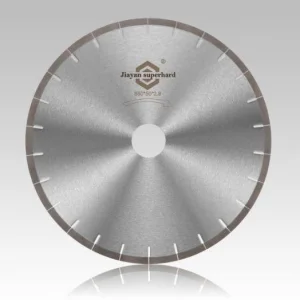
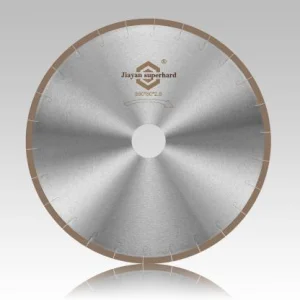
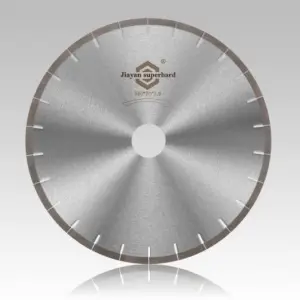
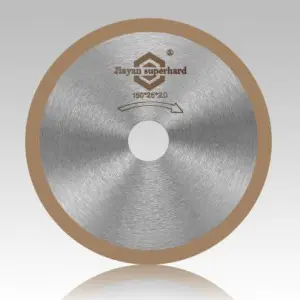
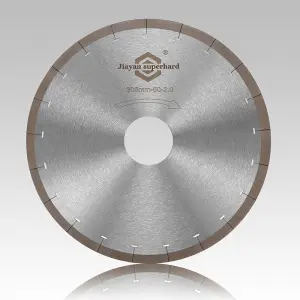
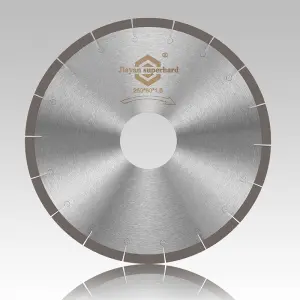
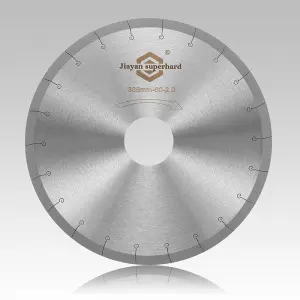
The steel core of a JIAYAN PCD saw blade utilizes German 75Cr1 high-tensile alloy steel, hardened to 44-46 HRC. Automated laser-cutting processes shape the blade plate with computer-modeled laser expansion slots filled with thermoplastic polyurethane or copper plugs. These expansion slots interrupt harmonic vibration resonance during high-RPM operation, reducing noise emissions by up to 12 dB while preventing thermal deformation when dry-cutting dense fiber cement planks on job sites.
How specialized Hardie Board circular saw factories engineer solutions for distinct regional construction practices and regulatory environments.
Primary Driver: OSHA 29 CFR 1926.1153 Respirable Crystalline Silica Standard.
Tool Solution: 7-1/4" (184mm) 4-Tooth PCD circular saw blades designed for cordless miter and circular saws. The reduced tooth count produces heavy grain debris that settles immediately into vacuum shrouds rather than remaining airborne.
Primary Driver: CE Compliance, EN 847-1 Safety standards, clean cut aesthetics for pre-painted rain-screen facades.
Tool Solution: 250mm–300mm 12-Tooth PCD table saw blades with high-rake angles for gang-cutting multiple dense sheets without edge delamination or surface coat cracking.
Primary Driver: 24/7 automated continuous factory panel cutting lines requiring minimal tool downtime.
Tool Solution: Heavy-core 350mm PCD blades with thermal-barrier coating and custom bore configurations for automated CNC panel sizing machines.
A major North American building supply distributor transitioned from supplying generic TCT fiber cement blades to a custom ODM PCD blade program engineered by JIAYAN Superhard Tools. By optimizing tooth bevel geometry (10° ATB + Flat Top Combination) and utilizing 2.0mm kerf PCD tips, end-user contractors reported a 42% reduction in blade expenditure over 12 months, accompanied by zero OSHA silica violation warnings due to compatibility with dust-collection vacuums.
Inside the JIAYAN production matrix: How custom PCD formulations, automated silver-copper brazing, and white-label branding empower global tool brands.
Customization begins at the atomic level. We select premium synthetic diamond micron powders, subjected to high-pressure high-temperature (HPHT) pressing to yield high diamond fraction PCD blanks with minimal cobalt content.
PCD tips are bonded to the 75Cr1 steel body using vacuum silver-copper sandwich solder alloy, achieving joint shear strength exceeding 350 MPa to prevent tip loss under severe thermal shock.
Complex tooth geometry is ground using 5-axis CNC Electrical Discharge Machining (EDM) with oil dielectric, delivering razor-sharp PCD cutting edges with surface roughness Ra < 0.2 µm.
100% of manufactured circular saw blades undergo dynamic balancing checks according to ISO 1940 standards (Grade G2.5), ensuring runout stays within < 0.03mm for vibration-free rotation.
Choose between anti-friction Teflon coatings, electro-coated titanium carbo-nitride (TiCN), or dark black ceramic coatings designed to prevent sap accumulation and reduce drag.
Complete private-label packaging including customized fiberboard blister cards, color sleeves, laser-etched logos, serial numbers, and localized safety regulatory compliance labels.
Anticipating industrial developments: Smart blades, nano-crystalline PCD matrices, and eco-friendly manufacturing.
As composite cement materials evolve to include recycled glass aggregates, ultra-high performance concrete (UHPC), and polymer-reinforced matrices, tool manufacturers must continuously innovate. The R&D division at JIAYAN Superhard Tools is pioneering three critical technological frontiers scheduled for global deployment over the next decade:
Traditional PCD uses cobalt as a solvent-catalyst during sintering. However, cobalt thermal expansion at high temperatures can trigger micro-cracking in diamond grains. Next-generation nano-binderless PCD utilizes direct conversion of graphite under extreme pressures (>15 GPa), creating diamond blades with 3x higher thermal resistance and zero thermal expansion mismatch.
Jobsite noise pollution limits in the EU and urban centers require circular saw sound levels below 80 dB(A). Future ODM Hardie board circular saw designs incorporate laser-etched labyrinth slots filled with viscoelastic acoustic damping polymers, reducing blade ring noise by over 70% without sacrificing plate stiffness.
For industrial pre-fab factories, JIAYAN is prototyping blade bodies embedded with micro-RFID chips and temperature-sensitive indicator zones. Factory operators can scan circular saw blades to verify total cutting footage, remaining PCD tip volume, and history of overheating events—enabling predictive tool maintenance before edge chipping impacts product yield.
Expert guidance from JIAYAN Superhard engineers on PCD tooling selection, OEM customization, and maintenance best practices.
Get direct factory pricing, engineering sample validation, and complete white-label custom manufacturing for your global tool distribution brand.