Engineered for heavy-duty granite, dense ceramic, quartzite, and sintered stone applications.
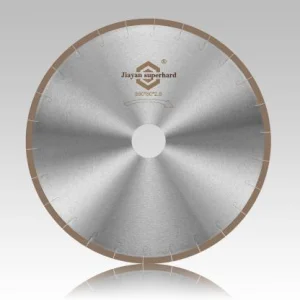
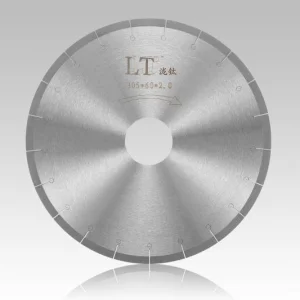
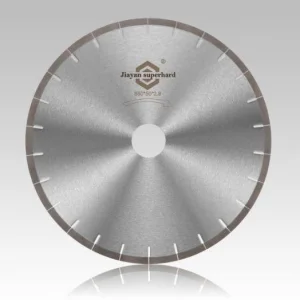
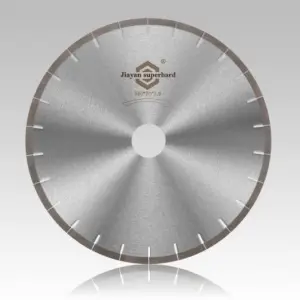
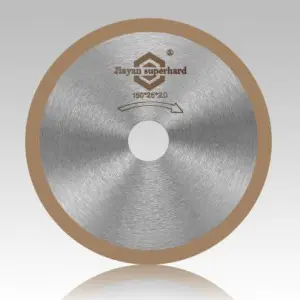
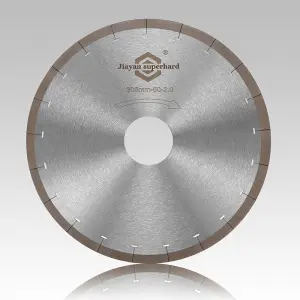
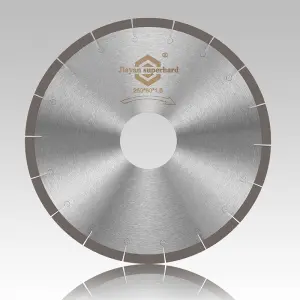
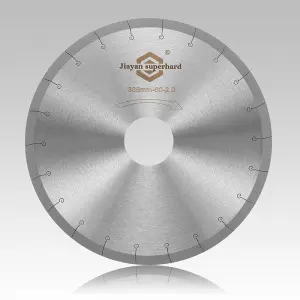
The global superhard tooling and industrial cut-off market has experienced a radical structural transition over the past decade. Traditional aluminum oxide ($Al_2O_3$) and silicon carbide ($SiC$) bonded abrasive discs are rapidly being superseded by high-density synthetic polycrystalline diamond (PCD) cut-off blades. Driven by massive infrastructure modernization projects, the expansion of ultra-hard architectural surfaces (such as sintered stone slabs, porcelain porcelain, and compact quartzites), and strict environmental regulations on dust emissions and tool longevity, global industrial procurers are prioritizing advanced OEM and ODM diamond cut-off blade manufacturing partners.
As an established center for superhard materials innovation, China’s industrial manufacturing ecosystems—represented by leaders like JIAYAN Superhard Materials—supply more than 70% of the world’s synthetic diamond raw crystals and finished diamond circular blades. Industrial buyers across Europe, North America, the Middle East, and Southeast Asia rely heavily on ODM (Original Design Manufacturer) partnerships to access proprietary metallurgical formulations, customized segment geometry, and low-vibration core technologies specifically calibrated for local substrate variations.
High-precision diamond cut-off blades are complex metallurgical systems engineered for controlled wear and extreme thermal endurance.
High-Purity High-Pressure High-Temperature (HPHT) synthetic diamonds are classified by thermal stability and crystal friability. Coarse mesh sizes (30/40 to 45/50 grit) deliver aggressive stock removal for hard granites, while fine grit sizes (60/80 to 100/120) prevent edge chipping on brittle ceramic tiles.
The matrix bond holds diamond grit until it fractures or dulls. Free-cutting soft bonds (high bronze/copper ratios) wear quickly to expose fresh diamond edges when cutting non-abrasive hard quartzite. Hard bonds (cobalt/tungsten carbide alloyed) resist abrasive wear when cutting green concrete or asphalt.
Laser sintering achieves metallurgical fusion between the diamond segment base and 75Cr1 steel core, providing supreme bond shear resistance for heavy dry cutting. Cold/hot-press sintering offers cost-effective, precise concentricity for ultra-thin wet ceramic cutting blades.
Selecting the optimal ODM diamond blade specification requires balancing diamond grit mesh, diamond concentration, matrix hardness, and segment joint engineering:
| Target Substrate | Diamond Grit (US Mesh) | Diamond Vol. Concentration | Matrix Bond Composition | Joint Tech | Cooling Mode |
|---|---|---|---|---|---|
| Hard Granite (Class IV-V) | 35/40 - 45/50 Mesh | 90% - 110% (4.4 ct/cm³) | Cobalt-Bronze-Nickel Alloy | Laser Welded | Wet / Heavy Water Jet |
| Ultra-Thin Sintered Stone | 60/70 - 80/100 Mesh | 75% - 85% (3.4 ct/cm³) | Cobalt-Free Bronze/Copper | Hot-Press J-Slot Rim | Continuous Wet Cooling |
| Reinforced Civil Concrete | 30/40 - 40/50 Mesh | 100% - 120% (4.8 ct/cm³) | Iron-Tungsten Carbide Hard Bond | Laser Fusion Welded | Dry / Wet Dual Purpose |
| Glazed Ceramic / Marble | 70/80 - 100/120 Mesh | 60% - 75% (2.8 ct/cm³) | High-Ductility Copper Matrix | Continuous Sintered Rim | Wet Operation Recommended |
For international distributors, chain brands, and industrial equipment OEMs, procuring generic off-the-shelf cut-off blades often leads to performance mismatches on local job sites. A comprehensive ODM framework bridges the gap between raw powder metallurgy and real-world cut performance.
We analyze the client's localized material characteristics—evaluating Mohs hardness, silica ($SiO_2$) percentage, compressive strength (MPa), and machine power parameters (kW/RPM) to formulate the target matrix wear rate.
Engineers design unique blade profiles: Turbo-rim for fast debris removal, J-slots for thermal expansion stress relief in delicate porcelain, or keyhole slots for aggressive chip clearing in reinforced concrete bridge sawing.
Steel cores (75Cr1) are machine tensioned and dynamically balanced to minimize run-out (< 0.05 mm), ensuring straight cuts, reduced arbor strain, and quiet operation under severe high-RPM industrial usage.
Furthermore, full ODM integration extends to custom laser etching of part numbers and safety certifications (EN13236 / oSa), custom color powder coatings, customized anti-vibration rubber rings, and localized point-of-sale retail packaging.
Diamond cut-off blades operate across vastly different physical environments worldwide. Custom ODM engineering allows suppliers to tailor blade characteristics to specific regional job-site requirements:
Challenge: Processing 12mm-20mm thick dense sintered porcelain slabs (e.g., Dekton, Neolith) without edge micro-fracturing or corner blowouts on high-speed bridge saws.
ODM Solution: Ultra-thin 1.2mm J-slot continuous rim blades utilizing fine-mesh 80/100 HPHT diamonds bound in a high-ductility bronze matrix. Yields clean, glass-like chip-free edges at feed speeds exceeding 2.5 m/min.
Challenge: High-speed dry cutting of heavily reinforced concrete containing rebar and hard river gravel aggregate using 35HP walk-behind saws.
ODM Solution: 350mm to 600mm laser-welded blades featuring segment undercut protection technology, high cobalt-content metal bonds, and 30/40 coarse diamonds, ensuring extreme safety under thermal shock.
Challenge: Continuous wet slabbing of hyper-hard pink granite blocks under ambient operational temperatures exceeding 45°C.
ODM Solution: Heavy 350mm-800mm steel cores with sandwich segment structure (outer diamond layers harder than center) to maintain a square cutting profile without blade drift during deep passes.
Industrial superhard tools operate at peripheral velocities exceeding 80 m/s. Precision manufacturing standards are vital for operator safety and operational compliance.
All manufactured blades undergo mandatory segment shear testing (minimum 600 MPa weld retention), side-load torque bending tests, and dynamic bursting speed verification exceeding 150% of rated RPM.
Streamlined export logistics with complete compliance documentation: CE marks, Mill Test Certificates (MTC), origin certificates, and full customs compliance under Harmonized System Code 6804.21 (Millstones, grindstones & diamond cutting wheels).
Calculating correct cutting speeds prevents segment glazing or premature bond wear:
v_c = (π × D × n) / 60,000
where D is diameter in mm, and n is machine RPM. Target range: 35-50 m/s for granite; 25-35 m/s for tiles.
The next era of superhard cutting tools is defined by micro-structural grain alignment, green metallurgical formulas, and smart machine telemetry integrations:
Unlike conventional random diamond distribution, 3D array technology places every synthetic diamond crystal at precise spatial intervals throughout the matrix. This guarantees uniform segment wear, extends blade lifespan by 35-50%, and increases cutting speed by 40%.
In response to EU REACH regulations and environmental sustainability initiatives, innovative iron-copper-nickel sinter matrices replace toxic cobalt powders while delivering equivalent thermal yield strength and mechanical impact resistance.
Automated real-time pyrometric sensors monitor laser seam temperatures during high-speed core fusion, eliminating microscopic metallurgical voids and delivering 100% defect-free weld joints across high-volume production batches.
Answers to common technical, manufacturing, and supply chain queries from B2B buyers and engineers.
OEM (Original Equipment Manufacturer) involves manufacturing blades according to exact client-provided technical specifications, drawings, and formulas. ODM (Original Design Manufacturer) leverages our internal metallurgical R&D expertise to design, formulate, and test custom diamond blades based on the buyer’s target material, machine specs, operating budget, and local market positioning.
Segment loss is primarily caused by overheating, incorrect matrix hardness for the substrate, or excessive side friction. Utilizing laser-welded segment attachments (certified under EN 13236), verifying sufficient coolant/water flow rate, matching machine RPM to blade diameter, and selecting laser-cut expansion slots (J-slots or Key-slots) will eliminate severe stress buildup and core cracking.
Diamond concentration refers to the volume percentage of diamond grit in the segment matrix (100 concentration = 4.4 carats/cm³). If the diamond concentration is too high for a low-horsepower saw, the machine cannot generate sufficient torque to break down worn diamond crystals, resulting in blade glazing (polishing) and loss of cutting action. Optimal performance requires matching concentration precisely to machine power and material hardness.
Standard ODM sample evaluation batches start at 20 to 50 pieces per specification depending on diameter. Production lead times for custom sintered or laser-welded orders typically range from 15 to 25 business days, including custom laser etching, dynamic balancing, dynamic run-out verification, and private-label packaging.
J-slots provide dual mechanical advantages: they create specific expansion channels that absorb intense thermal expansion during high-speed friction, preventing radial blade deformation; simultaneously, the curved J-geometry facilitates water delivery directly into the cutting kerf while dampening high-frequency harmonic vibrations that cause edge chipping.
Select a specialized diamond cutting disc tailored for your target distribution region and application.