Engineered for extreme wear resistance, high-speed cutting efficiency, and zero micro-chipping performance across stone, ceramic, granite, and ultra-compact sintered surfaces.
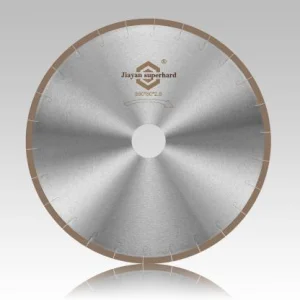
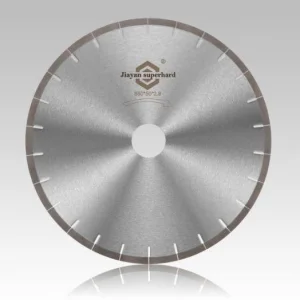
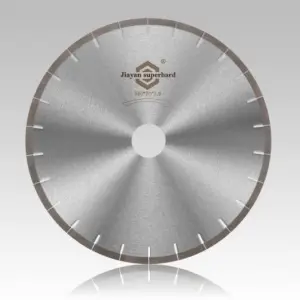
A deep dive into powder metallurgy, matrix retention forces, and original design manufacturing (ODM) paradigms in superhard tooling.
In modern industrial fabrication, the demand for precision cutting tools has shifted from standardized off-the-shelf catalog items toward highly customized, material-specific Original Design Manufacturing (ODM) solutions. The rapid proliferation of engineered sintered stones, ultra-compact ceramics, reinforced granites, and high-density civil composites has exposed the mechanical limitations of conventional abrasive wheels. As a pioneer in superhard material science and a proud member of the China Superhard Material Association, JIAYAN Superhard Tools operates at the nexus of high-pressure high-temperature (HPHT) synthetic diamond synthesis, advanced cobalt-bronze metal matrix formulation, and automated vacuum sintering technology.
Key Industry Insight: Optimal cutting performance depends on a precise balance between matrix wear rate and diamond grit exposure. If the metal matrix is too hard, the diamond grains glaze over; if too soft, the diamonds dislodge prematurely. JIAYAN’s proprietary ODM metallurgical formulas optimize diamond retention force for specific stone hardness levels.
Establishing an effective ODM partnership requires an end-to-end understanding of thermal dynamics, linear peripheral speed, coolant hydrodynamic dispersion, and mechanical tensioning. Standard cutting wheels often suffer from segment loss, thermal deformation, structural wobbling, and excessive edge chipping when operated under high feed-rate conditions. By integrating industrial micro-welding, laser displacement balance testing, and custom matrix composition, JIAYAN delivers tailored ODM diamond cutting wheels that increase cut speeds by 35%, extend tool operating lifespan by up to 50%, and maintain strict edge integrity on delicate architectural materials.
Pioneering chemical-bonding, nanostructured diamond coatings, and silent-core vibration dampening for high-stress industrial applications.
To prevent thermal oxidation and micro-graphitization during high-temperature sintering, JIAYAN utilizes Titanium (Ti) and Chromium (Cr) coated synthetic diamond particles. The carbide inter-layer creates a chemical bond between the diamond crystal and the metal matrix, raising mechanical retention force by over 40% compared to physical entrapment.
Traditional high-frequency silver brazing melts under intense dry-cutting heat. JIAYAN's fully automated 10kW laser welding units melt the steel core and segment alloy into a single fused root. This eliminates segment shear risks and meets strict EN13236 safety protocols for heavy-duty job sites.
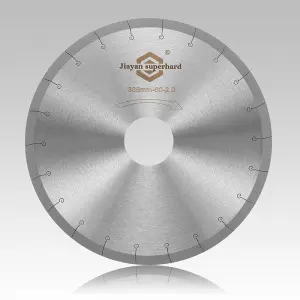
High-RPM bridge saw operations generate severe noise pollution and resonance vibrations. Our core body architecture features laser-etched expansion slots filled with viscoelastic copper/resin damping compounds. Combined with J-slot rim configurations, heat dissipates quickly, reducing decibel output by 12–15 dB while preventing thermal distortion.
Engineered tooling matrixes specialized for targeted industrial domains and material hardness classes.
Ultra-compact porcelain materials (e.g., Dekton, Neolith) possess extreme internal tension and high shore hardness. JIAYAN’s customized ultra-thin 1.0mm-1.2mm continuous rim blades utilize fine diamond mesh size (230/270 mesh) and a soft iron-bronze bond. This layout cuts cleanly through vitreous matrixes without causing micro-cracks or bottom-edge blowout.
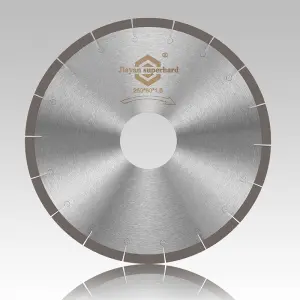
For high-quartz Class 4 and Class 5 granites, standard cutting wheels degrade rapidly due to severe abrasion. Our 350mm to 1000mm bridge saw blades feature multi-layer sandwich segment structures with controlled cobalt matrix dissolution, delivering continuous self-sharpening capabilities at linear cutting speeds exceeding 30 m/s.
Municipal road repairs, asphalt milling, and heavy reinforced concrete cutting demand ultimate segment structural integrity. JIAYAN manufactures drop-segment laser-welded cutting wheels with protective undercut segments that shield the core body from abrasive slurry wear during deep wet cutting operations.
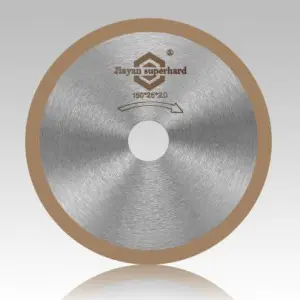
Automated high-speed industrial tile squaring and trimming units require predictable wheel wear and low power draw. Our OEM continuous rim hot-pressed wheels deliver consistent edge beveling, ultra-low vibration profiles, and maximum thermal stability on automated production lines.
Located in Wuhu, China, JIAYAN combines smart sintering robotics, strict raw material sourcing, and comprehensive quality assurance.
Supply chain reliability and batch-to-batch consistency are critical challenges for global industrial tool buyers. JIAYAN Superhard Materials Co., Ltd. addresses these demands through a fully integrated Industry 4.0 manufacturing ecosystem. Every step of our production workflow—from raw powder granulating to hot-press vacuum sintering, automated segment leveling, laser welding, and dynamic balance inspection—is managed by digital control systems.
Automated powder dispensing systems guarantee single-grain weight distribution within a ±0.02g tolerance, ensuring uniform segment density and eliminating localized wear spots.
Multi-stage heating profiles precise to ±1°C ensure complete metallic bonding of cobalt, nickel, and copper matrixes without overheating or degrading the synthetic diamond crystals.
100% of saw blade cores undergo automated tensioning adjustments and 3D laser deflection scans to prevent wobble at high operational speeds (up to 80 m/s).
From parameter mapping to rapid prototyping, private-label branding, and international SLA guarantees.
For international distributors, machinery manufacturers, and industrial tool brands, standard supplier catalogs often fail to deliver a localized competitive edge. JIAYAN’s ODM engineering framework allows enterprise clients to create tailored cutting wheel lines built for specific local stone types and regional machine power configurations.
Our technical specialists evaluate your cutting conditions: machine RPM, motor horsepower, wet/dry coolant flow rates, target feed speeds, and material Mohs hardness indices.
We match diamond grit mesh sizes (e.g., 30/40 to 70/80), concentration levels (15%–45%), and metal matrix compositions (cobalt-heavy vs bronze-alloy) to meet your exact life-to-speed requirements.
Following prototype testing and stress verification, we move to full-scale production. Custom laser etching, private-label color coatings, and customized packaging are provided under strict NDAs.
Adhering to strict European safety requirements, ISO frameworks, and international export protocols.
Industrial superabrasives operate under extreme centripetal forces and thermal stress. Structural tool failure presents major safety risks to operators and machinery. JIAYAN maintains strict quality control protocols across every stage of manufacturing to comply with global safety standards including EN13236 (Safety requirements for superabrasive products) and oSa design frameworks.
Our export logistic channels service over 50 countries across Europe, North America, South America, the Middle East, and Southeast Asia. Every shipment includes comprehensive certificates of compliance, dynamic balance verification logs, and segment shear test documentation to guarantee smooth customs clearance and zero end-user defects.
Explore our core catalog of diamond saw blades and cutting discs engineered for high-precision stone and ceramic fabrication.
Detailed engineering solutions addressing common performance challenges in diamond cutting wheel application and procurement.
Blade glazing occurs when a metal matrix is too resistant to abrasion relative to the material being cut. As diamond crystals dull, the hard matrix refuses to wear away, preventing fresh, sharp diamond grains from being exposed. Consequently, friction increases, cutting speed drops, and excessive heat builds up. Conversely, when cutting highly abrasive hard materials like quartzite-rich granite with a soft matrix, the matrix erodes too quickly, releasing diamonds before they have performed work. JIAYAN’s ODM engineering formulates custom bond compositions—utilizing controlled ratios of Cobalt, Bronze, Iron, and Tungsten Carbide—to match the exact abrasion index of your target material, ensuring continuous self-sharpening and optimal tool life.
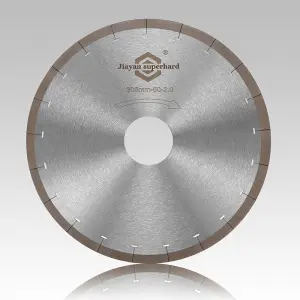
Ultra-compact materials and engineered porcelain slabs carry high residual internal stress. Traditional keyhole slots or standard continuous rims can trigger thermal shock expansion, leading to hairline cracks or edge chipping along the cut line. J-slot expansion cutouts dissipate circumferential stress, improve coolant flow directly into the kerf, and filter out micro-chips effectively. This design drastically reduces lateral blade vibration, preventing edge chipping on high-value decorative slabs.
High-frequency silver brazing creates a mechanical joint using a filler alloy with a melting point around 600°C–700°C. If coolant supply fails or dry cutting occurs, the heat can melt the braze joint, causing segment detachment and severe safety hazards. Automated laser welding uses a high-energy laser beam to melt the diamond segment steel base directly with the alloy core, creating a solid metallurgical weld with shear strengths exceeding 1,800 MPa. This structural bond complies with strict EN13236 safety standards for heavy industrial operations.
To ensure optimal custom tool engineering, buyers should provide: (1) Target material specifications (e.g., natural granite class, hard ceramic, reinforced concrete, shore hardness); (2) Machine operational parameters (spindle power in kW/HP, operational RPM, maximum blade diameter, arbor hole size); (3) Cutting method (wet cutting with coolant flow rates, or dry cutting); and (4) Primary performance target (maximum cutting speed vs maximum total blade lifespan).
Diamond concentration is defined relative to 100 concentration representing 4.4 carats of diamond per cubic centimeter of segment matrix. Higher concentration (e.g., 75%–100%) places more active diamond cutting edges in contact with the material, which distributes cutting forces, extends tool life, and reduces wear when cutting hard stone. However, excessively high concentration increases machine drag and requires higher spindle power. Lower concentration (e.g., 20%–35%) focuses power on fewer points, allowing lower-wattage angle grinders or small machines to cut rapidly through soft materials without stalling.
As a member of the China Superhard Material Association based in Wuhu, China, JIAYAN delivers enterprise-grade OEM/ODM manufacturing, low MOQs, and reliable global shipping. Contact our engineering team today to optimize your cutting tool performance.