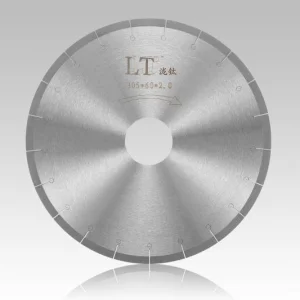
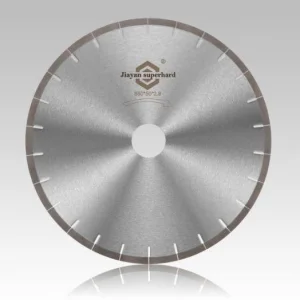
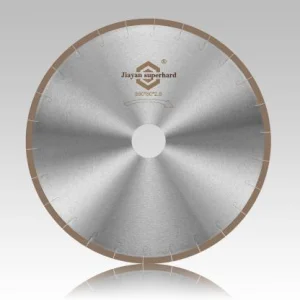
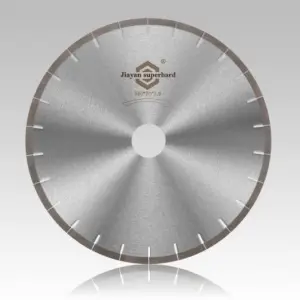
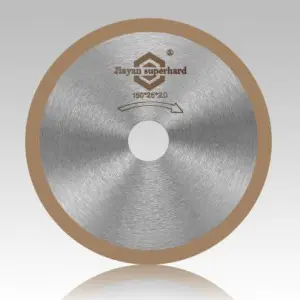
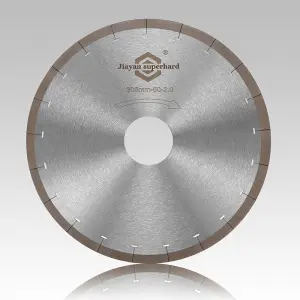
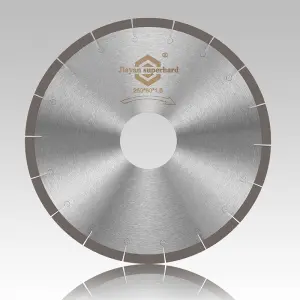
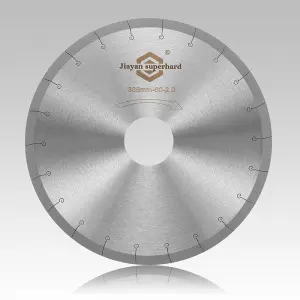
Precision-engineered continuous rim, J-slot, and ultra-thin circular diamond blades designed for high-yield glass and superhard stone processing.
Navigating the Material Science, Macroeconomic Drivers, and Precision Milling Demands in Modern Architectural Glass Processing.
Cutting glass tile represents one of the most mechanically demanding operations in the hard-surfacing and architectural fabrication sectors. Unlike crystalline granite or porous ceramic, glass is an amorphous solid characterized by high brittleness, low fracture toughness, and zero thermal ductility. Standard diamond blades designed for stone rapidly cause micro-cracking, severe back-side blowout, and catastrophic edge chipping. Partnering with an expert ODM Glass Tile Blade Manufacturer guarantees custom sintered matrix formulations tailored specifically to amorphous silicon oxide structures.
Modern luxury hospitality, commercial facades, and high-end residential interiors increasingly specify large-format glass tiles, subway glass bricks, and iridescent vitreous mosaics. This shift demands zero-chipping cut profiles at scale, raising the bar for blade precision.
Glass has extremely low heat tolerance during mechanical shearing. Advanced ODM manufacturers incorporate synthetic diamond powders with ultra-fine grain distribution (170/200 to 325/400 mesh) into soft cobalt-bronze alloys to facilitate self-sharpening at minimal operating thermal pressure.
Global distributors require reliable ODM/OEM partners capable of delivering batch-to-batch structural consistency, dynamic balance under 0.02mm run-out, and flexible private-label customization to protect brand equity in competitive regional markets.
An in-depth whitepaper analysis of how custom synthetic diamond grading and sintered bond alloys eliminate sub-surface glass fracturing.
The fundamental challenge in processing glass tiles—whether cast, stained, fused, or back-painted architectural glass—lies in controlling the brittle failure mechanism during diamond grit impact. Standard stone cutting blades rely on coarse diamond grit (30/40 or 40/50 mesh) and hard iron-cobalt matrix bonds to plow through crystalline materials like granite. When applied to glass, these coarse grains generate intense localized shear stresses exceeding the ultimate tensile strength of the glass, leading to deep sub-surface micro-cracks and unsightly chipped edges.
As a leading ODM Glass Tile Blade Manufacturer, JIAYAN Superhard re-engineers the cutting interface through three critical metallurgical pillars:
We utilize high-purity single-crystal synthetic diamond particles precisely graded between 170/200 and 325/400 mesh. Smaller diamond crystals increase the number of active cutting points per square millimeter of rim surface area, reducing the depth of cut per individual grain and preventing crack propagation into the glass body.
Glass produces non-abrasive, micro-fine slurry dust during cutting. To prevent the diamond blade from glazing over (dulling), our matrix metallurgy utilizes a ductile bronze-nickel bond matrix. This allows controlled, continuous erosion of the metallic binder, exposing fresh, sharp diamond edges without requiring excessive downward force.
Continuous rim design is mandatory for glass tile cutting to eliminate segment-striking shocks. For industrial wet-saw applications, we engineer specialized laser-cut micro J-slots and expansion keyholes that damp thermal expansion vibration and enhance coolant flow directly into the cutting zone.
| Blade Metric | Standard Ceramic/Stone Blade | JIAYAN Precision ODM Glass Blade | Performance Benefit |
|---|---|---|---|
| Diamond Mesh Size | 40 / 60 Mesh (Coarse) | 170 / 200 to 325 / 400 Mesh (Fine) | Eliminates edge chipping & back-side blowout |
| Bond Hardness (HRB) | 85 - 100 HRB (Hard Iron-Cobalt) | 55 - 70 HRB (Ductile Bronze-Co Alloy) | Continuous self-sharpening without thermal strain |
| Steel Core Tolerances | Run-out < 0.08mm | Run-out < 0.02mm (Laser Tensioned) | Vibration-free spinning up to 12,000 RPM |
| Rim Geometry | Keyhole Segmented / Turbo | Continuous Rim / Ultra-Thin J-Slot | Uniform edge profile; ideal for delicate mosaic glass |
| Coolant Requirement | Wet / Dry Dual Use | 100% Wet Cooling Recommended | Prevents glass thermal stress fracture |
How JIAYAN Superhard Combines Smart Automation, ISO Quality Protocols, and Scale to Drive Competitive OEM/ODM Advantages.
Located in Wuhu, China, JIAYAN Superhard is a recognized core member of the China Superhard Material Association. Backed by over a decade of direct export excellence, our facility integrates Industry 4.0 automated hot-pressing sintering presses, spectral laser tension testing, and strict QA protocols across all diamond saw blade production lines.

Our computerized sintering presses precisely monitor temperature, pressure, and dwell time, ensuring 100% density uniform bond matrices that prevent premature diamond shedding or blade warping.
Every single blade core undergoes automated spectral tensioning and dynamic balance testing. Radial and axial run-outs are calibrated to within micro-tolerances (<0.02mm) to ensure silent, vibration-free cuts.
By leveraging direct partnerships with top-tier synthetic diamond powder crystallizers and refined cobalt powder refiners in China, JIAYAN delivers unbeatable cost performance and lead-time reliability.
Comprehensive Private-Labeling Services for International Importers, Tool Brands, and Heavy Industrial Distributors.
As an established ODM Glass Tile Blade Company, JIAYAN provides end-to-end original design and manufacturing services tailored to regional market demands across North America, South America, Europe, the Middle East, and Southeast Asia. We transform customized performance specifications into turn-key branded commercial products.
Optimizing Machine Parameters, RPM Selection, and Coolant Hydrodynamics for Superior Jobsite Performance.
Achieving flawless, chip-free cuts on delicate glass tiles requires harmonious interaction between the machine, operator technique, blade selection, and water cooling. Our field engineering team has established strict operational guidelines to maximize tool life and cut quality across diverse installation scenarios.
Challenge: Cutting small 1"x1" or 2"x2" glass mosaics mounted on mesh backings without peeling or fracturing adjacent tiles.
Solution: Recommend 4" to 7" (100mm-180mm) ultra-thin continuous rim blades (1.0mm core thickness) paired with high RPM wet saws (4,000 - 6,000 RPM). Fine diamond mesh ensures zero mesh tearing and pristine micro-edges.
Challenge: Processing thick 12mm to 19mm architectural structural glass panels with high thermal expansion risk.
Solution: Recommend 10" to 14" (250mm-350mm) specialized J-slot continuous blades executed at lower RPMs (1,800 - 2,800 RPM) under heavy dual-nozzle water flow (min 5 L/min) to prevent thermal stress shock fractures.
Challenge: Rapid beveling and miter-cutting of back-painted glass subway tiles without chipping the painted backing film.
Solution: Utilize a medium-soft bronze matrix continuous blade dressed with aluminum oxide stone prior to cut. Execute smooth, consistent forward feed rate without forcing the cut.
Water coolant serves two essential functions during glass blade operation: removing micro-fine glass slurry away from the diamond rim and suppressing thermal spikes at the point of contact. Ensure continuous water delivery directed precisely at both the entry kerf and the exit kerf. Never attempt dry cutting on glass tiles under any circumstances.
Detailed Answers to Frequent Questions Asked by Industrial Tool Distributors, Factory Procurement Engineers, and Global Importers.
Explore our full assortment of industrial diamond tools, sintered stone discs, granite saw blades, and custom ODM glass cutting series.
Our technical team is ready to analyze your cutting requirements and provide sample blades for testing.