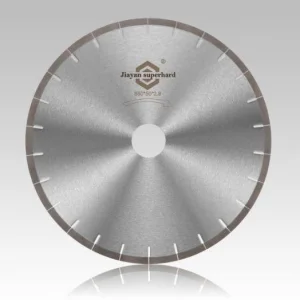
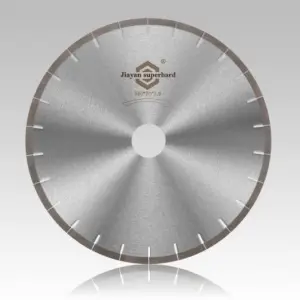
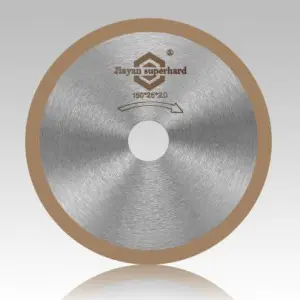
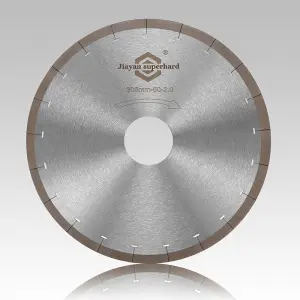
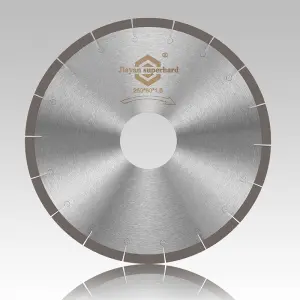
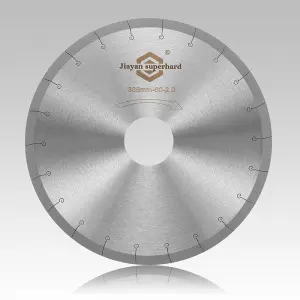
Explore our industrial-grade OEM diamond saw blades engineered with proprietary powder metallurgy and dynamic balancing for demanding stone and ceramic processing.
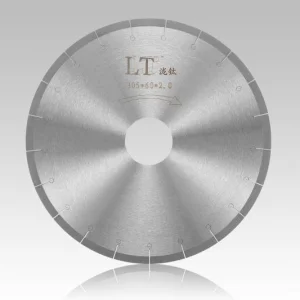
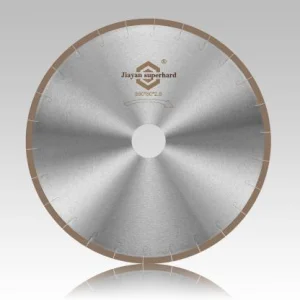
A comprehensive analysis of matrix metallurgical synthesis, segment design geometry, and mechanical dynamic balancing in modern OEM tool production.
In the domain of professional industrial stone processing, civil construction, and specialized masonry fabrication, the 9-inch (230mm) diamond blade occupies a pivotal strategic position. Serving as the primary workhorse diameter for high-torque angle grinders, handheld masonry saws, and bench cut-off machines, the 230mm form factor demands an unprecedented equilibrium between peripheral linear velocity, rotational inertia, matrix retention strength, and heat dissipation efficiency.
At JIAYAN Superhard Tools, as a member of the China Superhard Material Association, our OEM manufacturing methodologies integrate advanced solid-phase sintering technologies with micro-alloyed powder metallurgy. Achieving long service life combined with chip-free cutting speeds requires optimizing three key structural parameters: diamond crystal grade selection, metal bond matrix composition, and laser slot stress relief geometry.
The performance of an OEM 9-inch diamond blade depends heavily on matching the matrix hardness to the specific Mohs hardness of the material being cut:
Leveraging China's superhard material ecosystem to deliver unmatched cost efficiency, technical customization, and strict quality control.
China accounts for over 85% of global synthetic diamond crystal production. Factories in regions like Wuhu and Henan possess direct access to high-purity synthetic diamond grit (MBD grade) and high-purity cobalt powders, guaranteeing superior raw material consistency at optimized cost points.
Modern Chinese manufacturing facilities utilize computerized multi-stage vacuum hot-pressing sintering furnaces. Precise thermal control (±2°C tolerance) ensures total alloy density, eliminating internal porosity and maximizing segment shear strength beyond international EN13236 standards.
For heavy-duty dry cutting applications, Chinese OEM factories employ high-power continuous CO2 laser welding lines. Laser beam penetration deeply fuses the segment directly to the 65Mn steel core, delivering joint bond strength exceeding 15 Nm torque thresholds to eliminate segment shedding risks.
Every 9-inch steel blade blank undergoes automated hydraulic dynamic tensioning and runout alignment. This ensures planar runout stays under 0.15mm, eliminating blade wobble, reducing machine bearing fatigue, and delivering pristine, ultra-smooth cuts.
Chinese OEM suppliers offer comprehensive private-label customization: custom segment geometry (Turbo, Keyhole, J-Slot, Continuous Rim), specialized arbor bushings (22.23mm to 25.4mm), laser-engraved branding, custom color lacquering, and retail-ready packaging.
Adhering to strict oSa and EN13236 compliance, raw material powders and finished blades undergo destructive torque testing, dynamic balance verification, and ultrasonic flaw detection to ensure zero defect rates prior to global dispatch.
Engineered segment formulations optimized for distinct stone hardness grades, architectural slabs, and civil masonry materials.
| Target Substrate / Material | Recommended Rim Configuration | Bond Matrix Type | Optimum RPM | Primary Sector Application |
|---|---|---|---|---|
| Sintered Stone & Dekton | Ultra-Thin Continuous / J-Slot Rim | Soft Bronze-Tin Matrix | 4,500 – 6,000 | Luxury Architectural Countertops & Interior Slabs |
| Hard Granite & Quartzite | Keyhole Segmented / Wave Turbo | Medium Cobalt-Iron Matrix | 5,500 – 6,600 | Commercial Stone Processing & Monument Fabrication |
| Porcelain & Ceramic Tile | Mesh-Contoured Ultra-Thin Rim | Fine-Grained Copper Bond | 6,000 – 6,600 | Precision Residential Tiling & Floor Installations |
| Reinforced Concrete & Rebar | Laser Welded Heavy-Duty Segment | Hard Tungsten-Fortified Matrix | 5,000 – 6,500 | Civil Engineering, Infrastructure & Structural Demolition |
| Marble & Calcareous Stone | Vacuum Brazed / Continuous Rim | Electroplated / Soft Nickel Alloy | 5,000 – 6,000 | Sculptural Restoration & Soft Stone Milling |
The rapid rise of engineered sintered stone (e.g., Dekton, Neolith, Lapitec) presents severe cutting challenges due to internal material stress and high glass-phase density. Standard masonry blades cause severe edge micro-chipping or catastrophic slab fracturing. OEM 9-inch J-Slot and continuous mesh blades utilize fine 100/120 mesh diamond powder distributed across a soft bronze bond. The narrow J-slots actively dissipate thermal build-up while releasing stress waves to guarantee razor-sharp cuts across large format porcelain panels.
For municipal structural cutting, pipe trenching, and bridge restoration, 9-inch laser-welded diamond blades deliver extreme mechanical durability. Designed to handle high-horsepower handheld gas saws, these blades incorporate protective keyhole gullets to clear slurry and debris quickly, preventing blade drag when severing steel rebar embedded within high-PSI concrete.
Tailored diamond blade solutions manufactured to meet precise regional market requirements, private label branding, and machine specifications.
Custom arbor reaming: 22.23mm (7/8"), 25.4mm (1"), 50mm, or 60mm with custom pinholes or 5/8"-11 threaded brass hubs for direct grinder attachment.
Available in 10mm, 12mm, and ultra-durable 15mm segment heights. Geometries include Wave Turbo, Keyhole Segmented, Arrow Segment, and Detached Rim.
Optional multi-layer copper-laminated noise damping steel cores. Reduces operational high-frequency cutting noise by up to 12-15 dB in indoor fabrication shops.
High-resolution fiber laser etching for brand logos, safety specs, and barcodes. Customized color powder coating, blister packs, and color retail boxes.
How artificial intelligence, green powder metallurgy, and ultra-fine diamond crystallization are revolutionizing tool performance.
Leading OEM factories are integrating high-resolution AI visual inspection systems directly into post-sintering assembly lines. Computer vision models inspect segment micro-fractures, diamond distribution uniformity, and laser weld joint integrity at 200 frames per second, ensuring zero defective products reach international shipments.
Driven by European REACH regulations and corporate ESG compliance, next-generation research focuses on substituting cobalt with iron-nickel-copper nanostructured alloys. These eco-friendly bonds reduce environmental impact during production while maintaining thermal stability up to 900°C.
Traditional random diamond distribution is being superseded by automated 3D grid placement technology. Spacing synthetic diamond crystals in exact 3D coordinates ensures uniform blade wear, increases cutting speed by 30%, and extends operational life by up to 50% under harsh dry-cutting conditions.
Expert insights covering technical operating parameters, material compatibility, maintenance practices, and order procurement.
The optimal operating speed for a 230mm diamond blade ranges between 5,500 RPM and 6,600 RPM, depending on the target material. For hard materials like granite and sintered stone, lower linear peripheral speeds (around 30-35 m/s) prevent segment glazing, whereas softer materials like green concrete benefit from higher speeds (up to 50 m/s).
Hot-pressed continuous rim or segment blades are manufactured by sintering the metal powder core and diamond rim simultaneously under high thermal pressure, ideal for precision wet cutting of tiles and slabs. Laser-welded blades use high-power lasers to weld pre-sintered segments to the steel core, providing extreme thermal shear resistance required for heavy-duty dry cutting of concrete and brick.
Edge chipping can be prevented by selecting a 9-inch J-Slot or continuous fine-mesh rim blade with a soft bronze bond matrix. Additionally, ensuring proper water coolant flow, checking machine spindle alignment, and reducing feed speed during entry and exit cuts eliminates chipping.
OEM customization adjusts the matrix formulation according to local stone geology. For instance, European markets cutting hard Nordic granite require soft cobalt-bronze matrix bonds, whereas Middle Eastern markets cutting abrasive limestone demand hard, wear-resistant alloy bonds with keyhole slot cooling.
Glazing occurs when the metal bond is too hard for the substrate, preventing dulled diamond crystals from shedding. The exposed diamond flattens out, causing friction without cutting. A glazed blade can be re-dressed by making several cuts into an abrasive material like soft sandstone, asphalt, or an aluminum oxide dressing block to strip back the metal matrix and expose sharp diamond grains.
All high-performance OEM diamond blades exported globally must strictly conform to European Standard EN13236 safety requirements and optional oSa (Organization for the Safety of Abrasives) certification. This mandates stringent testing for maximum rotational speed, dynamic side-load fracture resistance, and segment shear torque limits.
Direct manufacturer access for global distributors, wholesalers, and OEM private label partners.