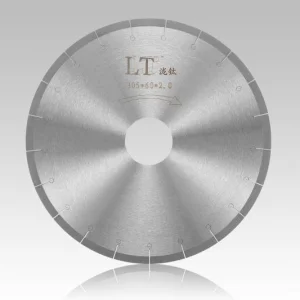
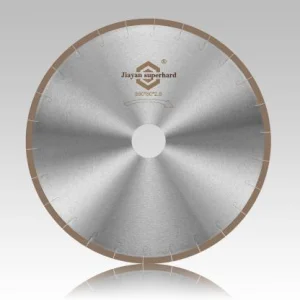
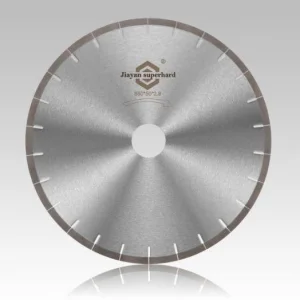
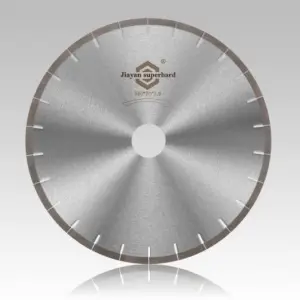
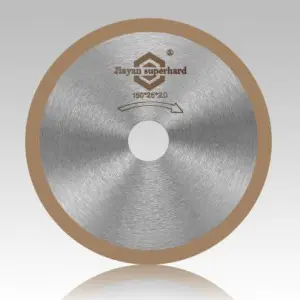
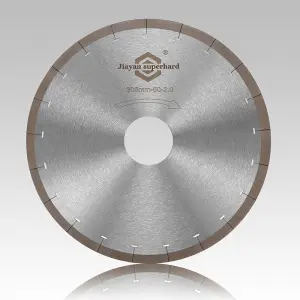
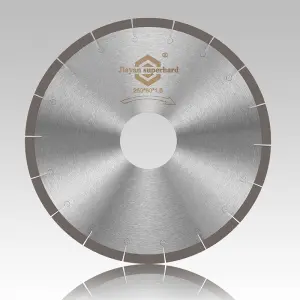
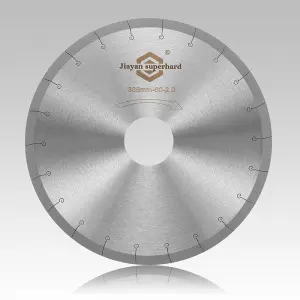
Precision-engineered tooling portfolio manufactured by JIAYAN Superhard Tools for high-speed metal cutting, granite sawing, and architectural ceramic processing.
An in-depth analysis of ceramic-metallic composite synthesis, tribological wear mechanisms, and high-velocity cold sawing efficiency.
In modern industrial manufacturing, the demand for high-speed, high-precision, and dry cold sawing of ferrous metals and hard composite materials has pushed traditional carbide tooling to its physical limits. As global production lines accelerate toward automated, continuous operation, contract manufacturers and OEM engineering teams are increasingly turning to Cermet Tipped Circular Saw Blades. Unlike standard tungsten carbide (WC-Co) tools, Cermet—a composite material consisting of ceramic (Ceramic) micro-grains bonded within a metallic matrix (Metal)—delivers unprecedented chemical stability, extreme hot-hardness, and superior micro-chipping resistance.
The foundation of premium Cermet tips lies in advanced powder metallurgy. The primary hard phase consists of Titanium Carbonitride (TiCN) combined with Secondary Carbides such as Tantalum Carbide (TaC), Niobium Carbide (NbC), and Molybdenum Carbide (Mo2C). Nickel (Ni) and Cobalt (Co) serve as the binder matrix. This precise formulation yields a micro-duplex grain structure:
Because Cermet has a dramatically lower chemical affinity for iron (Fe) than conventional tungsten carbide, it virtually eliminates the formation of Built-Up Edge (BUE) when machining soft steels, alloy bars, and stainless steel tubing. The result is a mirror-like cut surface finish ($Ra < 1.6\,\mu\text{m}$) and significantly reduced kerf drag.
Understanding regional procurement trends, macro-economic drivers, and the shift from flood-coolant HSS sawing to high-speed dry Cermet cold sawing.
Tier-1 automotive suppliers in Europe, North America, and East Asia rely heavily on CNC cold saw machines (e.g., Tsune, Nishijimax, Mega) equipped with Cermet tipped blades. The cutting of forged steel drive shafts, gear blanks, shock absorber tubes, and steering rack bars demands micro-tolerances. Cermet blades minimize cut cycle times from 45 seconds down to 8 seconds per billet.
The global energy and structural infrastructure sectors require clean, burr-free square cuts on high-strength low-alloy (HSLA) pipes, API 5L line pipes, and thick-walled structural steel tubing. Cermet blades eliminate secondary end-facing or deburring grinding steps, saving millions of dollars annually in plant labor costs.
With architectural trends shifting toward sintered stone slabs, ultra-hard ceramics, and engineered porcelain laminates, tooling manufacturers are blending superhard diamond segment engineering with specialized Cermet core stress-relief techniques. This cross-pollination provides unprecedented dimensional accuracy without edge chipping.
How JIAYAN Superhard Tools leverages advanced automated manufacturing, raw material scale, and deep member expertise of the China Superhard Material Association.
Situated in Wuhu, China, JIAYAN controls the full production cycle—from micro-grain metallurgical synthesis of Cermet tips to 75Cr1 German steel plate laser cutting, automated stress balancing, and CNC 5-axis tooth grinding on VOLLMER machines. This vertical integration guarantees batch-to-batch consistency.
Every single blade undergoes automated dynamic tensioning and optical laser runout testing. Radial runout is strictly maintained within < 0.02 mm, and lateral wobble is eliminated through computerized heat treatment annealing, preventing blade distortion under high feed rates.
We provide global tool brands, regional distributors, and saw mill plants with flexible OEM options. From custom pinhole configurations (e.g., 4/9/50, 4/11/63) to specialized tooth geometries (Triple Chip Grind - TCG, Alternate Top Bevel - ATB, Flat Notch), JIAYAN tailors saw blades to match exact machine dynamics.
Real-world engineering applications, cutting speed ($V_c$), and feed-per-tooth ($f_z$) configurations for optimized tooling yield.
Workpiece: S45C, AISI 1045, 4140 Chrome-Moly Solid Bars (Φ30mm – Φ120mm).
Tool Specs: 285mm x 2.0mm x 60T Cermet Tipped Circular Saw Blade.
Operating Envelope: Cutting Speed $V_c = 100\text{--}140\text{ m/min}$, Feed per Tooth $f_z = 0.04\text{--}0.07\text{ mm/tooth}$.
Performance Result: Zero burr end face, blade lifespan exceeds 25 sq. meters of cross-sectional cut area.
Workpiece: Seamless & ERW steel pipes (Wall thickness 1.5mm – 4.5mm).
Tool Specs: 360mm x 2.6mm x 100T Fine-Pitch Cermet Blade.
Operating Envelope: $V_c = 180\text{--}250\text{ m/min}$, high-speed index cycle.
Performance Result: Prevents tube wall deformation, eliminates interior edge tube flash, extends blade life by 300% over HSS saw blades.
Workpiece: Ultra-compact sintered stone slabs, 12mm-30mm granite blocks.
Tool Specs: 350mm JIAYAN Laser-Welded Segment / Continuous Rim Diamond Blade.
Operating Envelope: RPM 1800–2400, wet coolant flow 15 L/min.
Performance Result: Chip-free edge trimming on delicate porcelain and hard quartzites.
Workpiece: 6000-series aluminum structural extrusions, copper busbars.
Tool Specs: 405mm x 3.4mm x 120T Negative Rake Cermet Blade.
Operating Envelope: $V_c = 2500\text{--}3200\text{ m/min}$, MQL lubrication system.
Performance Result: Rapid chip ejection, no material smearing or side friction marks.
Emerging developments shaping the future of industrial cutting tools, PVD coatings, and acoustic damping.
Modern Cermet blades are increasingly augmented with AlTiN, TiAlSiN, or DLC (Diamond-Like Carbon) coatings applied via Physical Vapor Deposition (PVD). Nano-layered structures act as thermal barriers, raising surface oxidation thresholds beyond 1,100°C and reducing friction coefficients to below 0.35.
To comply with global workplace noise regulations (< 85 dB), high-end saw bodies feature computer-designed laser expansion slots injected with thermoplastic elastomers. This vibration-dampening core mitigates harmonic resonance, preventing edge chatter and micro-chipping.
Integration of IoT motor load monitoring on modern automatic cold saw machines enables real-time tracking of blade friction and torque resistance. Predictive wear algorithms prompt blade changes before catastrophic tooth failure occurs, preserving valuable raw stock.
A rigorous economic framework for factory managers, purchasing officers, and tool distributors to evaluate true cost-per-cut.
When purchasing industrial circular saw blades, evaluating procurement costs based solely on the initial purchase price ($C_{\text{initial}}$) leads to sub-optimal operational expenses. The true performance metric is Total Cost of Ownership per Cut (TCO/cut). High-performance OEM Cermet blades manufactured by JIAYAN reduce machine downtime and eliminate secondary finishing steps, resulting in significant net savings.
Plant managers should calculate cost-efficiency using the following standardized formula:
Because JIAYAN Cermet blades maintain sharp tooth geometry significantly longer than standard tooling, $N_{\text{total cuts}}$ increases by up to 300%, while $C_{\text{deburring penalty}}$ drops to zero due to pristine cut surface finishes.
Empirical breakdown of physical properties across key cutting material technologies.
| Material Class | Micro Hardness (HV) | Fracture Toughness ($K_{1c}$) | Thermal Resistance (°C) | Fe Chemical Affinity | Primary Application |
|---|---|---|---|---|---|
| TiCN Cermet (JIAYAN OEM) | 1900 – 2200 | 8.0 – 9.5 | 1,100°C | Extremely Low | High-speed dry cold sawing of solid steel bars, tubing & alloy components |
| Tungsten Carbide (WC-Co) | 1400 – 1700 | 10.0 – 14.0 | 600°C | Moderate | General metal cutting, wood processing, structural demolition |
| PCD (Polycrystalline Diamond) | 5000 – 8000 | 5.0 – 7.0 | 700°C | High (Reacts with Fe) | Non-ferrous alloys, ultra-hard stone, ceramics, composites |
| HSS (High-Speed Steel M2/M35) | 800 – 950 | 20.0 – 25.0 | 550°C | High | Low-speed wet sawing of structural steel pipe & profiles |
Actionable diagnostic guide to resolve premature tool wear, tooth chipping, and cut deflection in industrial production lines.
Root Cause: Excessive feed per tooth ($f_z$), backlash in gear train, or mechanical vibration caused by worn spindle bearings.
Corrective Action: Reduce feed rate by 15–20%; inspect machine hydraulic clamping jaws; ensure rigid workpiece holding.
Root Cause: Cutting speed ($V_c$) is set too high for material hardness; inadequate clearing of metal chips leading to re-cutting.
Corrective Action: Adjust RPM downward; check chip cleaning brush alignment and compressed air blast pressure.
Root Cause: Overheating of steel plate due to improper tensioning, excessive side friction, or worn blade guide blocks.
Corrective Action: Replace blade with proper initial tensioning; check lateral runout; ensure side clearances are free of debris.
Stay informed with technical insights, manufacturing updates, and global exhibition participation from JIAYAN Superhard Tools.
Understanding key testing standards for laser-welded joints, covering non-destructive testing, microstructure shear tests, and dynamic fracture evaluation.
Read Technical Paper →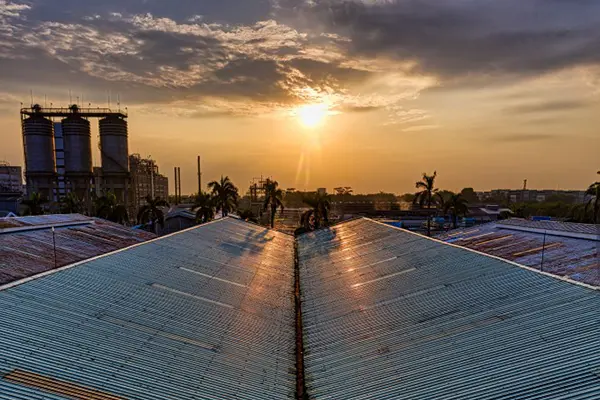
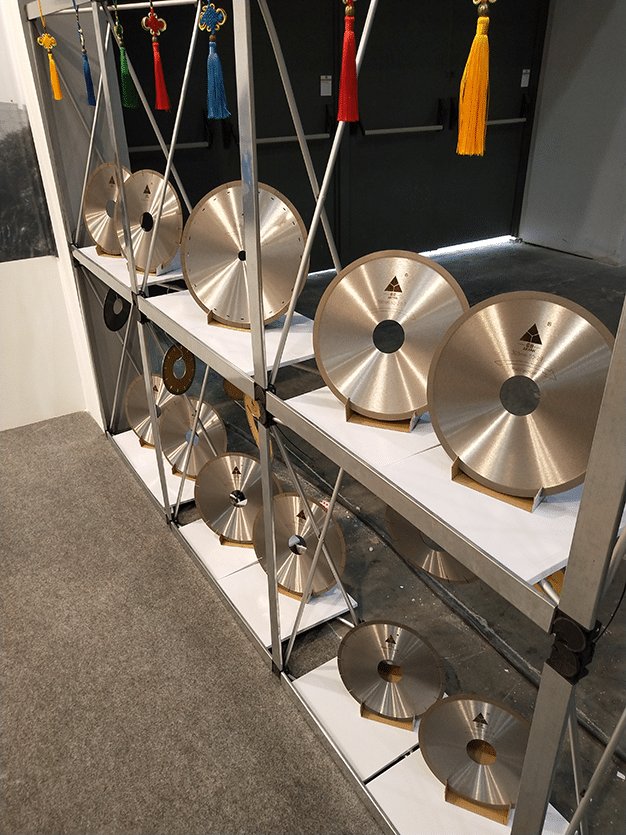
JIAYAN showcased next-generation superhard cutting discs and custom continuous rim circular blades at the Canton Fair Complex in Guangzhou.
View Event Highlights →
Presenting high-precision Cermet and superhard diamond saw blade innovations to European industrial tool distributors and factory buyers in Rimini, Italy.
Read Event Report →Detailed engineering answers to key technical questions surrounding Cermet circular saw blade performance and procurement.
Cermet tips feature a Titanium Carbonitride (TiCN) ceramic composite structure with negligible chemical affinity for ferrous metals. Unlike tungsten carbide, Cermet prevents material welding (Built-Up Edge) at high cutting speeds (>100 m/min). This results in cooler cuts, longer edge sharpness retention, and significantly smoother surface finishes.
Yes. OEM Cermet tipped circular saw blades can be re-sharpened 2 to 4 times depending on the extent of wear and remaining tip volume. Re-sharpening must be conducted on specialized 5-axis CNC grinding machinery using high-grit diamond grinding wheels under flood oil coolant to prevent micro-thermal cracking.
Cermet blades excel in dry cutting and Minimal Quantity Lubrication (MQL) applications. Liquid flood coolants can cause thermal shock leading to micro-fractures in the ceramic matrix. Air blow systems combined with micro-mist oil lubrication (MQL) provide optimal chip evacuation and flank cooling.
The general rule for solid steel sawing is to maintain between 3 to 6 teeth in continuous contact with the workpiece. Too few teeth cause heavy impact loading per tooth, leading to tip shear; too many teeth result in fine chip packing and heat buildup. JIAYAN provides tailored tooth pitch engineering based on your machine RPM and material wall thickness.
JIAYAN provides end-to-end OEM manufacturing, including custom arbor diameters, drive pinhole arrays (e.g., 4/9/50, 4/11/63), specialized kerf thicknesses, laser body slots, custom PVD coating options (AlTiN, TiSiN), and private-label laser etching and packaging for international distributors.
As an accredited member of the China Superhard Material Association, JIAYAN enforces ISO 9001 quality management protocols. Every blade undergoes optical AOI radial runout verification (< 0.02mm), dynamic balance testing, and 100% shear bond strength testing on brazed tips prior to shipment.
Explore our flagship superhard diamond circular blades and OEM Cermet series engineered for maximum production throughput.