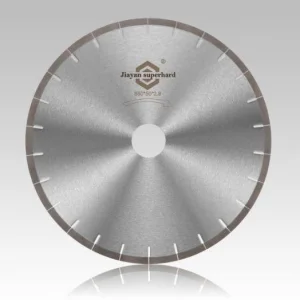
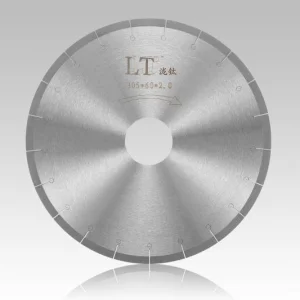
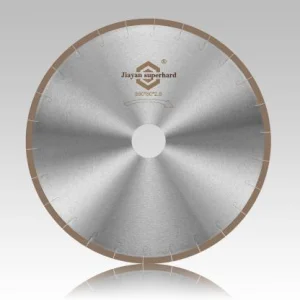
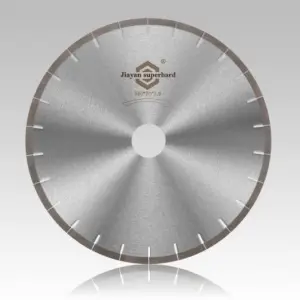
Explore our top-tier manufacturing line engineered for maximum cost-efficiency, high segment retention, and ultra-precise kerf margins across granite, marble, ceramic, and sintered stone applications.
In the global B2B procurement ecosystem for superhard cutting tools, evaluating an OEM cutting disc price company requires moving far beyond superficial unit-cost comparisons. Corporate buyers, regional importers, and industrial distributor brands must analyze the complex interlocks between single-blade unit pricing and operational lifetime economics—commonly measured in Cost per Cut ($/m²) and Material Yield Efficiency (%).
When global procurement heads evaluate suppliers across Asia, Europe, and North America, purchasing friction often stems from inconsistent metallurgical bonding, undisclosed diamond grit concentration variations, and core steel plate dynamic balancing issues. As a leading manufacturer within the China Superhard Material Association, JIAYAN Superhard operates at the convergence of advanced powder metallurgy and high-volume automated manufacturing, providing complete transparency into the cost structures of OEM diamond tools.
A 15% discount on initial unit price often correlates with a 30% reduction in diamond grit synthetic quality (e.g., lower single-crystal friability grades) or a sub-optimal Cobalt-Bronze alloy matrix. This leads to premature segment loss, frequent tool downtime, high thermal warping rates, and ultimately a higher Total Cost of Ownership (TCO) for industrial end-users.
To establish a competitive advantage when contracting an OEM cutting disc price company, enterprise buyers must understand the primary cost drivers behind high-performance diamond blades and abrasive discs. Industrial pricing is governed by four primary physical components:
Higher mesh grades (e.g., Mesh 30/40 vs 50/60) and synthetic single-crystal diamond strength directly impact cutting speeds in dense materials like quartz slabs and hard granites.
The combination of Cobalt (Co), Nickel (Ni), Copper (Cu), and Tungsten Carbide (WC) determines matrix wear matching. Cobal-rich matrices increase costs but provide extreme heat resistance.
High-tensile alloy steel cores (e.g., 75Cr1 or 65Mn) undergo stress relief tempering and dynamic laser balancing to prevent high-RPM deflection and vibration chatter.
Robotic laser welding provides superior segment shear strength (>800 MPa) for dry heavy-duty cutting, compared to silver brazing or hot-press sintering for wet applications.
The matrix below outlines standard pricing ranges across primary disc specifications, matching target cutting materials and core joint technologies.
| Disc Outer Diameter | Target Substrate | Joint / Welding Type | Diamond Grit Grade | Estimated OEM FOB Price (USD) |
|---|---|---|---|---|
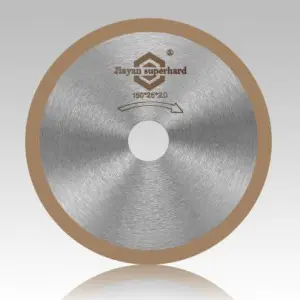
| 105mm – 125mm (4"-5") | Ceramic Tile / Porcelain | Hot-Pressed Continuous Rim | High Synthetic SVD Grit | $1.15 – $2.80 / pc |
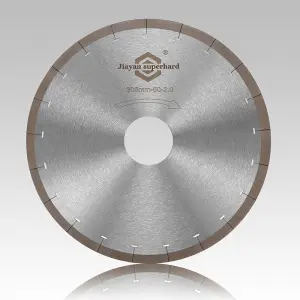
| 230mm (9") | Granite / Marble / Concrete | Turbo / J-Slot Segmented | Premium Industrial Diamond | $4.50 – $9.20 / pc |
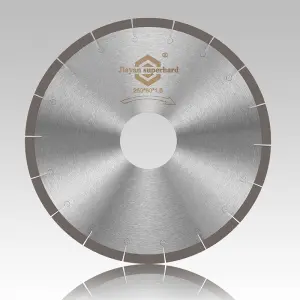
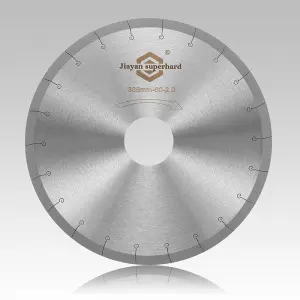
| 350mm (14") | Hard Granite & Engineered Stone | Automated Laser Welded | Cobalt-Matrix Superhard Grit | $18.50 – $38.00 / pc |
| 400mm – 500mm (16"-20") | Reinforced Concrete & Asphalt | High-Shear Laser Welded | Ultra-Hard Matrix Grade | $35.00 – $75.00 / pc |
China produces over 80% of the world's synthetic industrial diamonds and dominates the worldwide production of superhard cutting discs. Industrial clusters located in Henan and Anhui provinces—where JIAYAN Superhard Tools operates—benefit from complete vertical integration, spanning raw elemental carbon synthesis to advanced cold-press sintering and automated robotic finishing.
By partnering directly with a qualified Chinese OEM cutting disc factory, global buying organizations eliminate multiple layers of distributor markups while securing total customization over segment geometries, bond softness, kerf thickness, and private label branding.
Direct access to localized High-Pressure High-Temperature (HPHT) synthetic diamond synthesis ensures lower raw material procurement expenses and immediate access to tight particle-size distributions.
Automated vacuum sintering presses and high-speed laser welding arms reduce manual labor reliance, yielding strict batch-to-batch dimensional tolerances within ±0.02mm.
Modern automated lines support flexible order minimums (MOQ) and custom laser-engraved packaging, allowing regional distributors to launch proprietary brand lines seamlessly.
When operating heavy cutting machinery at peripheral speeds exceeding 80 m/s, segment separation poses severe structural hazards. Responsible global procurement policies require verified adherence to international safety standards prior to issuing purchase orders.
JIAYAN Superhard implements rigorous testing protocols across all product lines to ensure alignment with major international regulatory frameworks:
Mandated in the European Union, EN 13236 dictates strict design, testing, and safety marking requirements for superhard abrasive products under wet and dry cutting regimes.
Adherence to Organization for the Safety of Abrasives (oSa) and North American ANSI B7.1 standards guarantees dynamic imbalance limits and destruction speed safety factors above 1.5x working speed.
Technical support teams assist importers in tailoring bond hardness to local stone geology—such as soft, highly abrasive Indian sandstone versus hard, non-abrasive Brazilian quartzites.
For multinational tool distribution networks and original equipment brand owners, selecting an OEM cutting disc partner involves established stage-gate qualification workflows. Aligning commercial terms with rigorous engineering verification ensures seamless product adoption across global sales territories.
1. Geological Profiling: Material sample analysis (Mohs hardness, silica percentage, density).
2. Formula Matching: Metallurgical formulation of segment alloy and diamond grit grading.
3. Lab & Field Benchmarking: Automated shear testing, dynamic balance verification, and field cutting speed tests.
4. Private Label Packaging: Custom artwork, barcode integration, anti-counterfeiting holographic application, and export carton palletization.
The superhard cutting disc sector is undergoing rapid technological evolution driven by changing environmental regulations, automated stone fabrication systems, and specialized synthetic materials like sintered stone slabs.
Modern continuous rim blades feature kerf thicknesses down to 1.0mm–1.2mm, minimizing material chipping and saving up to 40% of precious sintered stone material waste.
In response to EU environmental health guidelines and cobalt commodity price fluctuations, advanced iron-nickel-copper alloys are replacing heavy cobalt matrices without sacrificing segment strength.
Automated optical camera systems inspect 100% of manufactured disc rims for micro-fissures, uneven segment spacing, and concentricity deviations before factory departure.
Superhard diamond cutting tools are engineered for specific mechanical environments. Customizing matrix attributes to the working scenario is essential for maximum operational longevity:
Requires J-Slot continuous rim discs operating at high RPM to prevent edge chipping on expensive large-format porcelain slabs in architectural kitchen countertops.
Heavy-duty 350mm–500mm laser-welded blades engineered to cut through steel-reinforced concrete bridge decks without segment detachment.
High-durability segmented circular saw blades built with soft bonds to continuously expose fresh diamond edges when processing dense quartz granite.
Review our full range of certified superhard cutting discs, diamond saw blades, and specialized segment configurations engineered for global markets.