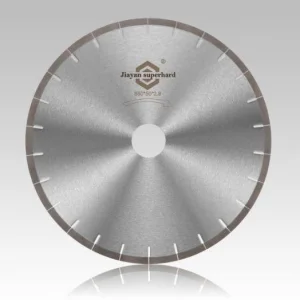
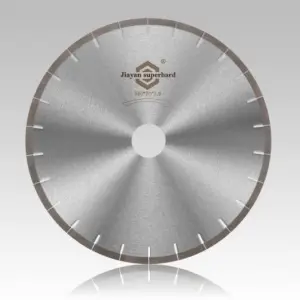
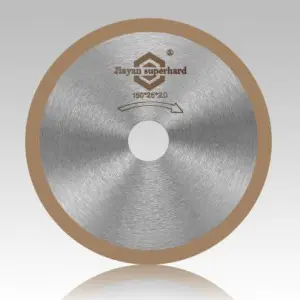
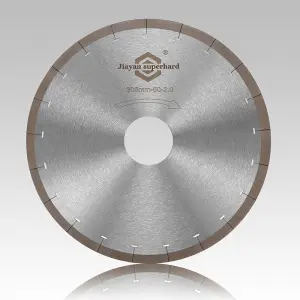
Engineered for extreme wear resistance, fast cutting velocity, and zero edge-chipping across hard stone, ultra-compact sintered stone, and technical ceramics.
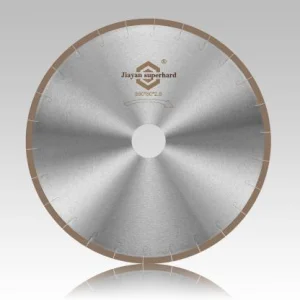
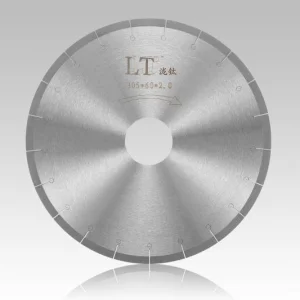
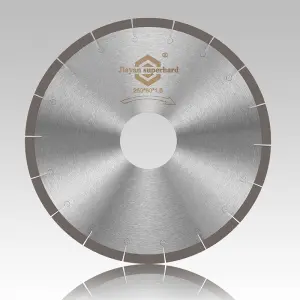
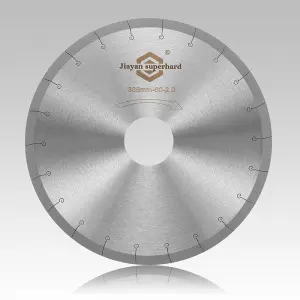
Analyzing market trends, material science advancements, and OEM procurement parameters in the superhard abrasive cutting industry.
The global market for synthetic diamond tooling and industrial diamond cutting discs is undergoing a structural transformation. Driven by the rapid proliferation of modern engineered materials—such as sintered stone slabs, ultra-compact porcelain slabs, high-density quartzite, and reinforced precast concrete—traditional cutting disc manufacturing standards are no longer sufficient. Industrial procurement heads, stone processing plant operators, and tool importers face unprecedented demands for higher linear cutting speed, extended segment lifespan, reduced power consumption, and absolute elimination of edge micro-chipping.
As a premier member of the China Superhard Material Association, JIAYAN Superhard Tools leverages advanced metallurgical research and smart sintering technologies to bridge the gap between high-speed material removal and pristine edge quality. To achieve optimal search clarity and align with modern search intent mining, industrial decision-makers must evaluate diamond blades not merely as consumable accessories, but as engineered precision components integrated into high-RPM CNC bridge saws, automated profiling lines, and hand-held angle grinders.
Understanding how matrix hardness, diamond crystal grit grading, and thermal sintering mechanisms influence real-world cutting performance.
We utilize premium MBD-8 and synthetic monocrystalline diamond grains featuring high thermal stability (up to 1100°C) and controlled friability. Titanium-coated (Ti) diamond particles are deployed in specialized granite and ceramic formulations to increase retention strength within the metal matrix by over 40%.
The segment matrix rate of erosion must match the abrasive fracture rate of the target substrate. Our custom powder metallurgy blends Cobalt (Co), Bronze (Cu-Sn), Nickel (Ni), and Tungsten Carbide (WC) to form micro-welded bonds optimized for specific stone hardness levels from Mohs 4 to Mohs 8.
Heavy industrial masonry blades utilize high-power automated laser welding to melt the segment base directly into the 65Mn spring steel core, preventing segment loss under dry cutting conditions. Ultra-thin tile discs rely on vacuum hot-press sintering for sub-millimeter precision.
| Application Target | Blade Diameter Range | Segment Type / Design | Matrix Composition | Bond Hardness | Cooling Method |
|---|---|---|---|---|---|
| Hard Granite & Quartzite | 300mm – 800mm | Key-Slot / Segmented | Cobalt-Iron-Tungsten Matrix | Hard Bond (HRB 95-105) | Wet Cooling Required |
| Sintered Stone / Dekton | 250mm – 400mm | J-Slot / Ultra-Fine Pitch Rim | Bronze-Cobalt Soft Matrix | Soft Bond (HRB 70-85) | High-Pressure Wet Cut |
| Ceramic & Porcelain Tile | 105mm – 350mm | Continuous Rim / Mesh Turbo | Fine Copper-Nickel Bond | Medium Bond (HRB 80-90) | Wet / Dry Compatible |
| Precast Concrete & Asphalt | 350mm – 600mm | Laser-Welded Drop Segment | Iron-Based Abrasion Resistant | Extra Hard Bond (HRB 105+) | Dry / Heavy Duty Wet |
How automated sintering presses, robotic laser welding, and localized raw material integration guarantee production efficiency and order reliability for international buyers.
The global supply chain demands predictable lead times, strict batch-to-batch repeatability, and uncompromised quality assurance. Located in Wuhu, China, JIAYAN Superhard Tools operates an advanced smart factory environment built upon Industry 4.0 manufacturing execution systems (MES). By digitizing the entire production flow—from elemental powder weighing to final dynamic balancing—we minimize human error and achieve unprecedented manufacturing yield efficiency.
Computer-controlled vacuum sintering presses monitor temperature profiles within ±1°C and hydraulic pressure within ±0.1 MPa, ensuring optimal metallurgical phase transformation and eliminating internal segment porosity.
Every steel core undergoes computer-controlled tensioning and dynamic runout testing. This prevents blade wobble, dampens high-frequency acoustic resonance, and delivers true axial runout below 0.02mm under high RPM loads.
Each manufactured cutting disc is etched with a unique batch laser code. This provides total transparency from raw diamond particle sourcing back to the specific sintering shift and quality inspector stamp.
Deciphering localized application criteria, safety certification norms, and specialized tool demands across major international markets.
Key Requirements: Heavy-duty dry-cutting masonry blades, high safety margins, and compliance with OSHA silica dust reduction rules (wet-cut preference in stone shops). High demand for 14-inch walk-behind concrete blades and small turbo discs with quad-holes for flush cutting.
Key Requirements: Strict adherence to EN 13236 safety standards and oSa certification. High market penetration of large porcelain slabs (3mm - 12mm thickness), requiring specialized J-slot and mesh-rim blades that guarantee zero chip formation on mitered edges.
Key Requirements: Large-scale commercial marble and granite quarrying and slab processing. High demand for 350mm to 800mm bridge saw blades capable of continuous operation under extreme ambient temperatures and aggressive water feed conditions.
Operational best practices for stone fabricators, civil engineers, and tile installation contractors.
Achieving optimal linear yield and edge perfection requires precise alignment between machinery operating parameters and blade engineering specifications. Disregarding operational variables—such as peripheral line speed (m/s), water coolant volume, and traverse feed speed—can result in premature segment glazing, core tension loss, or catastrophic thermal stress cracking.
Granite cutting requires linear speeds between 25–35 m/s, whereas marble and soft limestone perform best at 35–45 m/s. Sintered stone slabs demand conservative line speeds (20–28 m/s) with steady feed rates to prevent thermal stress accumulation.
Adequate water pressure must be directed squarely at the cut contact point (not just the blade body). Proper fluid delivery flushes out abrasive rock slurry, prevents segment friction overheating, and maintains matrix self-sharpening.
When cutting extremely hard or non-abrasive materials, the metal matrix may glaze over the diamond points. Making several cuts into an abrasive sandstone brick exposes new sharp diamond layers and restores peak cutting speed instantly.
Empowering tool distributors, regional brands, and hardware chains with tailored manufacturing, laser branding, and custom packaging solutions.
JIAYAN Superhard offers robust OEM and ODM partner programs configured to accelerate market entry for global tool distributors. From initial CAD drawing validation to customized segment height (e.g., 10mm, 12mm, 15mm, or 20mm), arbor hole reaming (50mm, 60mm, 22.23mm with copper bushings), silent core sandwich layers (steel-copper-steel acoustic damping), and customized laser marking, our engineering team tailors every detail to your precise brand specification.
Custom segment geometry, tensioning profiles, and slot engineering designed for target substrates.
High-resolution fiber laser marking for brand logos, part numbers, safety icons, and direction arrows.
Bespoke double-blister packs, color box packaging, display cartons, and barcode integration.
Comprehensive shear testing, axial runout measurement, and real-world cut performance verification.
Expert technical insights answering key commercial and technical procurement inquiries.
Select from our benchmarked cutting disc ranges designed for global industrial deployment.