Engineered with vacuum hot-pressed technology, micro-grain diamond matrixes, and vibration-dampened cores for chip-free performance.
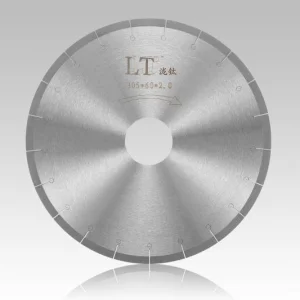
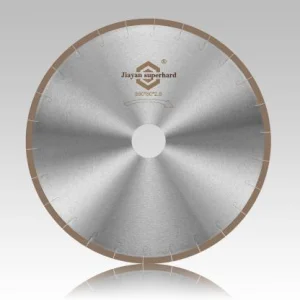
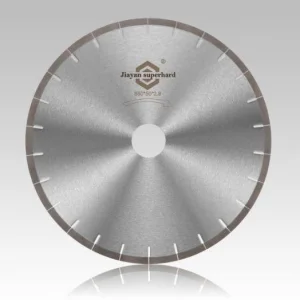
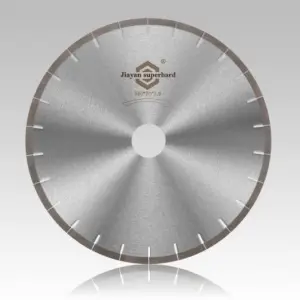
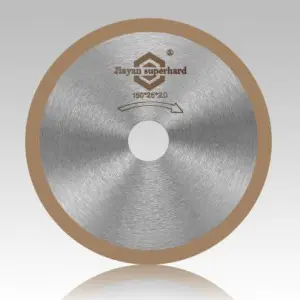
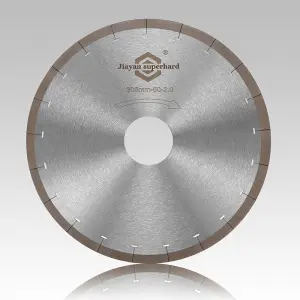
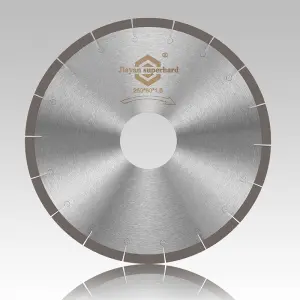
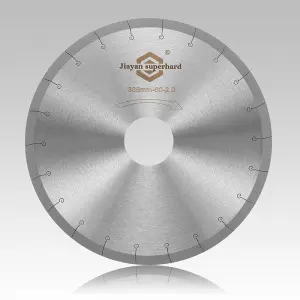
The modern architectural and surfacing industry has undergone a radical material transformation. The global transition from traditional ceramic tiles and soft natural marble toward ultra-dense porcelain slabs and sintered stone (such as Dekton, Neolith, and Lapitec) has created unprecedented mechanical challenges for industrial cutting tools. Sintered stone and technical porcelain exhibit extreme Mohs hardness (typically rating 7 to 8), high flexural strength (> 50 N/mm²), and massive internal stress profiles due to extreme manufacturing compaction (exceeding 40,000 tons of press force) and ultra-high sintering temperatures (above 1,200°C).
When cutting these superhard, vitreous materials, standard diamond saw blades consistently fail. Conventional blades experience rapid segment glazing, extreme heat generation, edge chipping, core warping, and catastrophic segment loss. To solve this, global procurement directors, industrial tool distributors, and fabrication workshop managers require specialized OEM Porcelain Tile Cutting Disc Suppliers capable of manufacturing tailored diamond matrix alloys designed for precision micro-chipping containment.
Industrial demand for precision diamond discs is expanding rapidly across three primary industrial sectors:
The cutting of porcelain tiles is essentially a controlled brittle fracture process. A high-performance cutting disc does not "slice" material in a metallic sense; rather, embedded synthetic diamond grit impacts the vitreous matrix at high peripheral velocities, generating localized micro-fractures that release fine dust particles. Understanding the tribological interaction between the diamond crystal, the metallic bond, and the ceramic substrate is paramount to optimizing cutting speed and disc longevity.
To prevent disc dulling (glazing), the rate of metallic matrix erosion must precisely match the rate of diamond crystal breakdown. If the metal bond is too hard, worn diamonds remain trapped, leading to friction and core overheating. If the metal bond is too soft, pristine diamonds are released prematurely, causing rapid blade wear.
Premium OEM manufacturers utilize synthetic diamonds synthesized under ultra-high pressure and temperature (HPHT). For hard porcelain and sintered stone cutting, crystal properties must meet rigid standards:
The matrix composition acts as the mechanical anchor for diamond particles. Modern OEM formulations employ multi-element alloy powders sintered via Vacuum Automated Hot-Pressing (VAHP):
| Bond Alloy Code | Primary Element Base | Additives / Dopants | Sinter Temp (°C) | Ideal Application Surface |
|---|---|---|---|---|
| MB-POR-01 (Soft Matrix) | Bronze (Cu-Sn) / Nickel Base | Cobalt, Tungsten Carbide | 820°C - 860°C | Ultra-dense Sintered Stone (Mohs 8), Dekton, Vitrified Slabs |
| MB-POR-05 (Medium Bond) | Cobalt-Iron (Co-Fe) Matrix | Copper, Titanium Powder | 880°C - 920°C | Standard Porcelain Tile, Glazed Ceramics, Floor Tiles |
| MB-GRN-09 (Hard Bond) | Iron-Tungsten (Fe-W) Matrix | Nickel, Silicon Carbide | 950°C - 1000°C | Abrasive Ceramic, Terracotta, Green Concrete & Granite |
Global procurement metrics indicate that over 75% of the world's superhard diamond tooling is manufactured in specialized industrial clusters in China, with Anhui (Wuhu) and Henan forming the nucleus of technological expertise. Sourcing directly from top-tier Chinese OEM manufacturers provides global brands with unprecedented competitive advantages across cost structure, custom metallurgical capability, and production speed.
Direct proximity to synthetic diamond synthesis centers guarantees access to pure, micro-graded diamond crystals at base market pricing, insulating buyers from supply fluctuations.
State-of-the-art multi-cavity vacuum hot-pressing machines ensure high density, zero segment voiding, and consistent bond hardness across millions of production units.
Automated tensioning and dynamic balancing eliminate runout, ensuring high radial concentration and preventing blade wobble during high-speed bridge saw operation.
The steel core (blank) serves as the structural backbone of any circular saw blade. Top Chinese OEM plants utilize 75Cr1 high-carbon alloy steel, heat-treated to 42-45 HRC. Each core undergoes laser-beam stress relief indexing to prevent thermal expansion deformation. When segment welding is required (as in heavy-duty wet bridge saw blades), fully automated 3D laser-welding stations fuse the diamond segment to the steel core with shear joint strength exceeding 150 MPa, far surpassing standard high-frequency silver brazing safety thresholds.
Maximizing the operational lifespan and cutting speed of a porcelain tile cutting disc requires matching the mechanical geometry of the disc to the specific equipment and cutting environment. Cutting modalities generally fall into two categories: Wet High-Speed Bridge Saw Machining and Dry Angle Grinding / Portable Masonry Sawing.
For industrial processing of 12mm and 20mm sintered stone slabs, wet bridge saws operate under high water coolant flow (minimum 15 to 20 Liters/min) focused directly at the kerf cut point. Water serves a dual role: flushing away microscopic glass/porcelain slurry and dissipating extreme frictional heat from the rim.
| Disc Diameter (mm/inch) | Spindle RPM Range | Peripheral Speed (m/s) | Linear Feed Speed (m/min) | Water Flow Rate (L/min) |
|---|---|---|---|---|
| 115mm (4.5") Dry/Wet | 10,000 - 12,000 RPM | 60 - 72 m/s | Manual Push / 1.5 - 2.5 | Air Cool / Mist |
| 250mm (10") Wet Saw | 2,800 - 3,400 RPM | 36 - 44 m/s | 2.0 - 3.5 m/min | 10 - 12 L/min |
| 350mm (14") CNC Bridge | 1,800 - 2,300 RPM | 33 - 42 m/s | 1.8 - 4.0 m/min | 18 - 25 L/min |
| 400mm (16") Industrial | 1,500 - 1,900 RPM | 31 - 40 m/s | 1.5 - 3.2 m/min | 25 - 30 L/min |
On job sites where water cooling is impractical, installers rely on ultra-thin continuous rim or Mesh Turbo J-Slot discs (ranging from 1.0mm to 1.4mm rim thickness). The continuous mesh pattern features alternating laser-cut slots that force air turbulence through the kerf, ejecting hot dust and keeping the steel core cool. The ultra-thin kerf minimizes material displacement, allowing effortless freehand cutting with zero surface glaze fracture.
For international importers, brand owners, and industrial hardware chains, establishing an OEM strategic partnership requires rigorous quality assurance evaluation. When procuring diamond cutting tools in bulk, purchasing directors must verify compliance across mechanical safety, structural tolerances, and customized branding requirements.
All professional diamond cutting discs must comply with the European standard EN13236 (Safety requirements for superabrasive products). This certification dictates strict burst-speed tests (blades are spun up to 1.5 times their maximum operating speed in armored chambers) and bending shear strength tests to guarantee operator safety under extreme industrial workloads.
Leading Chinese supplier factories provide total OEM/ODM flexibility to align with client branding and market localization:
The superhard material domain is undergoing accelerated technological evolution. As porcelain manufacturing technology pushes ceramic slab thickness down to 3mm flexible sheets or up to 30mm structural architectural panels, diamond tool engineering is adapting through three key technological advancements:
Transitioning from random diamond distribution to 3D matrix placement where every diamond particle is positioned at exact geometric intervals, maximizing cutting velocity by 50% and extending tool life by 30%.
Integrating sub-micron cobalt and titanium carbonitride powders to lower sintering temperatures while dramatically enhancing matrix yield strength and thermal resistance against heat-induced segment erosion.
Advancements in micro-tensioning enable the mass production of 0.8mm to 1.0mm ultra-thin discs capable of running at 12,000 RPM without dynamic deformation, reducing material waste and power consumption.
Direct answers to technical, commercial, and operational procurement inquiries for industrial buyers.
Porcelain slabs are vitrified at much higher temperatures (1200°C+) under extreme pressure, rendering them far denser and harder (Mohs 7-8) than standard ceramics (Mohs 5-6). Regular ceramic blades will glaze over, overheat, and cause massive edge chipping on porcelain. Porcelain discs require specialized softer metallic matrix bonds and finer diamond grit (100-140 mesh) to continuously expose fresh diamond edges.
J-Slots and Mesh Turbo patterns provide critical thermal expansion relief gaps and micro-dust extraction channels. They allow cool air or water to reach the cutting zone faster and prevent thermal stress build-up in the steel core, allowing thin discs (1.0-1.2mm) to make clean, straight cuts without binding or chipping surface glazes.
JIAYAN utilizes fully automated powder dosing, micro-grain laser particle analyzers, and computer-controlled vacuum hot-pressing sintering furnaces. Every production batch undergoes automated hardness testing, dynamic balance runout inspection, and destructive segment shear testing before passing ISO9001 quality audits.
No. Blades engineered exclusively for wet cutting utilize solder or silver-brazed bonds with lower melting thresholds. Running them dry will cause extreme thermal buildup, resulting in segment detachment, core destruction, and grave danger to the operator. Only blades certified as Hot-Pressed or Laser-Welded with dry-rated matrixes should be run without coolant.
Our standard OEM production lead time is 15 to 25 days depending on total order volume. Minimum order quantities (MOQ) start as low as 500 units for standard sizes (115mm-125mm) and 50 units for industrial bridge saw blades (350mm-400mm), complete with custom laser engraving and branded packaging.
If a disc slows down and begins sparking or glazing, perform 3 to 5 shallow cuts through an abrasive dressing stone, soft firebrick, or a block of green concrete. This erodes the excess metal matrix bond and exposes fresh, sharp diamond crystals.
Explore full commercial inventory options available for OEM branding, wholesale supply, and factory-direct global shipment.
Member of China Superhard Material Association. Combining advanced sintering technology with rigid ISO quality control for global enterprise buyers.
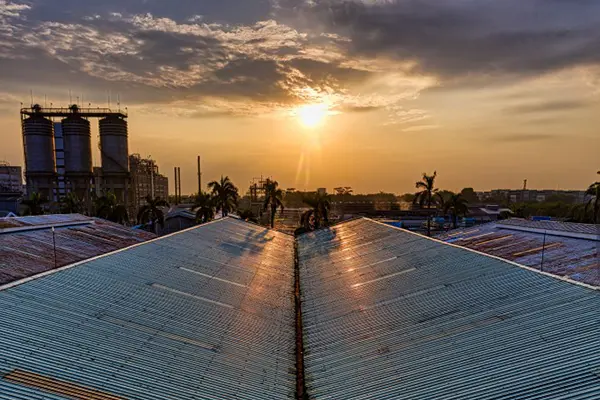
Founded in Wuhu, China, JIAYAN Superhard Materials Co., Ltd. specializes in the R&D and automated manufacture of premium diamond saw blades, diamond cutting discs, and superhard tools for stone, ceramic, porcelain, and granite industries. With over a decade of export leadership across Europe, the Middle East, Southeast Asia, and the Americas, JIAYAN provides factory-direct OEM/ODM manufacturing, agile lead times, and certified tool durability.
Request Official Product CatalogIn-depth technical breakdown of testing methodologies for laser-welded diamond joints, covering microstructure analysis, shear torque testing, and non-destructive inspection.
JIAYAN showcased next-generation ultra-thin porcelain cutting discs and silent core bridge saw blades at the Canton Fair Complex, Guangzhou.
Presenting European fabricators with custom matrix diamond tooling tailored for high-speed Italian CNC ceramic cutting machinery.