Engineered for extreme wear resistance, chip-free precision, and maximum feed rate across natural stone, ceramics, engineered quartz, and reinforced concrete.
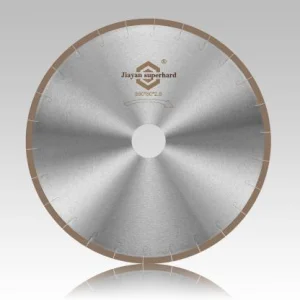
Designed with J-Slot thermal expansion waterways and micro-grade synthetic diamond matrix for ultra-fast chip-free cutting of porcelain tiles & marble.
View Specs & Inquiry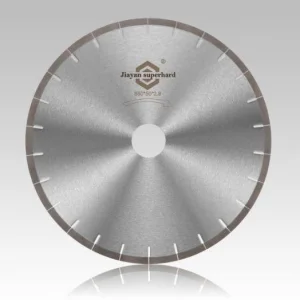
Heavy-duty 14-inch granite cutting disc utilizing laser-welded segments and Cobalt-Tungsten alloy matrix to withstand intense friction and impact.
View Specs & Inquiry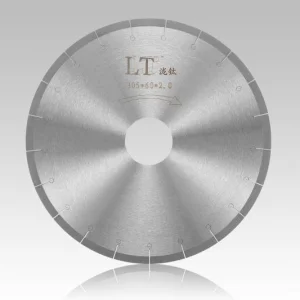
Engineered specifically for Dekton, Neolith, and dense porcelain slabs. Features ultra-fine diamond grit for clean edges with zero micro-cracking.
View Specs & Inquiry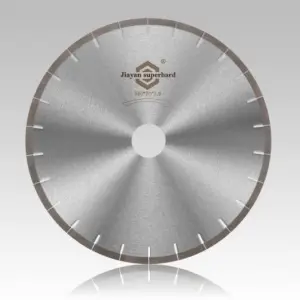
Flagship bridge saw blade featuring high sandwich segment height (15mm) for extended blade lifespan during continuous stone quarry processing.
View Specs & Inquiry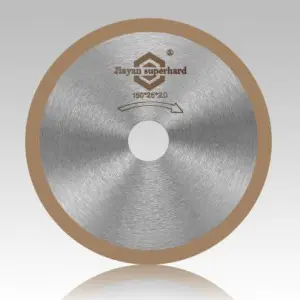
Versatile angle grinder discs with hot-press turbo segments. Optimized for dry and wet cutting of brick, field stone, tile, and masonry work.
View Specs & Inquiry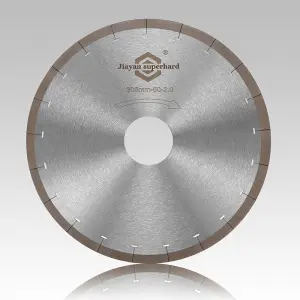
Uniform pressure sintered continuous rim design engineered for automated industrial tile cutting lines requiring glass-smooth cut margins.
View Specs & Inquiry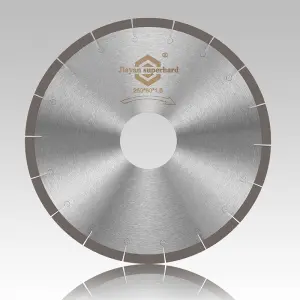
Features deep keyhole gullets for efficient slurry extraction and rapid cooling under high RPM industrial table saw operation.
View Specs & Inquiry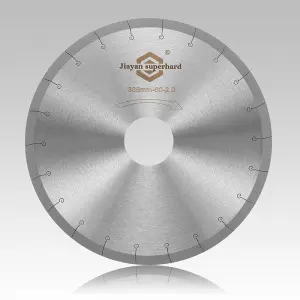
Ultra-narrow kerf technology minimizes material loss, reduces cutting drag, and prevents chipping on delicate glass tiles and vitreous ceramic slabs.
View Specs & InquiryMacroeconomic drivers, industrial stone fabrication demands, and why selecting the right OEM segment saw blade company dictates operational profitability.
In the modern industrial cutting landscape, the demand for high-efficiency, durable, and precise diamond tools has reached unprecedented heights. According to global industrial market research, the global diamond tool market is projected to expand at a compound annual growth rate (CAGR) of 6.2% over the next decade. Driven by expanding civil infrastructure, commercial high-rise construction, and the worldwide adoption of engineered stones (such as sintered stone slabs and ultra-dense quartz), selecting a specialized OEM Segment Saw Blade Company has transitioned from a routine procurement choice to a strategic core competency for distributors, machinery builders, and large-scale stone processing plants.
Segmented diamond circular saw blades represent the heavy-duty workhorse of hard material cutting. Unlike continuous rim blades—which excel in light-duty, chip-sensitive trimming—segmented blades incorporate individual diamond-impregnated teeth (segments) laser-welded or silver-brazed onto a high-strength alloy steel core. The gaps between these segments, known as gullets or waterways, serve two crucial physical functions: providing accelerated coolant circulation to dissipate intense friction heat and rapidly clearing abrasive swarf from the cutting kerf.
When cutting thick granite blocks, reinforced concrete slabs, or dense green-state ceramics, the mechanical stresses placed upon a circular blade are immense. High operational temperatures can cause thermal expansion of the steel core, resulting in blade wobbling ("snaking"), uneven kerfs, or catastrophic segment detachment. Original Equipment Manufacturers (OEMs) solve this through specialized segment matrix engineering, matching the bonding matrix's erosion rate to the specific hardness and abrasiveness of the target substrate.
Custom slot geometry (U-slot, Keyhole, J-slot) allows high-volume water flushing, keeping segment temperatures below the critical graphitization point of synthetic diamond (700°C).
Tailored metallurgical formulas (Cobalt-based, Iron-bronze, Tungsten Carbide) engineered specifically to wear down at the precise speed required to continuously expose fresh diamond edges.
Optional copper-laminated "sandwich" steel cores absorb acoustic harmonics, reducing operator noise pollution by up to 15 dB during high-RPM industrial stone sawing.
Understanding synthetic diamond selection, hot-press sintering physics, and bonding matrix formulations under E-E-A-T benchmark principles.
A diamond segment is a sophisticated metal-matrix composite (MMC). High-grade synthetic diamond crystals are uniformly blended with fine metal powders (Cobalt, Nickel, Copper, Tin, Iron, and Tungsten Carbide) and subjected to combined extreme pressure and elevated temperatures. The performance of an OEM segment relies on three fundamental engineering variables:
Not all industrial diamonds are equal. At JIAYAN Superhard Tools, synthetic diamond crystals are selected based on crystal morphology, thermal stability (TTP), and friability (the controlled breaking of diamond crystals under impact to create new sharp cutting facets):
The consolidation of metal powder and diamond crystals into a dense, non-porous structure requires precise thermal control:
| Sintering Method | Temperature / Pressure Range | Metallurgical Bonding Density | Primary Application & Advantage |
|---|---|---|---|
| Automated Hot-Pressing (HP) | 800°C – 1050°C | 25–35 MPa | Near 100% Theoretical Density | High-volume standardized saw blades for granite & marble. Ensures uniform segment hardness across mass production batches. |
| Laser Beam Welding (LBW) | Localized melting > 1400°C | Deep Fusion Joint (Steel to Segment) | Safety-critical dry cutting blades (construction site angle grinders, masonry floor saws). Prevents segment fly-off. |
| High-Frequency Silver Brazing | 650°C – 750°C Silver Alloy | Ductile Intermetallic Layer | Wet cutting large-diameter multi-blades (up to 3500mm). Allows convenient factory re-segmenting of expensive steel cores. |
The golden rule of segment engineering: Hard bond for soft/abrasive materials; soft bond for hard/dense materials. If a segment bond is too hard when cutting hard quartz, the metal will not wear down, causing the diamond edges to glaze over (smooth out) and stop cutting. Conversely, if the bond is too soft when cutting abrasive sandstone, the metal matrix erodes too rapidly, releasing diamonds before their cutting life is exhausted.
How specialized superhard tool clusters in Anhui and Henan deliver superior cost-to-performance ratios for international enterprise buyers.
China produces over 85% of the world's synthetic diamond raw materials and accounts for the majority of global circular diamond saw blade manufacturing. For global brand owners, regional distributors, and large stone processing facilities, partnering with a China-based OEM Segment Saw Blade Company like JIAYAN Superhard Tools provides distinct structural and technical advantages:
From raw synthetic diamond crystal synthesis and powder metallurgy compounding to precision laser welding and dynamic balance testing—every step takes place within high-density industrial ecosystems, reducing lead times to 15-20 days.
State-of-the-art multi-cavity automatic hot presses ensure that every segment within a 10,000-unit batch maintains identical density, hardness, and geometric dimensions (±0.05mm tolerance).
Every industrial saw blade core undergoes strict tensioning and dynamic runout testing (ISO 1940 standard). This eliminates axial vibration, protecting costly machine spindles from premature wear.
Tailor segment geometry (Arix aligned arrangement, Turbo segment, M-shape, Sandwich segment), core thickness, color coatings, laser etching logos, and customized arbor bores to build your brand identity.
Matching blade specifications to specific regional stone types, equipment machinery, and cutting environments worldwide.
Operational conditions vary significantly across international markets. An effective OEM manufacturer must understand regional material characteristics:
In markets like Italy, Spain, and Germany, bridge saws operate at high linear speeds (30–40 m/s) cutting engineered quartz, ultra-compact porcelain slabs, and Carrara marble. Focus is on quiet composite cores, ultra-clean chip-free edges, and strict EN13236 safety compliance.
In the USA and Canada, heavy walk-behind floor saws and high-horsepower masonry saws dominate for concrete road cut-outs, asphalt patching, and heavy granite countertop fabrication. Blades require laser welding, high impact resistance, and extra segment height (12mm-15mm).
Quarry operations in India, Egypt, and Saudi Arabia utilize multi-blade block cutters (up to 30 blades mounted in parallel) cutting hard Class IV/V granites under hot ambient temperatures. Blades require maximum thermal stability and wear resistance.
Mass production facilities cutting glazed ceramic tiles and architectural stone tiles demand cost-optimized blades capable of non-stop 24/7 continuous wet cutting with rapid feed rates.
The following matrix outlines standard industrial parameters available for custom OEM production at JIAYAN Superhard:
| Blade Diameter (mm/inch) | Segment Dimension (L x W x H mm) | Standard Arbor Bore | Target Material Substrate | Recommended Linear Speed |
|---|---|---|---|---|
| 105mm – 230mm (4" - 9") | 38/40 x 2.0/2.4 x 10/12mm | 20mm / 22.23mm / 5/8" | Ceramic Tile, Marble, Brick, Granite | 40 – 60 m/s (Dry / Wet) |
| 300mm – 350mm (12" - 14") | 40 x 3.0/3.2 x 12/15mm | 50mm / 60mm / 25.4mm | Granite Slabs, Sintered Stone, Concrete | 30 – 40 m/s (Wet Cutting) |
| 400mm – 500mm (16" - 20") | 40 x 3.6/4.0 x 15/20mm | 50mm / 60mm | Hard Granite Blocks, Reinforced Concrete | 28 – 35 m/s (Wet Cutting) |
| 600mm – 1200mm (24" - 48") | 24 x 5.0/7.0 x 15/20mm | 60mm / 80mm / Custom | Quarry Blocks, Heavy Wall Sawing | 25 – 30 m/s (Wet Cutting) |
Technological innovations redefining segment geometry, matrix metallurgy, and smart automated quality testing.
Transitioning from random diamond distribution to 3D matrix aligned placement. Every diamond crystal is positioned at precise 3-dimensional intervals, yielding 30% faster cutting speeds and 50% longer blade service life.
Driven by global supply chain compliance and worker safety regulations, new Iron-Nickel-Bronze alloy bonds replace cobalt while delivering equal or superior retention strength and toughness.
Integration of optical AI vision inspection to verify segment welding seam integrity and automatic laser tensioning machines that correct micro deflection to under 0.01mm in real-time.
Explore our complete catalog of certified diamond saw blades available for private-label brand customization and direct factory bulk ordering.
Engineered for clean, fast cuts in ceramic tiles, marble slabs, and porcelain. Customized gullet design.
Order Wholesale Samples
14-inch professional circular disc built with heavy-duty segments for intense granite quarry processing.
Order Wholesale Samples
Specialized chip-free blade designed for Dekton, Neolith, and dense porcelain fabrication.
Order Wholesale Samples
High-height sandwich segment technology ensuring extended operational life under continuous wet cutting.
Order Wholesale Samples
Compact hot-pressed turbo blades for manual power tools, masonry saws, and field tile installers.
Order Wholesale Samples
High-density sintered rim delivers glass-smooth finishing on high-end vitreous ceramic tiles.
Order Wholesale Samples
Equipped with deep cooling gullets and high-tensile steel core for rapid continuous table-saw cutting.
Order Wholesale Samples
Minimal material kerf width for delicate tile finishing, reducing tool resistance and dust emissions.
Order Wholesale SamplesA systematic 5-step quality assurance workflow ensuring guaranteed performance and safety compliance for global OEM buyers.
Buyer submits target substrate samples (e.g., specific granite Mohs hardness) or cutting speed parameters. Engineers formulate custom matrix composition.
Synthetic diamond grains and metal powders undergo computer-controlled hot-press sintering, ensuring uniform density (±0.02g/cm³ tolerance).
Segments are joined to the high-tensile 75Cr1 steel core. Torque shear tests verify bond strength exceeding EN13236 safety standards.
Blades are leveled and tensioned on precision balancing machines to eliminate axial and radial runout (≤ 0.02mm runout clearance).
Founded in Wuhu, China, JIAYAN Superhard is a recognized manufacturer of industrial diamond saw blades, continuous rim discs, and superhard cutting tools for stone, ceramic, and masonry construction. As a proud member of the China Superhard Material Association, we pair advanced hot-press sintering technology with automated quality verification to serve global buyers across Europe, the Middle East, Southeast Asia, and the Americas.


Addressing key engineering questions, segment selection standards, and OEM order customization procedures.
Laser Welding: Uses a high-energy laser beam to fuse the segment's steel base directly with the steel core, creating a solid metallurgical weld. It withstands extreme heat without melting, making it mandatory for dry-cutting construction applications where water coolant is unavailable.
Silver Brazing: Uses a silver alloy filler metal melted between the segment and core at around 650°C–750°C. It requires constant water cooling during operation to prevent the solder joint from softening. Silver brazing is widely used for large wet-cutting stone blades (e.g., 350mm to 3500mm multi-blades) because worn segments can be unsoldered and replaced, reusing the expensive steel core.
Apply the principle of wear-matching:
During rotation at 2000–4000 RPM, any slight weight asymmetry or stress imbalance in the blade's steel core creates centrifugal forces. If runout exceeds 0.03mm, it induces severe vibration (blade chatter). This results in uneven slab thickness, chipped cut edges, premature segment loss, and dangerous wear on the bridge saw spindle bearings. Every JIAYAN OEM blade undergoes precision computer tensioning and dynamic runout testing to under 0.02mm.
We provide full custom engineering, including:
For standard circular blade sizes (105mm–350mm), our flexible OEM sample MOQ starts at 50 to 100 units. For large-diameter bridge saw blades (400mm–1200mm), MOQs start at 10 units. Production lead time is typically 15 to 20 calendar days after sample parameters are validated.
For a 350mm (14-inch) granite blade, the recommended peripheral speed is 30 to 35 m/s, which corresponds to approximately 1650 to 1900 RPM. Coolant water flow should be maintained at a minimum of 15 to 20 liters per minute directly targeted into the cutting gullet to prevent thermal shock and diamond glazing.