Precision-engineered diamond cutting tools manufactured under strict tolerance control for global distributors and industrial stone processing plants.
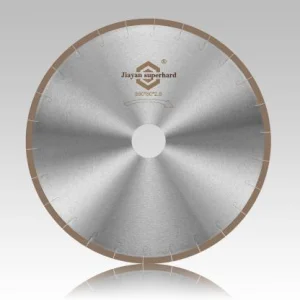
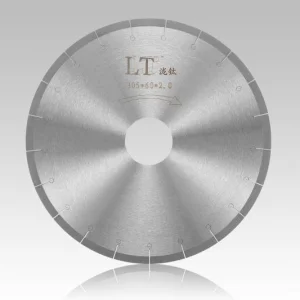
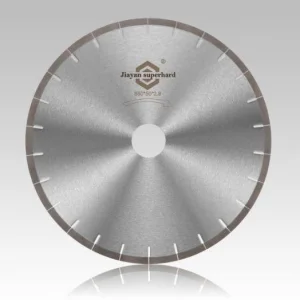
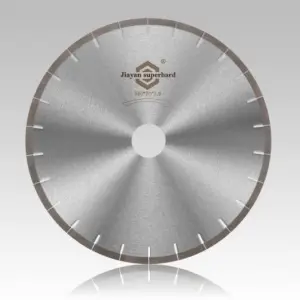
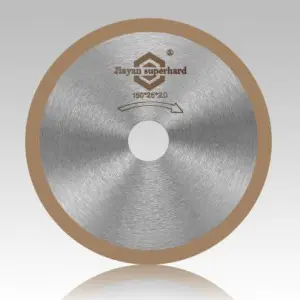
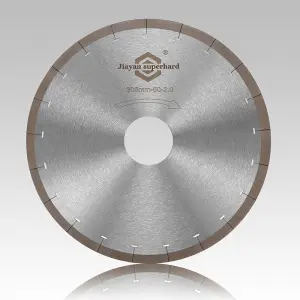
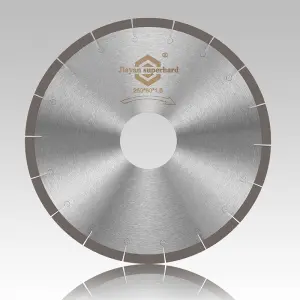
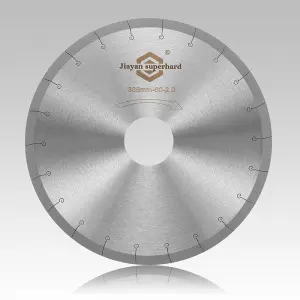
Segmented diamond saw blades represent the gold standard in heavy-duty structural cutting, quarry stone processing, and civil engineering infrastructure projects. Unlike continuous rim blades designed purely for smooth aesthetic tile cuts, segmented blades feature engineered expansion slots (gullets) separating individual diamond segments sintered to a heavy-spring steel core.
The defining advantage of a segmented circular blade lies in its aerodynamic and hydrodynamic slot geometry. Keyhole, U-Slot, and J-Slot designs act as physical evacuation channels for slurry, rock dust, and heat. During high-velocity rotation (typically 35 to 50 meters per second peripheral speed), these gullets draw ambient air or coolant directly into the cutting zone, mitigating thermal degradation of the bond matrix and preventing segment detachment.
At the microscopic level, cutting performance depends on synthetic diamond grain quality (typically monocrystalline synthetic diamond with high thermal stability) embedded within a sintered metal powder matrix. As the blade cuts, the metal matrix slowly erodes at a rate calibrated to the material's abrasiveness, continuously exposing fresh, sharp diamond edges without premature micro-fracturing or glazing over.
The industrial diamond tool sector is undergoing a massive shift toward high-precision, low-energy, and environmentally sustainable manufacturing. As modern construction and architectural processing demand harder engineered materials (like porcelain slabs and sintered stone), blade manufacturers must innovate beyond traditional hot-pressing techniques.
Traditional diamond segments feature randomly distributed diamond grit within the metal matrix. Emerging 3D array orientation (ARIX technology) places every single diamond crystal in exact geometric grid patterns throughout the segment layers. This uniform spacing ensures that every diamond crystal bears equal cutting loads, eliminating premature wear spikes, reducing power consumption on bridge saws by up to 30%, and increasing overall blade lifespan by 40-60%.
While low-cost silver brazed blades remain popular for wet-cutting soft marble, industrial safety regulations across North America and Europe (EN13236 compliance) increasingly demand laser-welded segments for dry cutting and heavy reinforced concrete demolition. High-power fiber laser welding melts the steel core and the segment base into a single cohesive metallurgical joint, achieving shear strength ratings exceeding 600 MPa and preventing segment detachment under extreme dry thermal loads.
With global market volatility and environmental regulations surrounding cobalt mining, leading Chinese OEM factories are pioneering cobalt-free or ultra-low cobalt matrix formulations. Utilizing nano-refined Iron-Nickel-Copper-Tin (Fe-Ni-Cu-Sn) alloy powders, these green matrices achieve identical micro-hardness and wear-resistance profiles while offering dynamic eco-compliance for global industrial buyers.
Selecting the correct matrix bond is critical for maximizing tool longevity and linear cutting efficiency. The fundamental engineering rule: Soft materials require hard bond matrices; hard materials require soft, free-cutting bond matrices.
| Workpiece Substrate | Material Mohs Hardness | Matrix Bond Hardness | Diamond Grit Size (US Mesh) | Diamond Concentration | Recommended RPM (350mm Blade) |
|---|---|---|---|---|---|
| Class V Hard Granite / Quartzite | Mohs 7.0 - 7.5 | Soft / Medium-Soft (Bronze-Copper Rich) | 30/40 to 40/50 Mesh | 22% - 28% High Density | 1,800 - 2,300 RPM (Wet) |
| Sintered Stone Slabs & Ultra-Compact Porcelains | Mohs 6.5 - 7.0 | Ultra-Soft Free-Cutting Bond | 50/60 to 60/80 Fine Mesh | 18% - 24% Precision Mesh | 2,100 - 2,600 RPM (Wet) |
| Medium Hard Granite / Concrete Blocks | Mohs 5.5 - 6.5 | Medium Hard Bond (Fe-Cu-Ni Mix) | 40/50 Mesh | 20% - 25% Standard | 1,900 - 2,400 RPM (Dry/Wet) |
| Reinforced Concrete with Rebar | Compressive Strength >50 MPa | Hard Abrasion-Resistant Bond | 35/45 Heavy Duty Mesh | 25% - 30% Extra High | 1,600 - 2,000 RPM (Wet/Dry) |
| Abrasive Asphalt & Green Concrete | Soft Abrasive Matrix | Ultra-Hard Tungsten-Carbide Reinforced | 30/40 Coarse Mesh | 18% - 22% Standard | 2,200 - 2,800 RPM (Wet) |
China produces over 70% of the world's synthetic industrial diamond grit, creating an unmatched cluster advantage in raw material sourcing, powder metallurgy development, and automated factory scalability.
By establishing strategic partnerships with synthetic diamond producers in Henan, our OEM manufacturing facilities access top-tier HPHT (High Pressure High Temperature) diamond crystal with optimal crystal morphology. This supply chain proximity guarantees lot-to-lot consistency in diamond toughness, thermal stability index (TSI), and particle purity.
Our factory floors deploy automated computerized multi-stage cold pressing machines and vacuum hot sintering presses. Computer-controlled sintering curves regulate temperatures down to ±2°C and pressure curves down to 0.1 MPa, eliminating human error and ensuring uniform density across every batch of diamond segments.
A high-performance saw blade core must be tensioned by skilled technicians and verified by automated laser runout gauges. We ensure radial runout tolerances within <0.03mm and lateral runout within <0.05mm, preventing blade wobble, operational fatigue, and machine spindle damage during high-speed cutting.
Precision mixing of diamond grit with Cu, Fe, Co, Ni alloy powders.
High-pressure cold pressing into preliminary segment shapes.
Sintering under controlled atmosphere to achieve full density.
Automated robotic laser fusion of segments onto 65Mn steel cores.
For enterprise purchasing directors and industrial stone processors, evaluating diamond tool suppliers based purely on unit blade price leads to sub-optimal ROI. True cost optimization requires analyzing the Total Cost per Square Meter Cut (TCO).
In high-capacity stone processing facilities, bridge saw operating hours represent substantial fixed overheads (labor, electricity, machine depreciation). A blade that costs 20% less but cuts 30% slower increases total machine operation hours, resulting in higher operational cost per slab. OEM blades custom-formulated for fast cutting minimize down-time and double daily plant throughput.
When cutting expensive imported natural marble or jumbo sintered stone slabs, kerf thickness matters. A reduction in blade segment thickness from 3.2mm to 2.2mm saves valuable material across thousands of cuts while reducing cutting friction, allowing lower horsepower machinery to operate cleanly without stalling.
Different heavy industries require specialized blade geometries, segment styles, and operational cooling setups.
Primary Equipment: High-HP CNC Bridge Saws & Multi-Blade Block Cutters.
Blade Specs: 350mm – 800mm Silent Core Segmented Blades with sandwich copper-steel noise dampening cores. Used with continuous water cooling to cut granite slabs, quartzite counter tops, and marble tiles.
Primary Equipment: Walk-behind floor saws & heavy gasoline cut-off saws.
Blade Specs: 300mm – 500mm Laser-Welded Segmented Blades featuring undercut protection segments to prevent premature core wear against abrasive sub-base road materials during asphalt and cured concrete trenching.
Primary Equipment: Angle grinders & portable wet masonry table saws.
Blade Specs: 105mm – 230mm J-Slot, Turbo Segment, or Continuous Rim ultra-thin discs engineered for chip-free edging of porcelain wall tiles, ceramic floor tiles, and thin porcelain panels.
Expert answers to common engineering, purchasing, and custom production queries.
Select from our standard industrial catalog or request custom formulation engineering for your target market.
Looking to expand your brand with high-performance OEM segmented diamond blades? Contact our engineering sales team to request factory pricing, sample testing kits, or custom technical solutions.