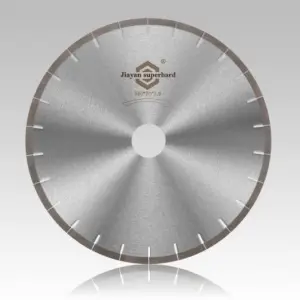
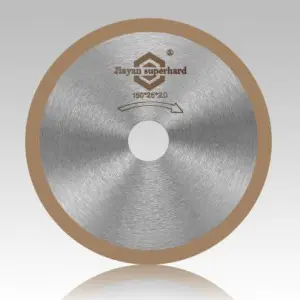
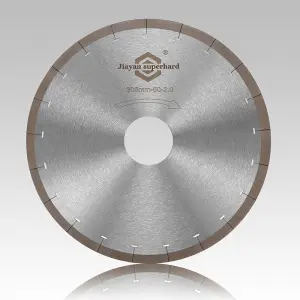
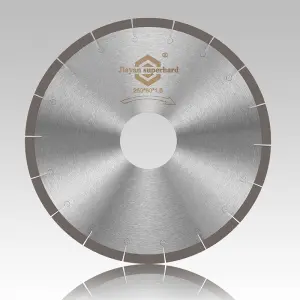
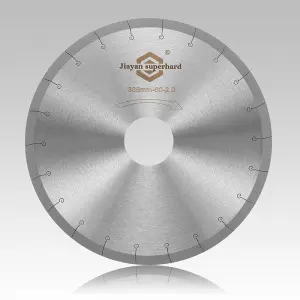
Engineered for high-RPM bridge saws, wet tile cutters, and heavy-duty masonry equipment. Select high-yield formulations certified under EN13236 safety standards.
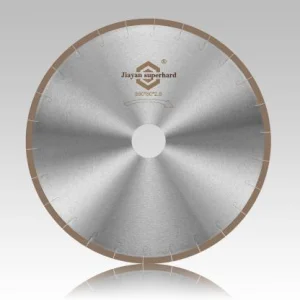
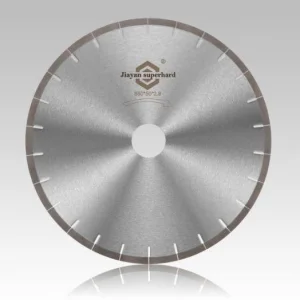
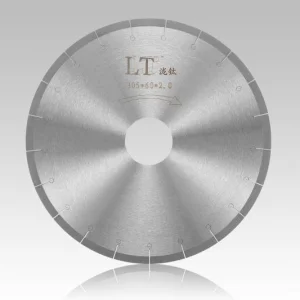
The 10-inch circular saw blade (outer diameter 250mm to 254mm) represents the structural baseline of global cutting tool procurement. Across architectural stone processing plants, commercial tile contracting, high-volume furniture manufacturing, and civil engineering infrastructure projects, the 10" blade form factor balances peripheral rim velocity with motor torque efficiency like no other size class.
Driven by rapid urbanization across North America, the Middle East, and Southeast Asia, the global market for industrial circular saw blades is undergoing a dramatic technological expansion. According to global industrial tooling indices, 10-inch diamond and Tungsten Carbide Tipped (TCT) blades account for over 38% of total volume in the commercial stone and masonry cutting sectors. As automated CNC bridge saws, sliding table saws, and portable wet tile cutters adopt higher spindle speeds and digital feed control, procurement officers face increasing pressure to source blades engineered with exact thermal stability, micro-structural diamond density, and zero-deflection steel cores.
Traditional diamond blades formulated for soft natural marble or medium-hard granite are failing when applied to modern sintered stone slabs (such as Dekton, Neolith, and Lapitec). Sintered stone features Mohs hardness ratings exceeding 7.0 and high internal tension. Procurement directors searching for wholesale 10 circular saw blade suppliers must prioritize factory formulations that integrate fine-grit synthetic diamonds (mesh size 170/200) within a customized cobalt-bronze matrix designed to continuously expose sharp diamond edges without micro-fracturing the slab edge.
Furthermore, ESG regulations and safety standards across Europe (EN13236) and the Americas (ANSI B7.1) have elevated mandatory segment bond shear strength and acoustic dampening. Industrial buyers are shifting away from cheap cold-pressed blades toward vacuum-brazed, hot-pressed continuous rim, and automated laser-welded blades capable of sustaining dry and wet cutting environments without segment detachment risks.
To evaluate a wholesale 10 circular saw blade supplier effectively, procurement engineers must look beyond superficial blade geometry and analyze the underlying metallurgical architecture. A premier 10-inch circular saw blade consists of two primary engineering components: the high-strength steel core and the abrasive cutting perimeter (segments or continuous rim).
The core serves as the backbone of the blade, responsible for absorbing torsional torque and dissipating intense frictional heat. Premium manufacturers like JIAYAN Superhard Tools utilize heat-treated 65Mn spring steel or imported German 75Cr1 high-carbon alloy steel. Cores undergo precision laser cutting, surface stress relief, dynamic balancing, and tensioning. Premium cores guarantee dynamic lateral runout tolerances below ±0.015mm, preventing blade wobble, excessive kerf loss, and finish deformation during high-RPM cuts.
The core scientific principle governing diamond saw blade efficiency is the inverse relationship between matrix bond hardness and material abrasive resistance:
| Target Substrate | Mohs Hardness | Recommended Bond Composition | Optimal Diamond Grit (Mesh Size) | Segment Type / Slot Design |
|---|---|---|---|---|
| Porcelain & Ceramic Tiles | Mohs 5.5 - 6.5 | Hard Bronze-Nickel Matrix | 170 / 200 Mesh Fine Grit | Continuous Rim / J-Slot Thin Kerf |
| Sintered Stone (Dekton/Neolith) | Mohs 7.0 - 8.0 | Soft Cobalt-Copper Free-Cutting Bond | 140 / 170 High-Grade Synthetic | Mesh Turbo Rim / Narrow J-Slot |
| Class 5 Red Granite & Quartzite | Mohs 6.5 - 7.5 | Medium-Soft Cobalt-Iron Alloy | 40 / 50 Premium Diamond Array | Laser-Welded Keyhole Segment |
| Reinforced Green Concrete | Mohs 4.0 - 5.0 (Abrasive) | Ultra-Hard Tungsten Carbide/Cobalt | 30 / 40 Coarse Diamond Grit | Deep Segment Protection / U-Slot |
| Hardwood & Non-Ferrous Metals | N/A (TCT Cut-off) | Micro-Grain Tungsten Carbide Teeth | N/A (Precision Carbide Tips) | Expansion Laser Slot with Resin Fill |
When cutting abrasive soft materials (like green concrete or soft sandstone), the metal bond must be hard enough to resist quick erosion. Conversely, when cutting dense, hard materials (like quartzite or sintered stone), the metal matrix must soft-wear gradually to continuously expose fresh diamond crystals—preventing blade glazing (polishing over) and thermal binding.
Global tool distributors, OEM brand owners, and industrial supply companies increasingly consolidate their 10-inch circular saw blade sourcing in China. The economic and technical driver behind this shift is China's fully integrated superhard material ecosystem, which combines raw material synthesis, precision metallurgy, and automated manufacturing within tightly linked industrial clusters.
China produces over 85% of the world's synthetic industrial diamonds. Direct upstream access to high-grade mono-crystalline and poly-crystalline diamond powders (e.g., Henan superhard clusters) allows Chinese manufacturers like JIAYAN to specify exact crystal friability, thermal stability, and grain morphology at a fraction of Western raw material costs.
Modern Chinese factories have transitioned from manual silver soldering to fully automated 6-axis laser welding cells. Laser beam welding creates an indivisible metallurgical bond between the diamond segment and steel core, achieving shear strength ratings 300% higher than traditional brazing—critical for high-speed dry-cutting safety compliance.
Through automated high-frequency hot-pressing sintering presses and zero-waste CNC core stamping, Chinese factories deliver unit production cost savings of 35% to 50% compared to European manufacturers, while adhering strictly to ISO9001 quality management and EN13236 security standards.
Member enterprises of the China Superhard Material Association, such as JIAYAN Superhard Tools (located in Wuhu, Anhui), demonstrate how advanced R&D combined with flexible production enables fast-turnaround OEM custom formulations. Whether a client requires specialized arbor sizes (5/8" with diamond knockout, 20mm, 25.4mm, or 50mm flange holes) or proprietary color coatings, Chinese manufacturers offer seamless scalable production from 500-piece pilot batches to 100,000-piece container shipments.
Deploying a 10-inch circular saw blade in commercial field operations requires aligning tool geometry with specific machine power parameters and target substrate behavior. Below are established engineering protocols for primary industrial field applications:
In high-end kitchen countertop fabrication shops using CNC bridge saws, cutting 12mm to 20mm sintered porcelain slabs poses extreme risk of corner cracking and edge chipping. The operational protocol dictates using a 10" J-slot continuous rim diamond blade with a soft copper-cobalt bond matrix.
On civil construction sites using portable masonry saws or walk-behind cut-off machines, 10-inch blades cut through steel rebar-reinforced concrete lintels and hard clay pavers. Here, safety and segment fatigue resistance are paramount.
In automated joinery shops and window frame fabrication facilities utilizing 10" sliding compound miter saws, TCT (Tungsten Carbide Tipped) circular saw blades dominate.
Sourcing 10-inch circular saw blades in wholesale quantities requires a structured vetting process to eliminate quality variances, late delivery risk, and international regulatory non-compliance. Professional buyers must establish a rigorous 4-step vendor evaluation workflow:
Verify that the supplier maintains EN13236 certification for superhard abrasive products. Request third-party shear strength laboratory test reports confirming that segment-to-core laser weld strength exceeds 500 MPa, preventing hazardous flying segments at high RPMs.
Before placing full container orders (FCL), order 20-piece trial samples across target substrates. Test maximum cut linear meters before segment depletion, power consumption amperage spikes, and runout stability after 50 continuous cuts in Class 4 granite or dense porcelain.
Ensure the OEM supplier offers complete private label packaging capabilities—including barcode integration, custom blister packing, laser logo engraving on the core surface, and color-coded application artwork designed for retail shelf appeal.
Consolidate your shipments by pairing high-volume standard 10" (250mm) saw blades with specialized high-margin tools such as 350mm granite bridge saw blades, ultra-thin porcelain discs, and vacuum-brazed core drill bits. Combining product categories in single FCL shipments reduces per-unit freight costs by up to 22%.
The global cutting tool sector is advancing rapidly with smart manufacturing technology, advanced surface treatments, and material science breakthroughs. Wholesale buyers should align with suppliers who actively invest in next-generation R&D:
Traditional diamond segments rely on random diamond particle distribution within the metal matrix. Next-generation 10" blades utilize automated 3D pattern placement, positioning every diamond crystal at exact equidistant intervals. This ensures consistent cut resistance, increases cutting speed by 35%, and extends total blade life by up to 50%.
Noise pollution in stone fabrication shops has led to strict OSHA and European workplace noise limits. Premium 10-inch blades now incorporate "sandwich" silent cores—consisting of two outer steel plates bonded around a central copper foil dampening layer. Laser expansion slots filled with vibration-absorbing epoxy polymer reduce operational decibels by up to 12 dB while minimizing micro-vibrations that cause tile chipping.
Physical Vapor Deposition (PVD) coatings (such as TiAlN and TiN) applied to the steel core reduce frictional heat buildup, resist chemical corrosion from recycled factory water, and prevent slurry adhesion during deep plunge cutting.
Direct factory supply with OEM capabilities, custom arbor sizes, and flexible MOQ options for global tool distributors and enterprise buyers.
Direct technical answers addressing long-tail engineering, procurement parameters, and operational protocols for 10-inch circular saw blades.
Elevate your product catalog with high-performance 10" circular saw blades, custom matrix bonds, and EN13236-certified cutting tools. Contact our engineering and procurement team for direct factory quotations, technical spec sheets, and sample evaluation.