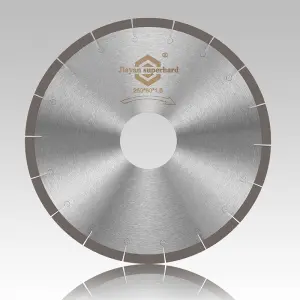
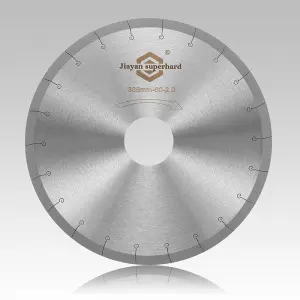
Wholesale Cutting Disc Saw Blade Manufacturer & Exporter

Engineering High-Precision Diamond Cutting Matrixes for Sintered Stone, Granite, Hard Ceramic, and Reinforced Concrete. Direct Factory OEM/ODM Procurement Architecture Built for Global Industrial Buyers.

Featured Industrial Cutting Discs & Saw Blades

Premium superhard diamond cutting tools engineered for high-speed linear cutting, zero edge-chipping, and maximum wear resistance across severe-duty stone and masonry applications.
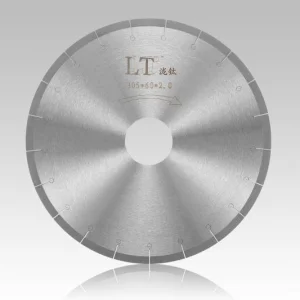
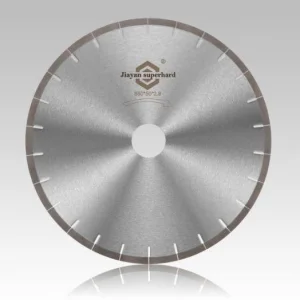
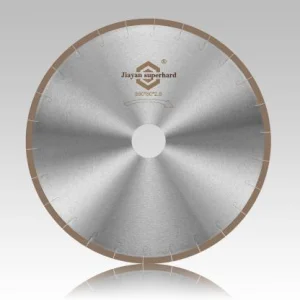
Best 14 Inch Diamond Saw Blades Specialized for SINTERED STONE 260-350mm Cutting Disc Manufacturer, Company

Best 14 Inch Diamond Saw Blades Specialized for SINTERED STONE 260-350mm

View Specifications
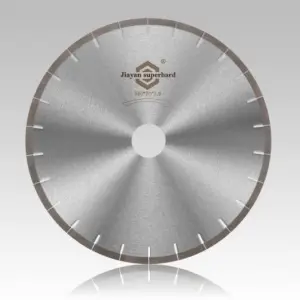
OEM Diamond saw blade cutting disc 350mm diamond circular saw blade for cut granite stone Company, Companies

OEM Diamond Saw Blade Cutting Disc 350mm for Granite Stone

View Specifications
Custom Super Fast Cutting segment Rim J Slot Diamond Saw Blade for Tile Ceramic for Marble Supplier, Suppliers

Custom Super Fast Cutting J-Slot Diamond Blade for Ceramic & Marble

View Specifications
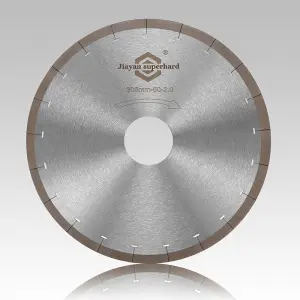
350mm Diamond Saw Blade for Granite — JIAYAN Stone Series

350mm Diamond Circular Saw Blade for Heavy Granite Slabs

View Specifications
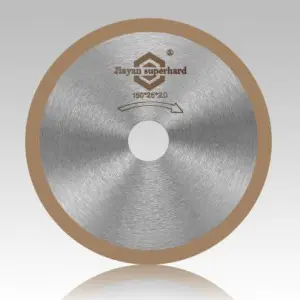
Small Size Diamond Cutting Disc for Tile and Stone

Small Size Diamond Cutting Disc Series (105mm–180mm)

View Specifications
14 Inch Hot Pressed Diamond Circular Saw Blade for Ceramic Tile

14" Hot-Pressed Continuous Diamond Blade for Porcelain Tile

View Specifications
14 Inch Welding Segment Diamond Cutting Blade for Ceramic

14" Laser Welding Segmented Diamond Blade for Hard Ceramic

View Specifications
1.0mm Ultra-Thin Diamond Segment Cutting Disc for Ceramic

1.0/1.2mm Ultra-Thin Precision Diamond Cutting Disc for Ceramic

View Specifications

Global Industrial Landscape & Commercial Diamond Tool Demand

Analyzing macroeconomic shifts in global architectural fabrication, high-density infrastructure expansion, and strict occupational safety regulations reshaping cutting disc procurement.

The international market for industrial diamond cutting tools has undergone a fundamental structural transformation over the last decade. Driven by modern architectural shifts toward ultra-compact sintered porcelain (such as Neolith, Dekton, and Lapitec), high-silica engineered quartz, and ultra-reinforced concrete structures, traditional abrasive discs and standard brazed diamond blades no longer suffice. Enterprise buyers, regional tool distributors, and industrial fabrication yards require specialized metallurgical bonds, optimized diamond crystal Friability index controls, and engineered stress-relief geometries capable of handling extreme mechanical shear forces without catastrophic segment loss or thermal core distortion.

Ultra-Compact Surface Market Surge

Sintered stone and porcelain slabs exhibit densities exceeding 2.45 g/cm³ and Mohs hardness scales reaching level 7–8. Cutting these vitreous surfaces demands ultra-thin steel cores (1.0mm–1.2mm) combined with high-grade synthetic diamond matrix formulations that self-sharpen continuously at high peripheral speeds.

Strict Occupational Safety Rules

Global regulatory frameworks—such as US OSHA Respirable Crystalline Silica standards and EU-OSHA directive 2017/2398—are accelerating the retirement of high-dust dry cutting tools. Industrials demand wet-cutting silent core blades engineered with copper/viscoelastic sandwich dampening to limit jobsite acoustic emission below 85 dBA.

Direct Manufacturer Supply Models

Escalating international shipping costs and tightening margin profiles have led commercial importers to bypass trading intermediaries. Wholesalers now demand direct OEM factory partnerships providing transparent raw material metallurgical tracing, ISO-certified dynamic balancing verification, and scalable lead times.

Strategic Industry Insight: High-performance diamond cutting tools are no longer treated as simple consumables, but as precision-engineered capital components. Optimizing blade life by 35% while maintaining cut speeds above 2.5 meters per minute drastically reduces machine operator hour costs and mitigates high material scrap rates during slab fabrication.

Material Science & Superhard Metallurgy Technology Roadmap

Comprehensive engineering breakdown of synthetic diamond synthesis, matrix sintering dynamics, laser welding joint microstructures, and blade vibration control.

Diamond Grit Selection & Matrix Retention

The core efficiency of a diamond cutting disc is governed by the mechanical interlocking between synthetic diamond crystals (MBD-grade mono-crystalline diamonds) and the surrounding metallic binder. Our engineering processes utilize Titanium-coated (Ti) synthetic diamond grains. The Ti coating creates a chemical carbide bond at the interface during high-temperature hot-pressing, preventing premature diamond micro-fracturing and extension of grit retention ratios by over 40%.
Matrix bond hardness is carefully tailored across a spectrum of Cobalt (Co), Nickel (Ni), Tungsten Carbide (WC), and Copper (Cu) powders:
  • Hard Metallic Matrix (Co-WC rich): Engineered specifically for abrasive, low-density materials such as asphalt, green concrete, and soft sandstone. Wear rate matches diamond bluntness progression.
  • Medium Metallic Matrix (Fe-Ni balanced): Optimized for standard structural granite, cured reinforced concrete, and heavy masonry work.
  • Soft Metallic Matrix (Bronze-Cu rich): Sintered for ultra-hard, non-abrasive substrates including Quartzite, Sintered Porcelain Slabs, and Class 5 hard granites, releasing fresh sharp diamond edges continuously.

Welding Metallurgy & Stress-Relief Core Engineering

Structural failure in saw blades typically occurs at the boundary layer between the diamond segment and the steel core. We utilize fully automated 3D Laser Deep-Penetration Keyhole Welding. By melting both the transition layer of the segment and the high-tensile 75Cr1 or 65Mn spring steel blank into a unified solid-solution joint, the shear fracture strength exceeds 1800 MPa—eliminating segment detachment under severe dry-cutting conditions.
Furthermore, laser-cut expansion slots (J-Slots, Keyhole slots, Teardrop slots) are calculated via Finite Element Analysis (FEA) to absorb thermal expansion stresses during high-speed rotation (up to 80 m/s peripheral velocity), eliminating dish warping and lateral axial wobble.

Technical Comparison Matrix: Cutting Tool Manufacturing Routes

Manufacturing Technology Joint Bond Strength Thermal Resistance Limits Target Substrates Typical Blade Lifespan Index
Laser Welded Segments > 1,800 MPa (Shear Test) Up to 600°C (Dry Cut Capable) Heavy Concrete, Hard Granite, Asphalt 160% (Maximum Industrial Grade)
Hot-Pressed Sintered Continuous Rim Direct Sintered Matrix Bond Up to 350°C (Wet Recommended) Ceramic Tiles, Porcelain, Glazed Tiles 120% (High Precision Rim)
High-Frequency Silver Brazing > 600 MPa (Shear Test) Up to 300°C (Strictly Wet Cut) Large Diameter Marble & Granite Blocks 140% (Re-segmentable Steel Core)
Vacuum Brazed Single Layer Direct Chemical Braze Coating Up to 500°C (Dry/Wet Flex) Cast Iron, Ductile Pipes, Fiber Glass 100% (Ultra-Fast Aggressive Cut)

China Factory Supply Chain Resilience & Manufacturing Capacity

Leveraging Wuhu's superhard industrial cluster to deliver unbeatable production efficiency, certified quality assurance, and seamless OEM scaling.

Situated within China's elite superhard materials manufacturing corridor in Wuhu, Anhui Province, JIAYAN Superhard Tools benefits from complete vertical supply chain integration. From immediate access to high-purity synthetic diamond raw powders (Henan synthesis hub) to ultra-precision CNC laser core cutters and automated hot-pressing sintering lines, our production facility mitigates upstream raw material volatility and guarantees stable pricing schedules for global enterprise partners.

As a verified member of the China Superhard Material Association, our operational methodology adheres strictly to lean manufacturing principles. Every batch of circular saw blades undergoes rigorous quality control protocols prior to export packaging:

5-Stage Direct Factory Quality Assurance Protocol

  1. Powder Metallurgy XRF Analysis: Verifying exact percentage ratios of Co, Cu, Fe, and Ni binder components.
  2. Automated Ultrasonic Flaw Detection: Scanning 100% of laser welds to ensure zero internal microscopic void formation.
  3. Dynamic Balancing & Tension Testing: Runout inspection ensuring lateral runout is within < 0.05mm at 12,000 RPM.
  4. Hardness & Microstructure Fractography: Checking Rockwell hardness (HRB/HRC) and diamond crystal distribution.
  5. Destructive Torque Shear Testing: Batch sampling testing segment torque shear resistance well above international standards.
15+
Years Engineering Expertise
650,000+
Monthly Blades Output Capacity
60+
Export Destination Nations
ISO 9001
Quality Management Certified

Localized Application Scenarios & Engineering Field Guide

Matching blade specifications, peripheral cutting speeds, and bond hardness to regional stone geology and construction equipment.

North America: Heavy Civil & Masonry Site Works

Worksite Dynamics: High-horsepower gas cut-off saws (Stihl, Husqvarna) and walk-behind concrete saws running at high RPMs.

Blade Optimization: Laser-welded segmented blades featuring 12mm–15mm segment heights, keyhole slot designs, and slant-drop protective segments to resist undercut when sawing through abrasive aggregate-rich cured concrete and asphalt.

European Union: Ultra-Thin Porcelain & Sintered Stone Fabricators

Worksite Dynamics: Automated CNC bridge saws and waterjet combination systems cutting expensive large-format slabs where edge chipping leads to total material rejection.

Blade Optimization: Continuous rim J-Slot and Mesh Turbo blades (14" / 350mm diameter) utilizing soft copper-bronze bonds, fine diamond grit (100/120 mesh), and sound-dampened sandwich cores operating at strict water-flow rates.

Middle East & GCC: Hard Granite & Quartz Quarrying/Processing

Worksite Dynamics: Extreme ambient temperatures, continuous duty block-cutting gang saws and heavy bridge saws processing dense regional granites and hard marbles.

Blade Optimization: High-frequency brazed and laser-welded multi-layer sandwich segments engineered with cobalt-titanium matrices to prevent thermal degradation during high-feed linear sawing without cooling loss.

Target Substrate Material Recommended Bond Type Optimum Peripheral Velocity (m/s) Recommended RPM (350mm Blade) Cooling Method
Granite (Class 4-5 Hard) Soft Bronze / Iron Matrix 25 - 32 m/s 1,400 - 1,750 RPM Wet Cut Mandatory
Sintered Stone / Dekton Ultra-Soft Copper-Rich Bond 28 - 36 m/s 1,550 - 1,950 RPM High-Pressure Wet Cut
Cured Concrete (Hard Aggregate) Medium Cobalt-Iron Bond 38 - 48 m/s 2,100 - 2,600 RPM Wet or Heavy Dry
Asphalt / Green Concrete Hard Tungsten-Carbide Matrix 40 - 55 m/s 2,200 - 3,000 RPM Wet / Dry Capable

International Compliance, Safety Standards & OEM Turnkey Services

Ensuring complete trade compliance, safety certifications, and private-label manufacturing options for global brand owners.

Strict Global Safety Certifications

Operating a cutting disc at rotational speeds in excess of 10,000 RPM introduces severe safety hazards if segment bonding or core tensioning fails. All JIAYAN cutting discs are manufactured in full compliance with European Safety Standard EN 13236 ("Safety requirements for superabrasive products") and certified under ISO 9001:2015 quality management procedures.

Our blades undergo maximum speed fracture testing (operating up to 1.5 times the maximum recommended RPM) to guarantee structural safety for end-users across industrial worksites.

Private-Label OEM / ODM Ecosystem

We provide full white-label and ODM packaging customization for international brand owners, tool distributors, and home-center chains. Services include:

  • Custom high-precision fiber laser etching of customer logos, barcodes, and safety icons directly on blade steel blanks.
  • Customized color powder coatings (heat-resistant industrial enamels).
  • Bespoke packaging design (color cards, double-blister packs, wooden crate bulk shipments for bridge saw blades).

Full Product Line: Industrial Diamond Cutting Discs

Explore our complete export-grade catalog engineered for extreme efficiency, minimal material waste, and extended operating lifespans.

Best 14 Inch Diamond Saw Blades Specialized for SINTERED STONE 260-350mm Cutting Disc Manufacturer, Company

Best 14 Inch Diamond Saw Blade for SINTERED STONE Slabs

Inquire Factory Direct
OEM Diamond saw blade cutting disc 350mm diamond circular saw blade for cut granite stone Company, Companies

350mm OEM Circular Diamond Blade for Hard Granite Cutting

Inquire Factory Direct
Custom Super Fast Cutting segment Rim J Slot Diamond Saw Blade for Tile Ceramic for Marble Supplier, Suppliers

Super Fast J-Slot Continuous Rim Diamond Blade for Marble

Inquire Factory Direct
350mm Diamond Saw Blade for Granite — JIAYAN Stone Series

JIAYAN Stone Series 350mm Granite Bridge Saw Blade

Inquire Factory Direct
Small Size Diamond Cutting Disc for Tile and Stone

Angle Grinder Small Size Diamond Cutting Disc Pack

Inquire Factory Direct
14 Inch Hot Pressed Diamond Circular Saw Blade for Ceramic Tile

14 Inch Sintered Continuous Rim Ceramic Saw Blade

Inquire Factory Direct
14 Inch Welding Segment Diamond Cutting Blade for Ceramic

14 Inch High-Speed Laser Welded Segmented Saw Blade

Inquire Factory Direct
1.0mm Ultra-Thin Diamond Segment Cutting Disc for Ceramic

1.0/1.2mm Ultra-Thin Porcelain Tile Diamond Disc

Inquire Factory Direct

Frequently Asked Questions (Technical & Commercial FAQ)

Expert engineering answers to common procurement, operational, and troubleshooting queries for industrial diamond cutting blades.

1. How do I select the correct diamond matrix bond for hard granite versus soft marble?

The fundamental rule of diamond tool metallurgy is opposites attract: For hard, dense, non-abrasive materials like Class 5 Granite or Sintered Stone, you must select a soft metal matrix bond (high bronze/copper content). The soft matrix wears away gradually, constantly exposing sharp synthetic diamond grains. Conversely, for soft, highly abrasive materials like sandstone or green concrete, you require a hard metal matrix bond (high tungsten carbide/cobalt content) to prevent premature matrix erosion before the diamond crystals have completed their cutting cycle.

2. What causes segment loss on diamond saw blades, and how can it be prevented?

Segment detachment occurs due to three primary operational flaws: (A) Dry-cutting with a blade rated strictly for wet operation, causing thermal degradation of the silver brazing joint; (B) Severe core undercutting caused by abrasive slurry grinding down the junction between the steel blank and segment; (C) Excessive mechanical side pressure or incorrect arbor bushing alignment. To eliminate segment loss, utilize laser-welded blades for dry applications and ensure protective slant segments are specified when cutting abrasive substrates.

3. Why is my continuous rim diamond blade causing edge chipping on porcelain tiles?

Edge chipping during ceramic or sintered stone fabrication is caused by excessive lateral blade vibration or a glaze-clogged diamond matrix. Remedies include: (1) Verifying that flange plates are clean, parallel, and clamp at least 1/3 of the blade diameter; (2) Dressing (sharpening) the blade by making several cuts into an abrasive dressing stone or soft firebrick to expose fresh diamond edges; (3) Switching to an ultra-thin (1.0mm–1.2mm) J-Slot or Mesh Turbo design that reduces cutting resistance.

4. What is the standard Minimum Order Quantity (MOQ) and production lead time for OEM orders?

For standard OEM custom-branded saw blades (laser-etched logo and custom color coating), our base MOQ is 100 pieces per diameter specification. Sample evaluation batches can be dispatched within 5 to 7 business days. Full container load OEM orders typically complete production within 20 to 25 days from final proof approval.

5. What is the difference between Hot-Pressed, Cold-Pressed, and Vacuum-Brazed diamond discs?

Cold-Pressed Sintering: Economical manufacturing process suitable for low-duty DIY masonry blades. Hot-Pressed Sintering: Metal powder and diamonds are simultaneously subjected to high heat and mechanical pressure, resulting in dense, pore-free segment matrixes designed for professional long-life cutting. Vacuum-Brazed: Synthetic diamonds are fused directly to the steel core exterior with a active braze alloy, exposing 70%+ of the diamond crystal surface for aggressive high-speed cutting of ductile iron, composite plastic, and rescue cutting applications.