 JIAYAN SUPERHARD
Engineered for extreme wear resistance, chip-free cutting edges, and operational efficiency across granite, sintered stone, quartz, and ultra-thin porcelain tiles.
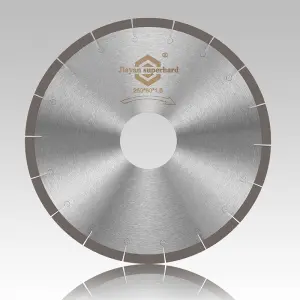
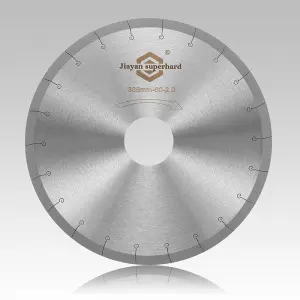
Exploring structural shifts in civil engineering, architectural stone fabrication, and how superhard tooling exporters fulfill high-yield B2B supply requirements.
Modern architectural trends have pushed natural stone and engineered surfaces into unprecedented hardness thresholds. The widespread adoption of Sintered Stone (e.g., Dekton, Neolith) and ultra-dense porcelain slabs requires a fundamental redesign of diamond saw blade geometry. Traditional bonded abrasives fail under the high mechanical stress and extreme density of ultra-compact sintered materials, leading to segment loss, thermal fatigue, micro-cracking, and unacceptable edge chipping.
As premier wholesale diamond blade tool exporters, direct-factory manufacturers like JIAYAN Superhard Tools engineer tailor-made matrix formulations that harmonize diamond grit concentration, bond hardness, and chip clearance mechanisms for computerized CNC bridge saws, manual cutters, and industrial walk-behind saws.
For B2B importers, tool distributors, and large-scale stone fabricators, tool procurement is governed by Total Cost per Meter Cut (TCO) rather than initial purchase price. Purchasing low-grade diamond blades results in frequent tool changes, extended machine downtime, higher energy consumption per cut, and costly material scrap.
Direct sourcing from specialized Chinese superhard tool exporters delivers high information gain: matrix metallurgy optimized for specific Mohs hardness ratings, precise diamond particle distribution, and certified laser-welding safety standards (EN13236). This ensures optimal feed speeds, extended linear meters of cutting life, and pristine edge finish.
A deep technical dive into synthetic diamond crystal chemistry, matrix bond dynamics, and sintering thermomechanics.
The core cutting element consists of High-Pressure High-Temperature (HPHT) synthetic diamond crystals. Key quality indicators include crystal symmetry, thermal stability index (TSI), and friability (controlled micro-fracturing under impact).
For hard granite cutting (Mohs 6–7), coarser mesh diamond (30/40 to 40/50 US Mesh) with high crystal toughness is utilized. For fragile ceramic and sintered stone slabs, finer diamond mesh (50/60 to 70/80 US Mesh) ensures smooth, chip-free kerfs.
The segment matrix is a sintered metal alloy composed of Cobalt (Co), Bronze (Cu-Sn), Nickel (Ni), Iron (Fe), and Tungsten Carbide (WC). The wear rate of the metal matrix must precisely balance the degradation rate of the exposed diamond grains.
If the bond is too hard, diamonds become polished/blunted, leading to glazing and friction heat. If the bond is too soft, diamond grains shed prematurely, drastically reducing tool lifespan. JIAYAN utilizes precise hot-pressing sintering curves to control metal grain boundaries.
The bonding method between the diamond segment and the manganese steel core (65Mn or 50CrV4) is critical for structural safety and application conditions:
Automated Fiber Laser Welding: Fuses the metal matrix directly to the steel core, creating a metallurgical bond capable of withstanding dry-cutting heat exceeding 800°C with shear resistance >600 MPa.
High-Frequency Silver Brazing: Uses silver-copper-based solder alloys, ideal for wet-cutting operations providing elastic dampening.
| Target Substrate | Material Mohs Hardness | Recommended Diamond Grit (US Mesh) | Bond Alloy Base | Optimal Peripheral Speed (m/s) | Coolant Requirement |
|---|---|---|---|---|---|
| Class 5 Granite / Quartzite | 7.0 - 7.5 | 35/45 - 40/50 | Cobalt-Tungsten High Hardness | 25 - 35 m/s | Wet Cutting (25-40 L/min) |
| Sintered Stone (Dekton / Neolith) | 6.5 - 7.0 | 50/60 - 60/70 | Bronze-Iron Dense Matrix | 28 - 38 m/s | Wet Cutting (Continuous Flow) |
| Ultra-Thin Ceramic Tile | 5.5 - 6.5 | 60/80 - 80/100 | Fine Bronze-Nickel Matrix | 30 - 42 m/s | Wet / Dry Capable |
| Cured Reinforced Concrete | 6.0 - 7.0 | 30/40 - 40/50 | Iron-Cobalt Tough Matrix | 40 - 55 m/s | Laser Welded (Dry/Wet) |
| Soft Marble & Limestone | 3.0 - 4.0 | 40/50 - 50/60 | Soft Copper-Bronze Matrix | 40 - 50 m/s | Wet Cutting |
How industrial manufacturing clusters in Wuhu, China, deliver unparalleled price-to-performance, scalable output, and stringent quality control.
Being situated in the epicenter of superhard material production allows direct integration with synthetic diamond mono-crystal suppliers and specialized steel core rolling mills. By bypassing intermediary traders, manufacturing facilities maintain strict control over raw diamond particle size distribution, impurity levels, and steel core tension consistency.
Every industrial batch undergoes rigorous automated testing before export clearance:
For global brand owners and industrial exporters, flexibility in private labeling, custom segment color coatings, specialized bore sizes (e.g., 50mm, 60mm, 25.4mm), and customized J-slot, continuous rim, or turbo geometries are provided with rapid sample lead times (3–5 days) and scalable container shipments.
Tailoring tool dynamics to specific regional market requirements, cutting equipment infrastructure, and material substrates.
Operational Environment: Automated CNC bridge saws (5-axis GMM, Breton, Park Industries) operating in wet environments at high feed rates (3–6 m/min).
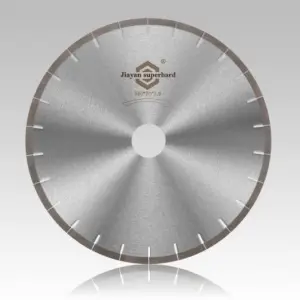
Technical Solution: 350mm to 400mm Silent Core Diamond Saw Blades featuring sandwich-patterned segments. The copper-steel laminated core dampens acoustics (<85 dB) while multi-layered diamond segment structures maintain steady cutting speed through dense quartzite and Class 4/5 granites without core flexure or deflection.
Operational Environment: Precision fabrication of large format sintered stone slabs (3mm to 12mm thickness) requiring immaculate 45-degree miter joints for kitchen islands and architectural facades.
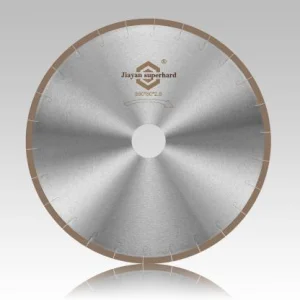
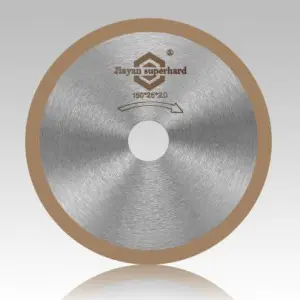
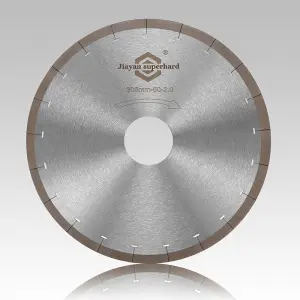
Technical Solution: 14-Inch (350mm) J-Slot & Continuous Rim Hot-Pressed Diamond Saw Blades with micro-grain diamonds. The J-slot design facilitates micro-coolant circulation and stress relief, preventing micro-chipping along delicate glaze layers.
Operational Environment: Extreme ambient temperatures (>45°C), heavy dust environments, cutting heavily reinforced concrete headers, asphalt, and natural limestone.
Technical Solution: Heavy-Duty Laser-Welded Segmented Blades with undercut protection segments. High thermal stability matrix allows dual dry/wet operation with rapid heat dissipation and extreme resistance to segment detachment under high torsional torque.
Operational Environment: High-volume tile installation, handheld angle grinders, small tile saws operating under variable power outputs.
Technical Solution: 105mm to 230mm Hot-Pressed Mesh Turbo Diamond Cutting Discs. The corrugated mesh rim reduces friction, accelerates dust clearance, and allows ultra-fast manual cuts with minimal operator force.
Pioneering advancements in superhard tool manufacturing: Smart tools, micro-alloying, and sustainable production.
Integration of real-time optical pyrometers and closed-loop pressure feedback systems during the sintering cycle. This guarantees exact metallurgical density (>99.4% theoretical density) and prevents grain growth, resulting in predictable batch-to-batch tool wear performance.
Application of Titanium (Ti) and Chromium (Cr) atomic vapor coatings onto synthetic diamond crystals. Titanium carbide (TiC) interface layers prevent thermal graphitization of diamond at temperatures above 800°C and enhance matrix retention force by 40%.
Developing high-performance Iron-Nickel-Copper active bond matrices to replace cobalt, reducing environmental impact and cost volatility while improving toughness in wet granite cutting applications.
Ensuring global regulatory adherence, jobsite safety, and comprehensive OEM account support for international importers.
Safety is paramount in high-speed rotary cutting tools. All circular saw blades and diamond cutting discs manufactured by JIAYAN strictly adhere to the European Safety Standard EN 13236.
Tools undergo centrifugal speed testing up to 1.5 times the maximum operational RPM to guarantee structural integrity against catastrophic core fracture or segment detachment.
For B2B importers building brand equity, comprehensive OEM services are provided:
Direct-factory pricing, customized segment heights (10mm, 12mm, 15mm, 20mm), and rapid worldwide delivery.
Addressing core technical, commercial, and operational procurement inquiries for wholesale buyers and engineers.
Natural granite is composed of quartz and feldspar crystals with inherent micro-fractures, requiring high impact resistance and coarser diamond grit (30/50 mesh). Sintered stone is an ultra-compact porcelain glass matrix under extreme tension with zero porosity; it requires ultra-fine diamond particles (60/80 mesh), soft bronze-iron matrix bonds that expose diamonds rapidly, and J-slot core expansion geometries to eliminate edge chipping and slab bursting.
Laser welding fuses the segment matrix directly to the manganese steel blade core without filler metal, providing heat resistance up to 800°C. This makes laser welding mandatory for dry-cutting handheld applications, precast concrete, and heavy infrastructure projects where water cooling may fail. Silver-brazed blades use a copper-silver solder layer melting around 650°C, requiring continuous wet cooling, making them ideal for high-precision factory stone fabrication on CNC bridge saws.
Higher segment heights (e.g., 15mm or 20mm) increase the total usable volume of diamond matrix, drastically extending tool operating life between blade changes. However, taller segments require higher machine horsepower and precise tension control on the steel core to maintain straight vertical cuts. 10mm segments offer lower resistance for lower-horsepower saws.
Standard trial MOQs for private-label diamond blades typically range from 50 to 100 units per specification. Custom engineering requests—including customized bore dimensions (50mm/60mm), specific matrix formulations, laser engraving, and custom packaging—are completed within 10 to 15 business days from design sign-off.
Glazing occurs when the metal bond is too hard for the substrate, preventing the matrix from wearing down to expose fresh diamond edges. To dress/resharpen a glazed blade, make several passes through an abrasive material like soft sandstone, firebrick, or an asphalt dressing block. If glazing persists, contact JIAYAN technical engineers to adjust the bond formula to a softer matrix composition.
Explore technical blogs, industry exhibitions, and global service documentation.