High-performance circular saw blades and thin kerf disking tools optimized for speed, kerf retention, and extreme material hardness.
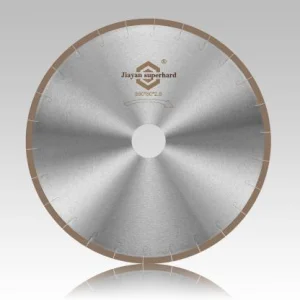
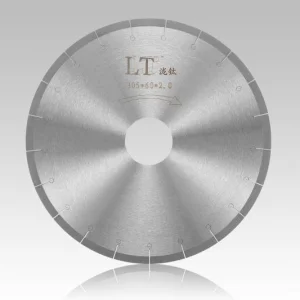
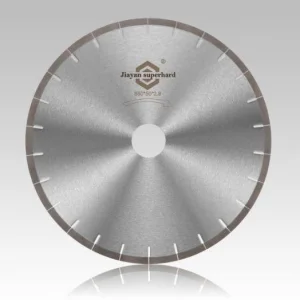
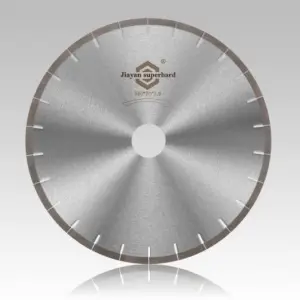
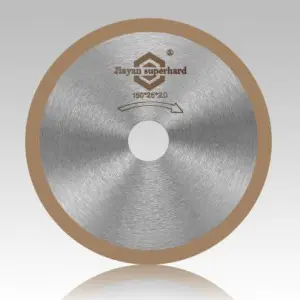
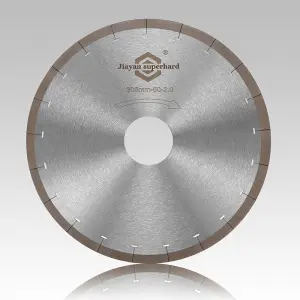
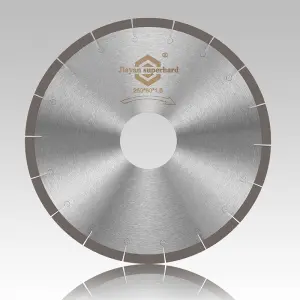
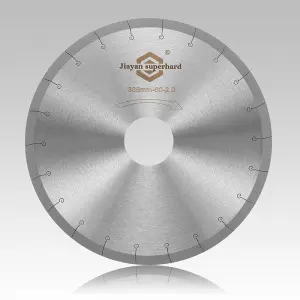
In the modern dimensional stone processing and ultra-hard architectural ceramic sectors, the demand for precision engineered cutting tools has escalated exponentially. Global procurement managers, commercial distributors, and industrial processing plants face unprecedented challenges: processing ultra-dense sintered porcelain (such as Dekton, Neolith, and Laminam), highly abrasive natural quartzites, and reinforced concrete structures while maintaining razor-sharp kerf integrity, zero edge-chipping, and low operational cost per linear meter cut.
As a prominent Wholesale Diamond Cutting Disc Exporter & Manufacturer based in China's advanced manufacturing cluster (Wuhu, Anhui), JIAYAN Superhard Materials sits at the apex of superhard tool technology. As an active member of the China Superhard Material Association, our engineering framework merges high-purity synthetic diamond grit selection with proprietary metallic matrix powder formulas, optimized via computer-controlled vacuum sintering and high-frequency laser welding.
Choosing an industrial diamond disc supplier requires looking beyond superficial blade geometry. Procurement decisions must evaluate the Information Gain of segment metallurgy: understanding how cobalt, nickel, bronze, and iron-alloy matrices wear down at a rate perfectly synchronized with synthetic diamond grit fracture mechanics to continually expose fresh, razor-sharp cutting points.
The convergence of synthetic diamond powder dominance, automated sintering robotics, and complete vertical supply chain integration.
China controls over 90% of world synthetic industrial diamond crystal production. Local sourcing allows exact selection of high-toughness, thermally stable monocrystalline grit (MBD series) at unbeatable cost baselines.
State-of-the-art cold-pressing automatic dosing systems paired with computer-monitored vacuum sintering furnaces guarantee segment density consistency above 8.5 g/cm³, preventing premature segment loss.
Fully automated laser welding lines fuse diamond segments onto high-strength 65Mn spring steel cores, delivering shear strength values that comfortably exceed European EN13236 safety standards.
Direct OEM factory export cuts out intermediate trade markups, reducing unit acquisition costs by 30-45% while delivering identical or superior cutting life compared to European brands.
The global diamond cutting disc market is undergoing a radical technological shift. Legacy cold-pressed sintered discs are rapidly yielding ground to specialized rim geometries and micro-alloyed segment matrixes. Key market developments include:
Traditional wide-kerf blades create substantial friction, leading to severe thermal expansion, blade distortion, and high material waste—unacceptable when cutting high-cost sintered porcelain slabs or natural marble. Modern J-Slot diamond blades incorporate laser-cut expansion slots shaped like the letter "J". These micro-engineered channels serve three vital functions: dissipating intense heat away from the steel core, relieving radial mechanical stress, and clearing micro-slurry rapidly to prevent blade binding.
Historically, synthetic diamond particles were randomly distributed within the metal bond matrix, resulting in uneven wear, diamond clumping, and premature grit loss. Next-generation wholesale exporters utilize 3D automated arraying technology to place each diamond grain at precise, equidistant intervals. This ensures that every single diamond crystal performs maximum work before micro-fracturing, boosting total cutting speed by up to 50% while extending overall blade longevity.
Sintered stone slabs present an extreme physical challenge: ultra-high density combined with intense internal tension. Standard ceramic blades frequently cause severe edge blowout or catastrophic slab cracking. Advanced manufacturers utilize ultra-fine cobalt-rich matrix powders blended with 100/120# fine grit diamonds. This soft matrix erodes smoothly under light pressure, continuously presenting new cutting edges that slice through vitrified glass-like structures cleanly without inducing mechanical shock.
Golden Rule of Superhard Tool Selection: Opposites attract. Extremely hard and dense materials (like granite, quartzite, and sintered porcelain) require a SOFT metal bond matrix (cobalt/bronze based) so the metal wears away to reveal fresh diamonds. Conversely, abrasive, soft materials (like green concrete, asphalt, or soft sandstone) require a HARD metal bond matrix (tungsten carbide/iron alloy based) to resist abrasive slurry wear.
Match your specific processing material with the correct diamond disc rim design, bond hardness, and recommended operation speeds.
| Target Material | Blade Rim Design | Diamond Grit Size | Bond Matrix Base | Cooling Method | Rec. Linear Speed (m/s) |
|---|---|---|---|---|---|
| Sintered Stone / Dekton | J-Slot Continuous Rim | 100# - 120# (Fine) | Soft Cobalt-Bronze Matrix | Wet Cutting Required | 25 - 35 m/s |
| Hard Granite & Quartzite | Keyhole Segmented Rim | 40# - 50# (Coarse) | Medium Cobalt-Iron Alloy | Wet / Dry Compatible | 30 - 45 m/s |
| Marble & Calcite Stone | Continuous Rim / Electroplated | 60# - 80# (Medium) | Copper-Nickel Matrix | Wet Cutting Preferred | 20 - 30 m/s |
| Porcelain & Ceramic Tile | Super-Thin Mesh Turbo / J-Slot | 80# - 100# (Medium) | Soft Bronze Alloy | Wet or Dry Cutting | 35 - 50 m/s |
| Reinforced Cured Concrete | Laser Welded Segmented | 30# - 40# (Coarse) | Hard Iron-Tungsten Matrix | Wet / Dry Heavy Duty | 40 - 60 m/s |
For global brand owners, hardware tool importers, and regional distributors, securing a reliable OEM factory partner is vital for maintaining brand equity. As a premier wholesale exporter, JIAYAN Superhard Tools offers a fully integrated, white-label manufacturing service tailored to specific market demands.
Precision machining for any arbor standard worldwide: 20mm, 22.23mm, 25.4mm, 50mm, or 60mm with custom pin holes, drive slots, and flush-mount countersunk holes.
High-resolution laser marking of your brand logo, barcode, and RPM ratings. Color-customized electrostatic powder coating, transparent varnish, or electroplated finishes.
Options from standard 8mm to ultra-extended 15mm or 20mm segment heights in Turbo, W-shape, Wave, or Slanted protective segment configurations.
Quality assurance at JIAYAN is executed through a rigorous multi-stage testing regimen before any consignment leaves our factory:
Expert answers to key technical questions from international buyers, distributors, and stone fabricators.
J-Slot blades feature a continuous rim intercepted by laser-cut J-shaped expansion slots. This design combines the chip-free cutting precision of a continuous rim blade with the thermal expansion relief and cooling capabilities of a segmented blade. They are specifically ideal for delicate, high-value materials like sintered stone slabs, ceramic porcelain, and marble where edge chipping cannot be tolerated. Standard segmented blades have wider gaps, suited for fast, aggressive rough cutting in granite, concrete, and masonry.
Cutting sintered stone requires three technical parameters: 1) A softer cobalt-based metallic bond matrix that wears evenly without glazing; 2) A fine diamond grit size (100# - 120#) to deliver smooth cuts; and 3) Continuous wet cutting with adequate water coolant flow. Using a standard granite blade on sintered stone will result in excessive slab vibration, edge chipping, or blade glazing.
Laser welding uses a high-energy laser beam to melt and fuse the metallic segment bond directly with the steel core matrix, creating a seamless metallurgical joint. Silver brazing relies on a solder filler material with a lower melting point (~650°C). Laser welding provides significantly higher shear strength, allowing safe dry-cutting operations where frictional heat would otherwise melt silver solder and cause dangerous segment detachment.
Standard OEM production lead time is 15 to 25 days depending on total order volume and custom packaging specs. For standard stock sizes, MOQ starts at 50 pieces. For custom bond formulations, custom segment geometries, or specialized private-label laser etching, our MOQ typically ranges between 100 to 300 pieces per specification.
Blade glazing occurs when the metal bond is too hard for the target material, preventing the matrix from eroding and polishing the diamond tips flat. Glazing can be corrected by performing several dress cuts into an abrasive material like soft sandstone, asphalt, or an abrasive firebrick. This strips back the worn metal layer and exposes fresh sharp synthetic diamonds.
Select a product model below to inspect technical specifications or place an OEM wholesale inquiry directly with our engineering team.