Explore precision-engineered diamond segments and specialized circular blades tailored for marble, granite, sintered stone, and ceramics.
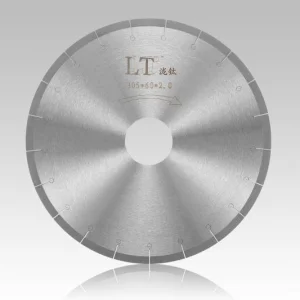
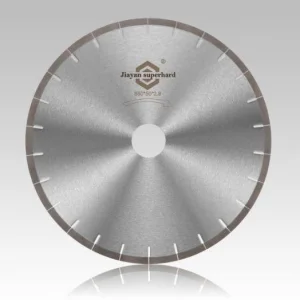
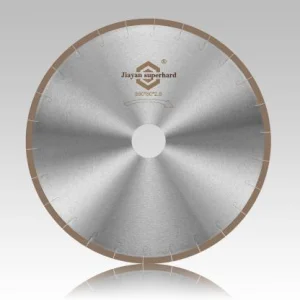
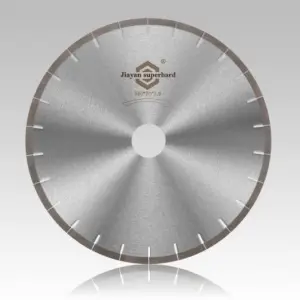
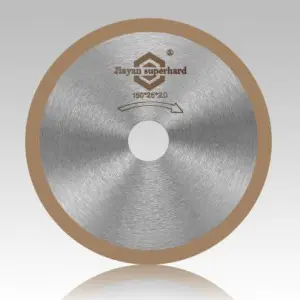
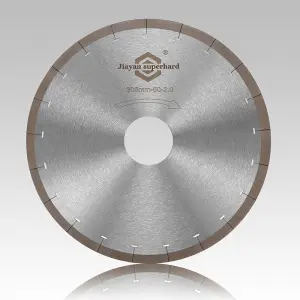
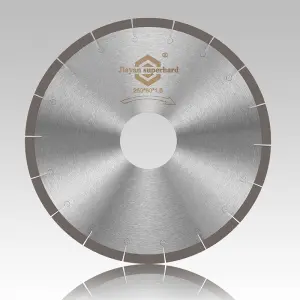
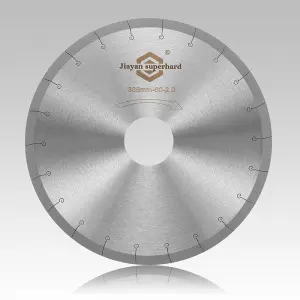
An authoritative engineering breakdown on powder metallurgy, diamond grit mechanics, and shear yield optimization for primary stone processing enterprises.
The global dimension stone quarrying and processing industry generates over $35 Billion annually, with natural marble accounting for more than 45% of total cut-slab output. Major quarrying clusters—ranging from Carrara in Italy, Rajasthan in India, Afyonkarahisar in Turkey, to Shuitou and Yunfu in China—handle vastly different geological stone grades. Unlike granite, which is primarily abrasive due to its high free-quartz ($SiO_2$) content, natural marble consists overwhelmingly of calcite ($CaCO_3$) or dolomite ($CaMg(CO_3)_2$). This fundamental difference alters the tribological mechanical wear mechanism of industrial diamond segments.
Primary slab processing relies on heavy industrial machinery including multi-blade bridge block cutters (utilizing saw blades from Ø900mm up to Ø3500mm) and high-tension frame gang saws carrying up to 150 parallel blades. Wholesale procurement directors face constant pressure to maximize lineal cutting speed (m²/hour) while extending the total operational segment life (m²/segment) and minimizing energy draw (kWh/m² cut).
Processing natural marble presents a unique physical challenge: **Adhesive friction and thermal micro-cracking**. Calcitic marbles (Mohs hardness 3) cut relatively fast, but their low abrasiveness fails to wear down the metal matrix naturally. If the metal matrix is too hard, the synthetic diamond grit becomes rounded and polished ("glazed"), halting cutting action and inducing severe blade deflection, slab breakage, and excessive motor load.
Conversely, Dolomitic marbles (Mohs hardness 3.5–4.5) contain higher magnesium content and micro-crystalline structures that increase yield resistance. Cutting dolomitic slabs requires high-impact synthetic diamond crystals bonded inside a self-sharpening matrix that sheds spent diamond layers precisely when micro-fracturing occurs, ensuring continuous exposure of sharp cutting edges.
Engineering high-efficiency segments through precise powder metallurgy chemistry, vacuum hot-pressing sintering, and optimal synthetic diamond grit selection.
We utilize premium-grade high-purity single-crystal synthetic diamonds (such as MBD-8 and MBD-12 grade) possessing high thermal stability (Ti coating available) and controlled friability. For marble gangsawing and circular sawing:
The binder matrix holds the diamond particles securely against high shear forces during high-speed rotation or reciprocating gangsaw strokes. Our proprietary metallurgical formulas blend:
Modern marble segments discard monolithic square designs in favor of hydro-dynamically efficient geometry:
| Marble Type & Hardness | Recommended Segment Alloy Matrix | Diamond Grit Size (US Mesh) | Diamond Concentration | Optimal Linear Speed ($V_s$) | Coolant Flow Rate |
|---|---|---|---|---|---|
| Calcitic White (Carrara, Thassos) Mohs 2.5 - 3.0 |
Bronze-Rich (Cu-Sn-Fe system) Soft self-sharpening matrix | 35/45, 40/50 Mesh | 18% – 22% Vol. | 40 – 55 m/s | 40 – 60 L/min |
| Cream Beige (Crema Marfil, Galala) Mohs 3.0 - 3.8 |
Cobalt-Copper Balance (Co-Cu-Fe-Ni) Medium wear matrix | 40/50, 50/60 Mesh | 22% – 26% Vol. | 35 – 45 m/s | 50 – 75 L/min |
| Dolomitic & Quartz Intrusion Mohs 4.0 - 5.0 |
Cobalt-Hardened (Co-Fe-Tungsten Carbide) High yield matrix | 40/50, 50/70 Mesh | 26% – 32% Vol. | 28 – 38 m/s | 60 – 90 L/min |
| Reconstituted / Artificial Marble Resin Bonded Matrix |
Ultra-Soft High Copper Matrix with low sintering temp | 50/60, 60/80 Mesh | 16% – 20% Vol. | 30 – 40 m/s | 40 – 50 L/min |
Optimizing throughput across Block Cutters, Bridge Saws, and Frame Gang saws with tailored segment configurations.
Designed for large raw marble block processing. Gang saw segments require extreme vertical rigidity, high side clearance, and superior swarf removal capabilities to prevent hydraulic blade deflection.
Key Spec: Length 20mm, Height 8mm–15mm, Width matched to steel blade body (4.0mm - 5.5mm). Silver-brazed or high-frequency induction welded.
Used for high-volume conversion of blocks into tiles or thick slabs. Multi-blade setups often combine alternating blade diameters (e.g., Ø1600mm and Ø1000mm) on a single spindle shaft.
Key Spec: Sandwich structure segment prevent tapering and step defects on stone slab edges. High thermal resilience matrix withstands continuous multi-blade shear forces.
For precision dimension cutting, mitering, and edge shaping of marble slabs. Demands zero chip performance on polished marble surfaces.
Key Spec: Silent steel core compatibility. Fine diamond grit size (50/60, 60/70) combined with narrow slots delivers glass-smooth cutting lines without surface flaking.
Customizing segment formulas based on regional stone quarry characteristics, temperature conditions, and local processing machinery.
In Italy (Carrara, Verona) and Spain (Novelda, Macael), processing plants emphasize high yield per block with minimal edge chipping. Slabs are often polished immediately after cutting without intermediate surface grinding.
Engineering Solution: Our European-spec wholesale diamond segments utilize low-temperature hot-pressed bronze-cobalt matrices with a self-sharpening M-profile design. This ensures low motor load on Pedrini, Gaspari Menotti, and Breton machinery while maintaining zero edge breakages on white calcite slabs.
Processing hubs in Egypt (Shaq El Thoban), Saudi Arabia, and UAE operate under elevated ambient temperatures with high recycled water mineral content (high dissolved calcium salts and slurry density).
Engineering Solution: We supply heat-resistant segments featuring Ti-coated synthetic diamonds and anti-corrosive nickel-alloy matrices. Wide water cooling channels prevent slurry accumulation and thermal diamond graphitization even when operating continuously under 45°C ambient plant temperatures.
Driving the future of superhard cutting materials through nanostructured bonding, intelligent wear-sensing, and eco-friendly metallurgies.
Traditional mechanical retention relies on matrix shrinkage to clamp diamond particles. Our emerging 5th-generation segments utilize active titanium coating ($Ti$) on diamond surfaces. Sintering forms a chemical bond ($TiC$ titanium carbide phase) between the diamond crystal and metal binder, boosting diamond retention strength by over 300% and preventing premature diamond pop-out.
To reduce global reliance on raw cobalt and lower environmental impact, our R&D team has engineered nanocrystalline Iron-Copper-Nickel ($Fe-Cu-Ni$) matrices. Utilizing ultra-fine sub-micron metal powders, these matrices achieve equivalent toughness and hardness at reduced sintering temperatures without sacrificing operational lifespan.
Production line integration of automated optical inspection (AOI) and hot-press computer automation guarantees density uniformity across every segment batch (density variance < 0.02 g/cm³). Prototype testing is currently underway for smart segments featuring embedded RFID micro-trackers for real-time temperature and stress reporting.
In-depth solutions to common procurement, engineering, and operational questions for diamond segment users worldwide.
Granite segments require a hard, wear-resistant metal matrix (high Cobalt, Tungsten Carbide, and Iron) because quartz debris rapidly erodes soft metals. Marble segments require a softer, self-sharpening metal matrix (high Bronze, Copper, and fine Cobalt powders) because non-abrasive calcite does not wear the matrix down naturally. Using a granite segment on marble results in polished ("glazed") diamond tips that refuse to cut.
Blade deflection is caused by unbalanced lateral pressure, uneven segment wear, or improper hydraulic blade tension. Ensure that: (1) Steel gang saw blades are tensioned to machine specifications (typically 8–10 tons per blade), (2) The segment side clearance (overhang) is uniform across both sides (typically 0.4mm–0.8mm per side), and (3) You use multi-layer sandwich segments that maintain a flat cutting face throughout their operational lifespan.
Segment detachment typically stems from three causes: inadequate heating during induction welding, poor cleaning of the segment base before flux application, or inadequate cooling water reaching the cut zone. We employ silver solder alloys (35%–45% Ag content) and precision high-frequency induction heating to achieve joint shear strength exceeding 350 MPa, virtually eliminating segment loss.
We provide full OEM customization including: Exact segment dimensions (Length x Width x Height), diamond concentration, matrix hardness adjustments based on your target stone Mohs rating, custom slot profiles (M-shape, K-shape, Turbo, Straight), laser logo etching on steel blanks, and custom export packaging.

Founded in Wuhu, Anhui, China, JIAYAN Superhard is an industry-leading manufacturer specializing in diamond saw blades, diamond segments, and superhard cutting tools for natural stone, ceramic, and engineered materials. As an official member of the **China Superhard Material Association**, JIAYAN operates an ISO9001-certified 25,000m² manufacturing plant equipped with automated vacuum hot-press sintering stations, high-precision laser welding lines, and rigorous ultrasonic weld inspection systems.
Select from our complete range of certified diamond segments and cutting blades for industrial stone factories and commercial distributors.